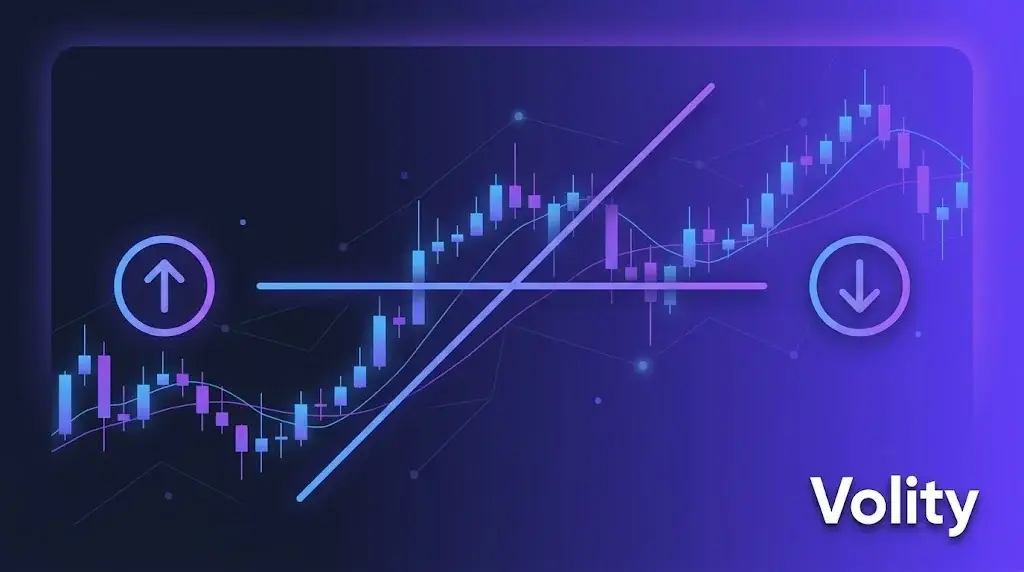
Crypto options trading uses contracts that give the right but not the obligation to buy or sell a cryptocurrency at a specific strike price on or before a specific expiry date. Calls profit when prices rise above the strike; puts profit when prices fall below it. This guide explains the mechanics, the main strategies, and how Volity’s CFD model relates to options-style exposure.
The Crypto Trading Starter Kit
A plain-English PDF: what to check before you trade, how orders and risk really work, and the mistakes to skip. Get it free.
Crypto options trading: the basic option mechanic
Two parameters define every option:
- Strike price: the price at which the option can be exercised
- Expiry date: the last day the option is valid
Two option types:
- Call: right to buy at the strike. Profits when price rises above strike + premium
- Put: right to sell at the strike. Profits when price falls below strike, premium
The premium is the cost of the option, paid upfront by the buyer to the seller (writer). It captures intrinsic value (how far the option is currently in the money) plus extrinsic value (time value + implied volatility).
Why crypto options exist
Three uses:
1. Directional bets with capped downside. Buying a call risks only the premium; the upside is uncapped. Compared to a leveraged long position which can liquidate, a long call has a known maximum loss.
2. Volatility trades. Options price implied volatility. If you expect crypto to be more volatile than the market is pricing, you can structure trades that profit from volatility expansion regardless of direction. Common: long straddles (long call + long put at same strike).
3. Hedging. A trader holding spot BTC can buy a put to protect against downside while keeping upside exposure. The put acts like insurance with a known premium cost.
How options differ from futures and CFDs
| Feature | Crypto option | Crypto future/CFD |
|---|---|---|
| Max loss for buyer | Premium paid | Up to deposit (with NBP) |
| Max profit for buyer | Uncapped (call) or to strike-zero (put) | Up to deposit, unbounded with continued favourable movement |
| Time decay | Yes (theta) | No (CFD), implicit in roll (futures) |
| Volatility exposure | Yes (vega) | No direct exposure |
| Margin required | Premium for buyers | Variable margin for futures/CFDs |
| Complexity | Higher (Greeks, strategies) | Lower (direction only) |
Options are richer instruments but harder to price and trade well. For most retail traders, futures or CFDs are the simpler entry point to leveraged crypto exposure.
Where you trade crypto options
Crypto options venues are mostly offshore exchanges (Deribit, OKX, Bybit). CME lists Bitcoin options for institutional accounts. Most retail-friendly crypto options trading happens on offshore venues with the regulatory and counterparty considerations that come with that.
Volity does not currently offer options as a standalone product. Volity’s CFD model captures most of the directional exposure use case at much simpler complexity. For traders specifically seeking volatility or capped-loss exposure, options venues are the right tool.
Common crypto options trading strategies
Long call (bullish). Buy a call at a strike above current spot. Pay premium. Profit if price rises above strike + premium by expiry.
Long put (bearish). Buy a put at a strike below current spot. Pay premium. Profit if price falls below strike, premium by expiry.
Covered call (income on spot holdings). Hold spot BTC. Sell a call at a strike above current spot. Collect premium. If price stays below strike, keep premium and spot. If price rises above strike, deliver spot at strike (capping upside).
Protective put (hedge on spot). Hold spot BTC. Buy a put at a strike below current spot. Pay premium. If price falls, the put protects below the strike; spot remains owned.
Long straddle (volatility expansion). Buy a call and a put at the same strike. Pay both premiums. Profit if price moves significantly in either direction.
Iron condor (range-bound, advanced). Sell an out-of-the-money call and an out-of-the-money put while buying further-out hedges. Profit if price stays within the range until expiry.
The Greeks (briefly)
- Delta: sensitivity to price changes (~ how much option price changes per $1 spot move)
- Gamma: sensitivity of delta to price changes
- Theta: sensitivity to time decay (option loses value as expiry approaches)
- Vega: sensitivity to implied volatility changes
- Rho: sensitivity to interest-rate changes (small in short-dated crypto options)
Profitable options trading requires understanding all five at least directionally. This is why options trading has a steeper learning curve than directional spot or CFD trading.
When options beat CFDs and when they do not
Options can be better when: – You want capped maximum loss (long calls/puts) – You want to trade volatility specifically – You want to hedge spot holdings cheaply – You have a strong directional view with very short time horizon
CFDs are better when: – You want simple directional exposure – You want leverage without expiry management – You want to trade across asset classes from one account – You want regulated execution under a known framework
Volity’s positioning
For users in Volity’s regulatory footprint: – Spot crypto exposure: Volity wallet (hold BTC, ETH, USDT, USDC) – Leveraged directional exposure: Volity CFDs on 20+ pairs with up to 1:50 leverage – Options-specific strategies: offshore options venues (Volity does not currently offer this product)
If options are core to your strategy, you need a dedicated options venue. If directional leverage is your goal, Volity CFDs cover it without the options-trading learning curve.
Expiry and settlement terms decide what an option is actually worth, and binary event contracts work the same way. Our explainer on how prediction markets resolve covers what counts as the source of truth and how long a payout takes.
Frequently asked questions
Sources
Related crypto guides on Volity
More crypto-trading depth on Volity:
- Wash Trading Crypto: What It Is and How to Spot It
- Crypto Trading Liquidity and Volume: How They Affect Your Fills
- Crypto Perpetual Trading: Funding Rates and the CFD Alternative
- Crypto Futures Trading: How CFDs Compare on Volity
- Short-Term Crypto Trading: 1 Hour to 30 Day Strategies
- Is Crypto Trading Legal? A Country-by-Country Snapshot
- Is Crypto Trading Profitable? An Honest Look at the Data
- Crypto Trading Fees on Volity: Spreads, Commissions and Zero Wallet
- Crypto Trading Bot: The Three Styles and How They Work
Frequently asked questions
What is crypto options trading?
Crypto options trading uses contracts that give the right but not obligation to buy or sell crypto at a specific strike price by a specific expiry. Calls bet on price rising; puts bet on price falling. The maximum loss for buyers is the premium paid, regardless of how far the underlying moves.
Does Volity offer crypto options?
No, Volity does not currently offer crypto options as a standalone product. Volity’s CFD model on 20+ crypto pairs covers most retail directional exposure use cases. For specific options strategies (volatility trades, capped-loss directional bets), offshore options venues like Deribit are the established option.
What is the difference between crypto options and crypto CFDs?
Options have a strike price, expiry date, premium upfront, and capped buyer loss. CFDs are open-ended directional exposure with leveraged margin. Options offer more strategic flexibility (volatility plays, hedging) at the cost of higher complexity. CFDs offer simpler directional exposure.
Are crypto options profitable?
Options trading requires understanding the Greeks (delta, gamma, theta, vega, rho) and pricing volatility correctly. Profitable options traders are often more sophisticated than profitable directional traders. The learning curve is steeper; the strategy space is wider. Most retail participants who try options without preparation lose money.
What are the main crypto option strategies?
Long call (bullish), long put (bearish), covered call (income on spot), protective put (hedge spot), long straddle (volatility expansion), iron condor (range-bound). Each strategy has a specific market view and a specific risk profile.
What is the maximum loss on a crypto call option?
For the buyer of a call: the premium paid. If you pay $500 for a BTC call and the underlying drops to zero, you lose $500 and nothing more. The unbounded loss potential is for the option seller (writer).
Where can I trade crypto options legally?
Crypto options are available on offshore venues (Deribit, OKX, Bybit) and on regulated venues for institutional clients (CME for Bitcoin and Ether). Retail access varies by jurisdiction. Tax treatment of options is country-specific.