A crypto trading bot is software that places trades automatically based on pre-defined rules. Three styles dominate retail use: grid bots, DCA bots, and signal-following bots. Volity supports automation through MQL Expert Advisors running natively on Volity MT plus REST/WebSocket API connections to hosted bot platforms.
The Crypto Trading Starter Kit
A plain-English PDF: what to check before you trade, how orders and risk really work, and the mistakes to skip. Get it free.
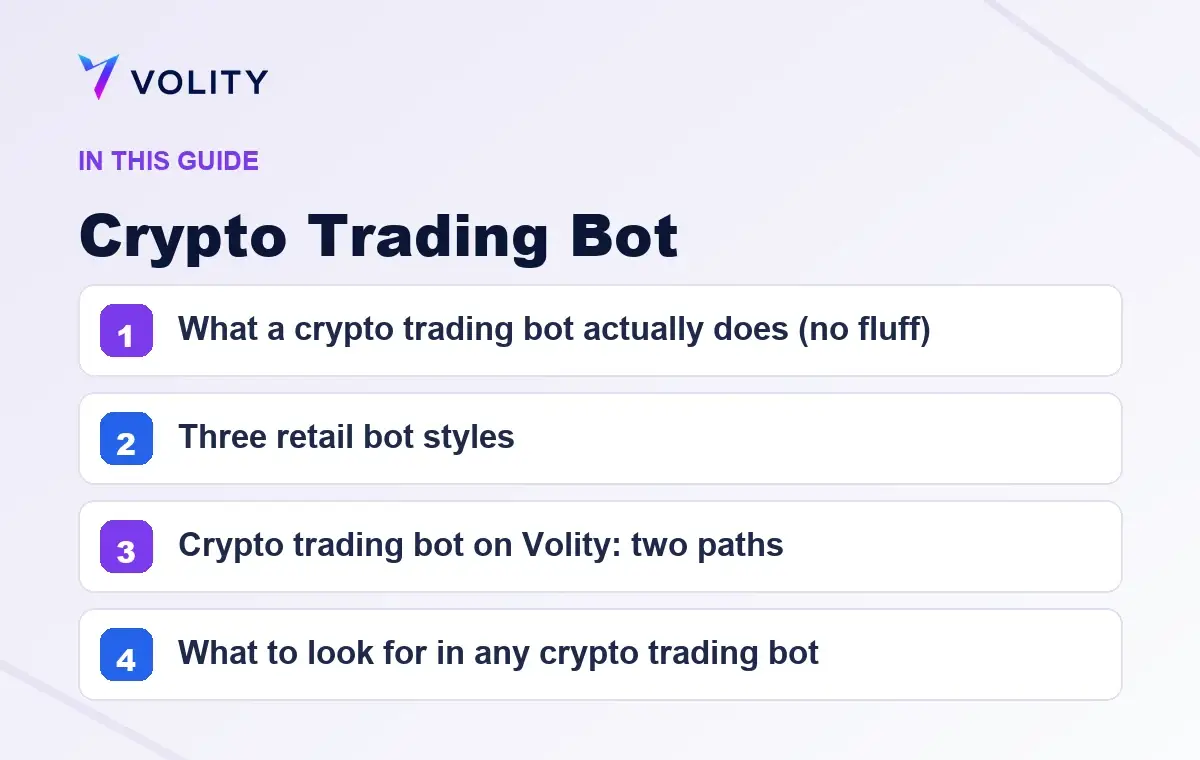
What a crypto trading bot actually does (no fluff)
A trading bot is a small program that watches market conditions and triggers buy or sell orders when the conditions match a rule. The rule can be simple (“buy when RSI crosses 30”) or complex (multi-indicator confluence, news sentiment, cross-asset correlation). The bot runs continuously; you do not have to watch the chart.
Three things a bot does not do:
- Generate alpha out of thin air. A bot executes a strategy you (or its developer) designed. If the strategy is bad, the bot loses money faster than a human
- Eliminate risk. Volatility, liquidation, gap risk, regulatory risk, exchange outages all apply to bots equally
- Replace strategy thinking. Bots automate execution; you still own the strategy
Three retail bot styles
1. Grid bots. Place a series of buy and sell orders at fixed price intervals around the current price. As price moves up and down inside the grid, the bot accumulates small wins on each oscillation. Best in sideways markets; worst in strong trends where price breaks out of the grid range.
2. DCA (dollar-cost averaging) bots. Buy fixed amounts at fixed time intervals regardless of price. The classic long-term-accumulation bot. Useful for adding to a position over months or years without timing decisions. Volatility-averse, simple to set up.
3. Signal-following bots. Wait for an external signal (TradingView alert, custom indicator, third-party feed, news event) and execute on receipt. The most flexible style; the bot is essentially an execution layer on top of any signal source, whether you read the setups yourself or follow crypto trading signals from an analyst or service.
Volity supports all three styles. The mechanism differs:
- Grid and DCA bots typically run as MQL Expert Advisors inside Volity MT, or as third-party platforms (3Commas, Cryptohopper) connected via REST API
- Signal-following bots work either via EA listening to TradingView webhooks, or via custom Python/Node listening to the Volity WebSocket and executing via REST
Crypto trading bot on Volity: two paths
Path A: native EAs inside Volity MT.
Pros: – Runs on Volity’s infrastructure, same 99.6% sub-1s execution as manual orders – No third-party platform fees or subscription costs – Direct access to MT4/MT5’s 20-year EA ecosystem – Custom EAs in MQL4 or MQL5 for any logic you can express
Cons: – Requires MT4/MT5 to be running (Volity MT VPS removes this if you want 24/7) – Limited to MQL language ecosystem – Less convenient UI than purpose-built bot dashboards
Best for: traders comfortable with technical setup; cost-sensitive users; anyone wanting full control over execution.
Path B: third-party bot platforms via API.
Pros: – Polished UIs designed specifically for bot management – Pre-built bot templates (grid, DCA, scalping) ready to deploy – Cloud-hosted, no local infrastructure – Marketplace of community strategies to copy
Cons: – Subscription cost ($15-50/month typical) – Extra counterparty (the bot platform itself) – Slightly higher execution latency due to extra API hop
Best for: traders who value UX over technical control; users running multiple bot styles concurrently.
Both paths use the same Volity execution engine. Order routing, slippage, fills are identical.
What to look for in any crypto trading bot
Five practical criteria:
1. Backtest evidence. Has the strategy been backtested over multiple market conditions (bull, bear, sideways, high-volatility, low-volatility)? Backtests can be over-fitted, but a complete absence of testing is a red flag.
2. Live track record. A backtest is one thing; live forward performance is the truth-teller. Hosted bot platforms expose track records for community strategies. Take any “365 days of profitable trading” claim with appropriate scepticism and verify the period covered.
3. Risk controls. Does the bot have stop-loss logic, max drawdown limits, position-size caps? Bots without risk controls can blow up an account in one bad day.
4. Transparent rules. You should understand exactly what triggers a trade. Black-box “AI bots” with no explainable logic are a category to approach carefully.
5. Reasonable cost. A bot subscription that costs 30% of expected return is doing you a disservice. Run the maths on subscription + spread + swap vs realistic expected profit before subscribing.
Risk: what bots do not protect you from
- Strategy failure. A bot built on a strategy that worked in 2023 may fail in 2025. Markets adapt; bots do not
- Black swan events. Sudden crashes, exchange outages, regulatory shocks. A bot in long positions during a 30% crash will lose 30% (or more, with leverage)
- Over-leverage. Bots that run with 1:50 leverage and no position-size cap can liquidate fast
- Bad parameter tuning. Most bots have parameters (grid spacing, DCA interval, signal thresholds). Bad parameters produce bad outcomes regardless of strategy quality
Best practice: paper-trade the bot for 30 days minimum before live. Start live with the smallest position size that lets you observe behaviour. Scale up only after live data confirms expected behaviour.
Common myths
Myth: “Bots make money while you sleep.” They also lose money while you sleep. A bot is an execution layer; the strategy still has to work.
Myth: “AI bots beat human traders.” “AI” in retail bot marketing usually means “we added a machine-learning model on top of standard indicators”. The underlying edge has to be real for the bot to make money.
Myth: “Bots eliminate emotion.” They eliminate execution emotion (no second-guessing the entry). They do not eliminate the emotion of watching the bot lose money during a drawdown.
Myth: “More bots = more profit.” Running multiple bots on the same account can produce overlapping or conflicting positions, accidental leverage stacking, and unintended correlation. Better to run one well-tuned bot than five competing ones.
How to start with bots on Volity
- Open a Volity demo account
- Decide path: native EA or third-party platform
- If EA: install Volity MT, download an EA (off-the-shelf or custom), test on demo for 30 days
- If third-party: sign up for the platform, generate a Volity API key with trading permission, connect, configure one bot on demo
- Track performance: win rate, max drawdown, average trade duration
- If demo data is positive after 30 days, transition to live with smallest viable position size
- Scale up only on live performance evidence, not on demo
Frequently asked questions
Sources
Related crypto guides on Volity
More crypto-trading depth on Volity:
- Wash Trading Crypto: What It Is and How to Spot It
- Crypto Trading Liquidity and Volume: How They Affect Your Fills
- Crypto Perpetual Trading: Funding Rates and the CFD Alternative
- Crypto Options Trading Explained: Calls, Puts and Derivatives
- Crypto Futures Trading: How CFDs Compare on Volity
- Short-Term Crypto Trading: 1 Hour to 30 Day Strategies
- Is Crypto Trading Legal? A Country-by-Country Snapshot
- Is Crypto Trading Profitable? An Honest Look at the Data
- Crypto Trading Fees on Volity: Spreads, Commissions and Zero Wallet
Frequently asked questions
What is a crypto trading bot?
A crypto trading bot is software that places buy and sell orders automatically based on pre-defined rules. It runs continuously, removes the need to manually monitor charts, and executes the same strategy consistently. Volity supports bots through MQL Expert Advisors and REST/WebSocket API connections.
Are crypto trading bots profitable?
Some are, most are not. A bot’s profitability depends on the underlying strategy. A profitable strategy executed by a bot can produce returns; a losing strategy executed by a bot loses faster than a human. Backtest evidence and live track record matter more than the bot software itself.
Can I use a crypto trading bot on Volity?
Yes. Two paths: native MQL Expert Advisors on Volity MT, or third-party hosted bot platforms (3Commas, Cryptohopper) connected via Volity’s REST/WebSocket API. Both routes use the same execution engine with 99.6% sub-1s fill rate.
Do I need to know how to code to use a bot?
No. Off-the-shelf EAs on the MQL marketplace and pre-built bots on hosted platforms (3Commas grid bot, Cryptohopper signal-following) work out of the box. Coding skill helps if you want custom logic, but the no-code path is functional for grid, DCA, and basic signal-following.
Are crypto trading bots safe?
The bot software is one risk dimension; the strategy is another. Use bots from reputable platforms, restrict API keys to trading-only (no withdrawal permission), set position-size and drawdown limits, paper-trade first. Funds on Volity are segregated under CySEC-regulated execution; the bot is an execution helper, not custody.
Can a bot run 24/7 on Volity?
Yes. EA bots need Volity MT to be running (use a VPS for true 24/7) or run on Volity’s cloud-hosted MT environment. Third-party bot platforms run in the cloud by default. Crypto markets are 24/7; bots match that schedule.
What does a crypto trading bot cost?
Native EAs: $0 (with Volity account) up to a few hundred dollars for purchased MQL EAs. Third-party hosted bots: $15-50/month typically, with premium tiers up to $200/month. Trading costs (spread, swap, 1% FX) apply on top, identical to manual trading on Volity.