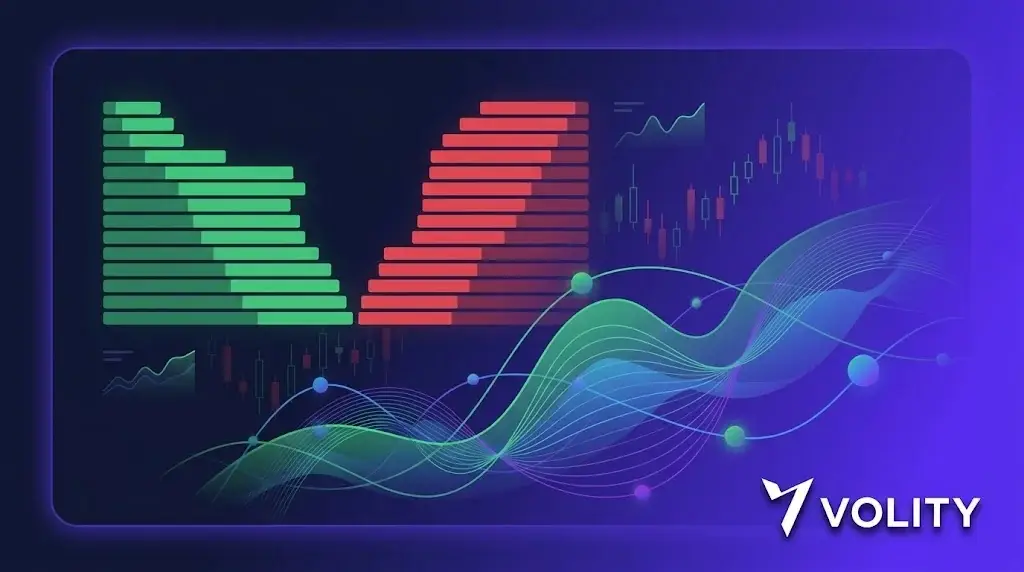
Liquidity in crypto trading is the depth of buy and sell orders near current price. High liquidity means tight spreads and minimal slippage; low liquidity means wide spreads and price impact on larger orders. This page explains how to read liquidity, why reported volume can mislead, and how Volity’s execution layer handles fills.
The Crypto Trading Starter Kit
A plain-English PDF: what to check before you trade, how orders and risk really work, and the mistakes to skip. Get it free.
What liquidity actually measures
Three components:
1. Spread: the gap between best bid and best ask. Tighter = more liquid 2. Depth: the total order value within a price range (e.g., orders within 0.5% of spot) 3. Resilience: how fast the order book replenishes after a large trade consumes liquidity
A pair can have a tight spread but shallow depth: a small order fills perfectly, a large order moves the market. Volume reports rarely surface this nuance.
Reported volume vs real liquidity
Major data sites publish 24h volume per coin per exchange. These numbers are useful but not the whole story:
- Wash trading inflates reported volume. Exchanges that rank themselves by volume have incentive to wash. Independent estimates suggest 30-70% of reported crypto volume is wash on some venues (B-06 covers this)
- Cross-exchange aggregation hides venue concentration. A coin showing $100M daily volume across all venues may have 90% concentrated in one offshore exchange
- Spot volume vs derivatives volume. Reported “crypto volume” often blends spot and perpetuals. The two have different liquidity profiles
Real liquidity assessment: look at the order book on the venue you trade through, not the aggregate volume number.
Why liquidity matters for your fills
Three direct effects:
1. Spread cost. A tight-spread pair (BTCUSD on a major venue) costs less to enter/exit than a wide-spread pair (a small altcoin during off-hours).
2. Slippage on entries. Market orders fill at the next available price level. If you place a large market order on a thin book, you fill across multiple levels, paying progressively worse prices.
3. Slippage on stops. A stop-loss converts to a market order when triggered. In low-liquidity moments (Asian late-night, weekends, news flashes), stops can fill far worse than the trigger price.
How Volity execution handles liquidity
Volity aggregates liquidity from multiple top-tier sources. Three practical effects:
- Tight spreads on top pairs. BTCUSD and ETHUSD spreads are competitive with the largest centralised exchanges
- No requotes. Once you click, you fill, no “price has changed, accept new price?” loop
- 99.6% sub-1s fills even on larger sizes, because execution is internalised against aggregated liquidity rather than routed to a single venue
Volity does not publish per-pair volume numbers as a marketing metric. The relevant numbers are spread and fill latency, which the platform displays before every order.
How to read liquidity on any platform
Three quick checks before opening a position:
1. Look at the current spread. Wide spreads = thin liquidity right now. Tight spreads = better fills 2. Check the order book depth. Most platforms show the top 5-20 levels on bid and ask. If $10,000 in orders sits within 0.5% of spot, the pair handles your $5,000 order without much impact 3. Compare to historical typical spread. If the pair normally has 5 bps spread and currently shows 30 bps, something is happening, news, low-volume hour, exchange issue. Trade with caution
When liquidity dries up
Three predictable windows:
1. Asian late-night / weekend. Lower retail participation, thinner books on altcoins. BTC and ETH stay relatively liquid; tail coins widen substantially 2. Major news events. When CPI prints or a Federal Reserve decision drops, traders pull resting limit orders, spreads widen briefly, market orders slip 3. Pre/post-listing on a venue. A new coin listing or a delisting causes temporary illiquidity. Trade after the dust settles
In these windows, use limit orders rather than market orders. Accept that your order may not fill, rather than fill at a poor price.
Liquidity and trade size
A practical rule: your order should not consume more than 10-20% of the visible top-of-book depth. If the top bid has $50,000 in orders and you want to sell $40,000, expect slippage. Either split the order across multiple smaller fills, or use a limit order at your target price.
For most retail position sizes ($100-$10,000), top-of-book liquidity on Volity’s major pairs is more than sufficient. The issue arises at larger sizes ($50,000+) on smaller altcoin pairs.
Liquidity vs slippage on the demo
A common surprise: the Volity demo fills at the displayed quote with no slippage. Live fills can slip in fast markets. The gap is small (99.6% of live fills are sub-1s and match quoted price), but it exists. Plan for 1-3 pips of slippage on average crypto pairs in normal conditions; up to 10 pips in news events.
Frequently asked questions
Sources
Related crypto guides on Volity
More crypto-trading depth on Volity:
- Wash Trading Crypto: What It Is and How to Spot It
- Crypto Perpetual Trading: Funding Rates and the CFD Alternative
- Crypto Options Trading Explained: Calls, Puts and Derivatives
- Crypto Futures Trading: How CFDs Compare on Volity
- Short-Term Crypto Trading: 1 Hour to 30 Day Strategies
- Is Crypto Trading Legal? A Country-by-Country Snapshot
- Is Crypto Trading Profitable? An Honest Look at the Data
- Crypto Trading Fees on Volity: Spreads, Commissions and Zero Wallet
- Crypto Trading Bot: The Three Styles and How They Work
Frequently asked questions
What is crypto trading liquidity?
Crypto trading liquidity is the depth of buy and sell orders near current price. High liquidity means tight spreads and minimal slippage. Low liquidity means wide spreads and price impact on larger orders. Volatility is not the same as liquidity; a coin can be illiquid and stable, or liquid and volatile.
How is crypto trading volume calculated?
Trading volume is the total value of trades over a time period (typically 24 hours) per pair per exchange. Major data sites aggregate across exchanges. Independent studies suggest 30-70% of reported volume on some venues is wash trading, so reported volume should be treated as an upper bound rather than ground truth.
Why does liquidity matter for retail crypto trading?
Liquidity affects three things: spread (cost to enter/exit), slippage (price difference between quote and fill), and stop-loss execution quality (stops convert to market orders that can fill far worse in thin markets). At retail position sizes, top pairs on Volity are not liquidity-constrained.
Does Volity have good liquidity?
Volity aggregates liquidity from multiple top-tier sources, producing tight spreads on top pairs (BTCUSD, ETHUSD, USDTUSD, USDCUSD), no requotes, and 99.6% sub-1s fills. For retail-sized orders ($100-$10,000) on major pairs, liquidity is more than sufficient.
What is the most liquid crypto pair?
BTCUSD globally has the deepest liquidity, followed by ETHUSD, then stablecoin pairs (USDTUSD, USDCUSD). After that, the top-10 large-cap coins (XRP, SOL, ADA, DOGE, etc.) carry good liquidity on major venues. Tail altcoins below top-100 by market cap can have meaningful spread and depth issues.
When does crypto liquidity dry up?
Three predictable windows: Asian late-night / weekend on tail altcoins; major news events (CPI prints, FOMC); periods around new listings or delistings. In these windows, prefer limit orders to market orders.