Quick answer
Crypto wash trading is faking trading volume by repeatedly buying and selling the same asset, often by one party on both sides, to make a coin or exchange look more active than it is. It misleads investors and inflates metrics. Be wary of tokens and platforms with suspiciously high volume but thin real liquidity.
The Crypto Trading Starter Kit
A plain-English PDF: what to check before you trade, how orders and risk really work, and the mistakes to skip. Get it free.
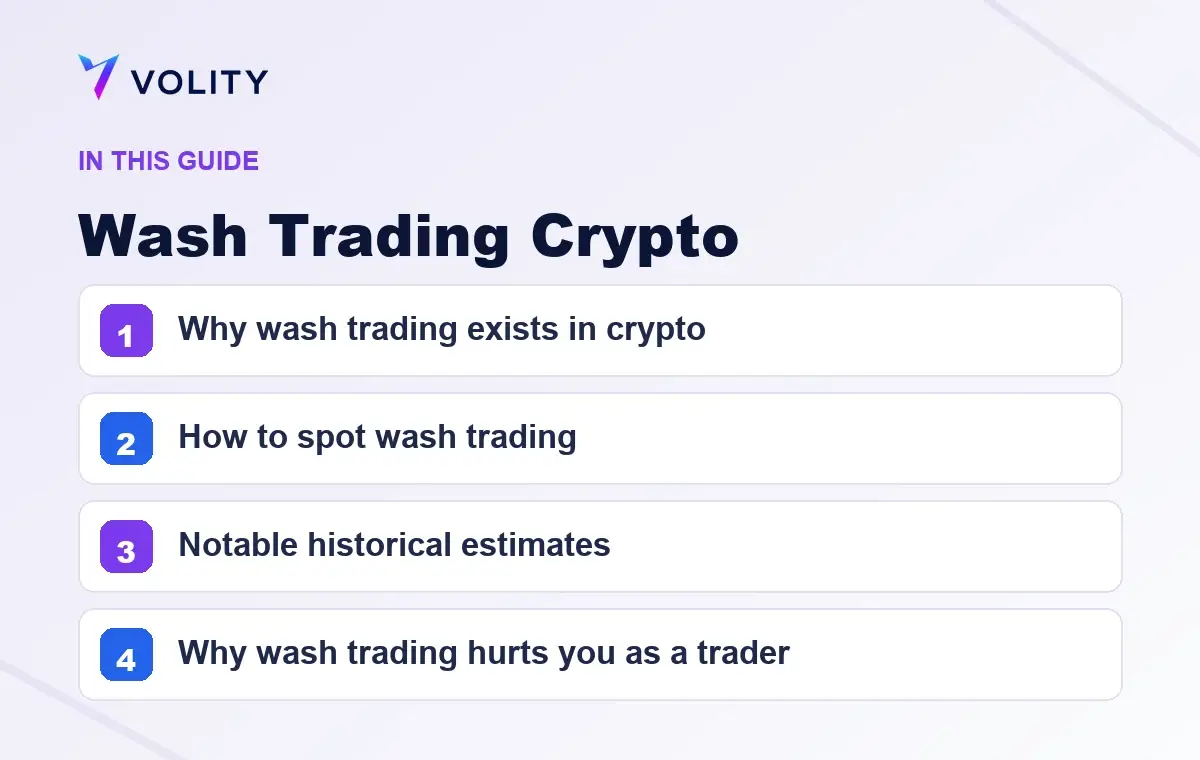
Wash trading crypto is when a trader (or an exchange) buys and sells the same asset to itself, inflating reported volume without changing real ownership. In crypto, wash trading distorts exchange-ranking tables, misleads retail traders about liquidity, and damages market integrity. This page explains the mechanics, the spot-check methods, and Volity’s broker-model structural difference.
Why wash trading exists in crypto
Three incentives drive wash trading:
1. Exchange ranking competition. Coin ranking sites (CoinMarketCap, CoinGecko historically) listed exchanges by reported volume. Higher rank = more retail signups = more revenue. Inflating volume directly increased exchange revenue.
2. New-coin listing demands. Token projects pay for listings on exchanges. Some exchanges require minimum trading volume to retain a listing. Wash trading by the project (or by the exchange itself) keeps the volume number above the threshold.
3. Market-maker incentives. Some exchanges reward market makers with rebates for high volume. Self-trading to capture rebates is a form of wash trading.
Regulated brokers like Volity have none of these incentives. Volity does not rank itself by volume, does not list new coins by paid promotion, and does not run a market-maker rebate scheme that would reward self-trading.
How to spot wash trading
Five spot-check methods:
1. Volume-to-market-cap ratio. A coin with $100M market cap should not have $5B daily trading volume. Realistic spot turnover is 0.5-5% of market cap daily for major coins, lower for tail coins. Outliers signal wash.
2. Trade-size clustering. Wash trades often use identical or near-identical sizes (e.g., always 0.1 BTC). Real retail trading produces a Pareto distribution of trade sizes. A histogram showing one or two dominant sizes is suspicious.
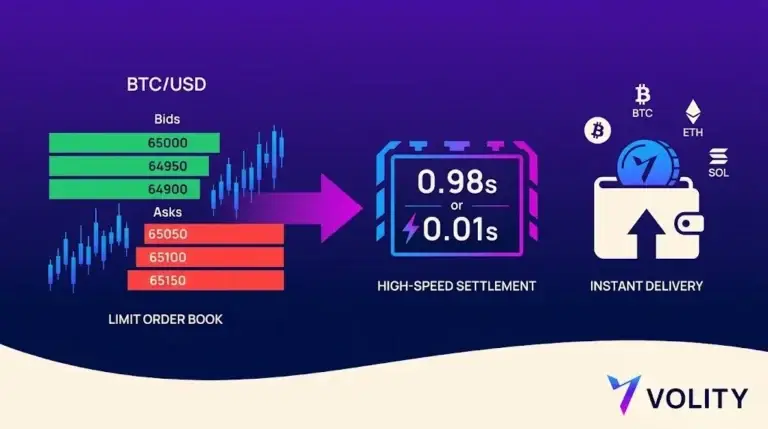
3. Bid-ask spread vs volume mismatch. A pair claiming high volume but showing wide spreads is inconsistent. Real volume tightens spreads through market-maker competition.
4. Cross-exchange price arbitrage that does not happen. If wash trades drive volume but not real activity, prices on the wash-heavy exchange should drift from prices on real-volume exchanges. Cross-checking against a reference price (like the CoinMarketCap or Kaiko index) surfaces drift.
5. Independent venue ratings. Sites like CER.live, Nomics, and Messari rank exchanges by liquidity-adjusted volume that filters out suspected wash trades. The gap between reported and rated volume is the wash estimate.
Notable historical estimates
Bitwise Asset Management filed a study with the SEC in 2019 estimating that 95% of reported Bitcoin volume on smaller exchanges was wash. Subsequent studies by CER.live and Forbes’ “real volume” investigation found 30-70% inflation across various venues over different periods. The exact percentage varies; the directional conclusion is consistent: reported volume overstates real activity.
Why wash trading hurts you as a trader
Three direct harms:
1. False liquidity signals. A coin that looks liquid (high reported volume) but is actually thin (top of book has $5,000 depth) is a slippage trap. Place a $20,000 market order and you fill across many levels at progressively worse prices.
2. False popularity signals. Coins promoted as “high-volume” attract retail buyers. If the volume is wash, the buying is one-sided real demand against fake supply, which can push prices up unsustainably before reverting.
3. Misallocated capital. Project-level wash trading by token issuers misleads retail investors about real adoption. Funds that should flow to real projects flow to wash-padded ones.
Why Volity’s model structurally avoids the wash problem
Volity is a regulated broker, not an exchange that earns through self-listed volume. Three structural protections:
1. No exchange-ranking competition. Volity does not market itself as “the highest-volume crypto venue.” Wash trading would not benefit Volity’s revenue model.
2. No project listing fees. Volity does not accept payments from token projects to list new coins. The 20+ crypto pairs are chosen for liquidity quality, not promotional revenue.
3. CySEC regulation. Volity’s operating entity (UBK Markets, CySEC 186/12) is subject to surveillance for market abuse including wash trading. Regulated brokers face direct legal liability for facilitating wash; offshore exchanges face none.
The result: when you trade BTCUSD on Volity, the price reflects aggregated real-market liquidity, not Volity’s self-inflated volume.
What to do as a retail trader
Three practical habits:
1. Trade where regulation creates accountability. Regulated brokers face legal liability for market abuse. Offshore exchanges face minimal external oversight. The wash-trading problem concentrates on the offshore side.
2. Verify liquidity, not just volume. Check the order book depth directly. Place small test orders to see real fill quality. Compare spreads to other reputable venues.
3. Be skeptical of “high-volume” altcoin claims. Coins ranked highly by volume on small exchanges often have wash-padded numbers. If the volume looks too high relative to market cap, it usually is.
Wash trading vs market making (different things)
Wash trading and legitimate market making are different:
- Market making: providing continuous bid and ask quotes to facilitate trading. Generates real volume from real participants. Earns from spread
- Wash trading: buying and selling to oneself with no real participant. Inflates reported volume. Earns from rebates or ranking position
Volity’s liquidity providers are real market makers, not wash traders. Spread costs reflect real market-making compensation, not artificial activity.
Key takeaways
Wash trading crypto remains one of the largest hidden risks in the retail crypto market. The exact rate of wash trading crypto activity varies by venue and over time, but multiple independent studies (Bitwise, CER.live, Messari) confirm that 30-95% of reported volume on smaller exchanges shows characteristics of wash trading crypto.
For retail traders, three habits reduce exposure to wash trading crypto risk:
- Verify spreads and order book depth, not just headline volume
- Trade on regulated platforms where wash trading crypto activity carries direct legal liability
- Use liquidity-adjusted volume metrics from independent sources (CER.live, Nomics) rather than self-reported exchange numbers
Volity’s broker model structurally avoids the incentives that drive wash trading crypto on self-ranking exchanges.
Frequently asked questions
Sources
Related crypto guides on Volity
More crypto-trading depth on Volity:
- Crypto Trading Liquidity and Volume: How They Affect Your Fills
- Crypto Perpetual Trading: Funding Rates and the CFD Alternative
- Crypto Options Trading Explained: Calls, Puts and Derivatives
- Crypto Futures Trading: How CFDs Compare on Volity
- Short-Term Crypto Trading: 1 Hour to 30 Day Strategies
- Is Crypto Trading Legal? A Country-by-Country Snapshot
- Is Crypto Trading Profitable? An Honest Look at the Data
- Crypto Trading Fees on Volity: Spreads, Commissions and Zero Wallet
- Crypto Trading Bot: The Three Styles and How They Work
Frequently asked questions
What is crypto wash trading?
Crypto wash trading is when a trader or exchange buys and sells the same asset to itself, inflating reported volume without changing real ownership. The motive is usually exchange-ranking competition, new-coin listing requirements, or capturing market-maker rebates. It distorts the data retail traders use to evaluate venues.
How much crypto trading volume is wash trading?
Estimates vary widely. Bitwise’s 2019 SEC filing estimated 95% on smaller exchanges. Subsequent studies by CER.live and others found 30-70% inflation across various venues over different periods. The exact percentage moves over time; the consistent conclusion is that reported volume overstates real activity.
How can I tell if an exchange is wash trading?
Five spot-checks: implausibly high volume-to-market-cap ratio, trade-size clustering at identical sizes, mismatch between high volume and wide spreads, lack of cross-exchange price arbitrage, and the gap between reported and liquidity-adjusted volume (from sites like CER.live).
Is wash trading legal?
In regulated jurisdictions: no. Wash trading is a form of market manipulation under most securities and commodities laws. The CFTC and SEC have prosecuted wash trading cases in regulated futures and equities. Offshore crypto venues face less direct enforcement, which is why the practice has been more visible there.
Does Volity wash trade?
No. Volity is a regulated CFD broker under CySEC 186/12 via UBK Markets. The business model has no incentive to wash (no ranking competition, no listing fees, no rebate gaming) and the regulator monitors for market abuse. Trades on Volity reflect real-market price discovery against aggregated liquidity.
Why does wash trading hurt traders?
Three harms: false liquidity signals trap retail traders into slippage on apparently-liquid pairs; false popularity signals attract one-sided demand that reverts; capital misallocation toward wash-padded projects. The harm compounds across the retail crypto user base.