Quick answer
Crypto CFD vs crypto spot: with spot you buy and own the actual coin, settling immediately, while a crypto CFD is a leveraged contract on the price that you never take delivery of. Spot has no liquidation and suits holding; CFDs offer leverage and the ability to go short but carry funding costs and liquidation risk. Choose spot to own, CFDs to trade with leverage.
The Crypto Trading Starter Kit
A plain-English PDF: what to check before you trade, how orders and risk really work, and the mistakes to skip. Get it free.
Crypto CFDs are complex derivative products with high risk due to leverage. 70-80% of retail accounts lose money when trading CFDs. Spot trading involves direct asset ownership but carries significant blockchain security and private key risks. Instrument availability and leverage limits differ from one jurisdiction to the next. Past performance is not indicative of future results. Capital at risk.
Crypto Spot vs. CFD identifies the choice between direct asset ownership and price speculation via derivatives. This comparison reveals a 2026 landscape where Spot favors long-term HODLers seeking DeFi utility, while CFDs offer capital efficiency and zero-gas execution for active day traders. Identifying your regulatory jurisdiction is essential for safe instrument selection.
Crypto Spot vs. CFD identifies the fundamental divide between purchasing actual digital assets for a private wallet and entering a derivative contract to speculate on price movement. This distinction reveals a significant 2026 fee divergence, with Spot trading involving commissions up to 0.5% and CFDs utilizing tight spreads under 0.1%. By understanding the mechanics of each instrument, traders can align their capital with the most efficient execution model for their specific timeframe.
The 2026 market is defined by a “Race to Zero” in exchange fees and the rise of funding rate arbitrage for professional retail participants. As regulators in the UK and Australia maintain 1:2 to 1:20 leverage caps on crypto derivatives, the choice between ownership and agility determines your net profitability. This guide identifies the core attributes of Spot and CFD trading and reveals the 2026 benchmarks for risk management and cost control.
While understanding Crypto Spot vs. CFD is important, applying that knowledge is where the real growth happens. Create Your Free Crypto Trading Account to practice with a free demo account and put your strategy to the test.
What is the main difference between Crypto Spot and CFD?
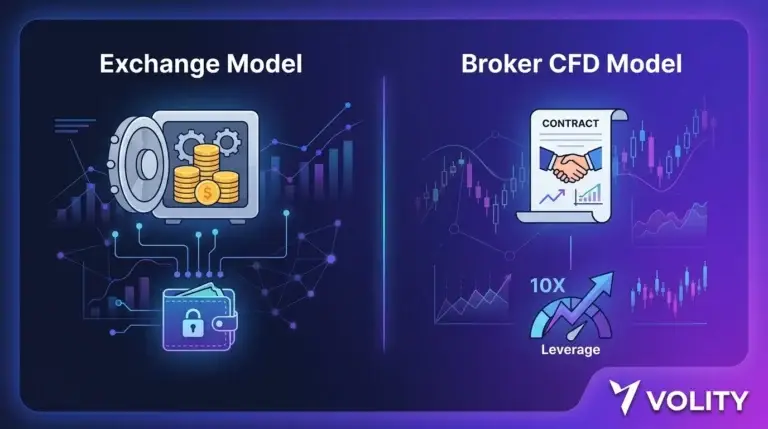
The primary difference between Crypto Spot and CFD identifies the nature of the transaction, where Spot involves the transfer of actual coins while CFDs are cash-settled contracts between a trader and a broker. Asset ownership shows that Spot traders hold the private keys and can use assets in DeFi, providing true decentralized control. The derivative model demonstrates how CFDs track the underlying price without the need for blockchain interaction, eliminating on-chain transaction costs.
Counterparty risk identifies the broker as the market maker in the CFD model versus the exchange in the Spot model. Target audience reveals that ‘HODLers’ prefer Spot for long-term wealth building, while ‘Speculators’ prefer CFDs for rapid capital deployment. Active traders gravitate to regulated derivative venues and perpetual swaps because they can go both ways and never touch a wallet. Mastering Crypto Spot Trading: Buy & Sell Confidently explores the fundamentals of self-custody.
Ready to Elevate Your Trading?
You have the information. Now, get the platform. Join thousands of successful traders who use Volity for its powerful tools, fast execution, and dedicated support.
Create Your Account in Under 3 MinutesFee Comparison: Spreads, Commissions, and Blockchain Gas
The fee structure for Crypto Spot and CFDs identifies a trade-off between one-time entry commissions and ongoing daily financing costs for leveraged positions. Spot costs are a commission of roughly 0.1% to 0.5% plus a network withdrawal fee that moves with chain congestion. CFD costs are carried in the spread rather than a commission, with daily ‘Swap’ or ‘Overnight’ funding rates that accumulate rapidly on long-term positions.
The ‘hidden’ gas fee reveals why Spot trading on Ethereum can verifiably cost $20-$100 in network fees during peak volatility. Liquidity impact shows the ‘all-in’ cost divergence of a $10,000 trade between the two models over a 24-hour period. How to Sell Crypto: Cashing Out Safely reveals withdrawal fee structures across major exchanges.
Leverage and Capital Efficiency in 2026
Leverage and capital efficiency identify the primary appeal of Crypto CFDs, allowing traders to control large market positions with a fraction of the total capital required for Spot. Regulatory caps show the 1:2 to 1:20 limits enforced by ESMA (EU) and ASIC (AU) for retail protection, significantly restricting the leverage available compared to unregulated platforms. Margin calls identify the point where a broker verifiably liquidates your position to cover losses.
Capital allocation examples show how a trader can open a $1,000 BTC position with only $500 in a CFD account. Funding rate arbitrage pairs a short derivative position against a long spot holding so the trader collects the funding leg rather than the price move. What it pays depends entirely on the funding rate at the time, which can and does go negative. Crypto Leverage: How to Trade Volatility Safely explores position sizing techniques.
💡 KEY INSIGHT: Funding rate arbitrage captures the funding paid between leveraged longs and shorts rather than the price move itself. The rate is set by the market and flips sign, so it is a position to monitor, not a yield to bank.
2026 Trading Benchmarks and EAV Table
Trading benchmarks reveal the specific technical and financial performance metrics of Spot and CFD platforms during the 2026 market cycle.
| Feature | Crypto Spot | Crypto CFD |
| Primary Cost | Commission (0.1% – 0.5%) | Spread, no separate commission |
| Leverage | Generally 1:1 (Limited) | Up to 1:20 (Regulated) |
| Gas Fees | Variable (On-chain) | Zero (Off-chain) |
| Shorting | Complex (Borrowing) | Simple (Cash-settled) |
| Ownership | Direct (Private Keys) | Derivative Contract |
The table compares the structure of the two instruments, not the pricing of any particular venue.
Turn Knowledge into Profit
You have done the reading, now it is time to act. The best way to learn is by doing. Open a free, no-risk demo account and practice your strategy with virtual funds today.
Open a Free Demo AccountHow Regulation Shapes Access to Crypto Derivatives
Access to leveraged crypto exposure is set by where you are, not by the instrument itself. Frameworks differ on maximum leverage, on whether negative-balance protection is mandatory, and on which client categories may hold which products. The European Securities and Markets Authority and the Financial Conduct Authority articles set out how those two regimes are structured; check what applies where you are before choosing an instrument.
Legal alternatives show that retail traders can use regulated ‘Crypto Futures’ or ‘ETPs’ to achieve compliant leveraged exposure. The practical read is simple: a venue that will not tell you which authority it answers to is telling you something. Ledger Nano X: Ultimate Crypto Security helps traders secure Spot positions safely.
WARNING: Avoid unregulated offshore CFD brokers. These entities identify a high risk of ‘liquidity traps’ where withdrawals are verifiably blocked following large profitable trades. Always verify Tier-1 licenses from the FCA or ASIC.
Wikipedia’s contract for difference article sets out how the instrument is constructed and settled.
Which Method is Better for Your 2026 Strategy?
Selecting between Spot and CFD trading identifies the trade-off between the security of ownership and the agility of leveraged price speculation. The HODL case reveals that Spot is superior for long-term investors avoiding daily swap fees and counterparty risk, providing true asset ownership and DeFi participation rights. The scalper case shows that CFDs are better for intraday momentum traders seeking high turnover without gas costs.
Risk tolerance comparisons reveal the 100% loss potential of Spot (through hacks/scams) versus 100% loss potential of CFDs (through liquidation during volatility spikes). Regional selection shows that your physical location (UK/AU/EU vs US) is the final determining factor for eligibility and available instruments. Worked illustration: on a 5% drop, a spot holder is down 5% and still holds the coin; a 10:1 leveraged position with no stop is down 50% of margin and, without more margin, closes out. Same move, two entirely different outcomes, decided by the structure rather than the view. Past performance is not indicative of future results.
CFDs vs Futures: Key Differences Explained explores alternative leveraged structures.
Key Takeaways
- Crypto Spot trading identifies the direct purchase of actual digital assets, granting the user full ownership and private key control.
- Crypto CFDs reveal a derivative agreement to exchange the price difference of an asset without owning the underlying coin.
- Leverage for CFDs is identified as being capped at 1:2 to 1:20 for retail traders in regulated markets like the UK and Australia.
- Spot trading fees reveal a ‘Race to Zero’ in 2026 commissions, but are verifiably offset by high on-chain withdrawal and gas costs.
- Which crypto instruments you can access, and at what leverage, is set by the framework that applies where you are.
- Funding rate arbitrage captures the funding leg between longs and shorts; the rate is market-set and can go negative.
Frequently Asked Questions
This article contains references to Crypto Spot trading, Crypto CFDs, derivatives trading, and financial instruments, and mentions Volity, a regulated CFD trading platform. This content is produced for educational purposes only and does not constitute financial advice or a recommendation to trade any particular market or instrument. Crypto CFD trading involves high leverage and significant risk of loss. Spot trading involves security risks related to private key management and exchange security. Always verify your regulatory status and local laws before trading. Some links in this article may be affiliate links.
What Volity analysts watch: The fee comparison between spot and CFDs depends on holding period. Spot venues charge taker fees of roughly 10 to 25 basis points round-trip plus blockchain network fees on deposit and withdrawal. CFDs price wider spreads but typically zero commission and apply daily overnight financing for held positions. Below a few days of holding, CFDs are often cheaper end-to-end once on/off-ramp friction is included. Beyond a few weeks, financing accumulates and spot wins on cost. The split also matters for tax: in many jurisdictions CFD profits are taxed as ordinary income while spot disposals are capital gains, so the after-tax answer is rarely the same as the pre-tax one.
Volity operates a trading platform and also publishes educational and analytical content about trading. The content on this page is for educational purposes only and should not be considered financial advice. Volity may benefit commercially when readers open trading accounts through links on this site.
Our content is produced and reviewed under documented editorial standards; see our comparison and review methodology.