CFDs and Futures are leveraged derivatives that involve a high risk of losing money rapidly. 75% of retail investor accounts lose money when trading CFDs. Ensure you understand the mechanics of margin and contract expiration before committing capital. Past performance is not indicative of future results. Capital at risk.
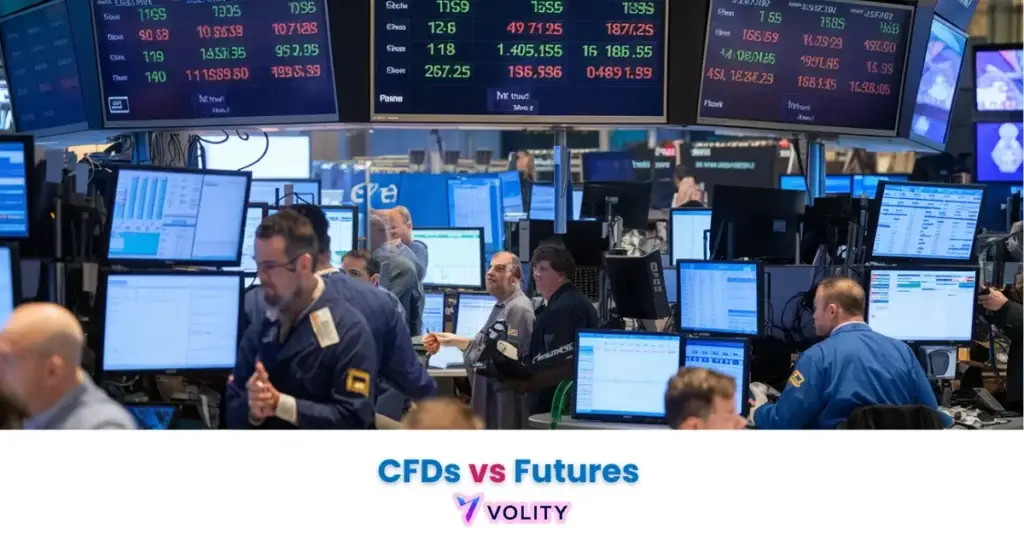
CFDs vs Futures identifies the choice between over-the-counter contracts and exchange-traded agreements. CFDs reveal flexible position sizing and no fixed expiry, while Futures identify standardized contracts on centralized exchanges. Understanding 2026 margin rules and fee structures is essential for selecting the optimal vehicle for your derivatives strategy.
CFDs vs Futures identifies the two dominant instruments for leveraged speculation in global financial markets. This comparison reveals that CFDs operate as private agreements between a trader and a broker, while Futures identify standardized contracts executed on regulated exchanges. In 2026, the choice between these derivatives depends on your capital requirements, transparency needs, and the duration of your market exposure.
The 2026 regulatory environment has sharpened the distinction between these products, with ASIC and the FCA enforcing tighter leverage caps for retail CFD participants. As institutional volume in futures reaches record levels, retail traders are increasingly weighing the flexibility of OTC markets against the transparency of centralized exchanges. This guide identifies the specific cost drivers and mechanical differences to help you execute your strategy with precision.
While understanding CFDs vs Futures is important, applying that knowledge is where the real growth happens. Create Your Free Forex Trading Account to practice with a free demo account and put your strategy to the test.
What is the main difference between CFDs and futures in 2026?
The main difference between CFDs and futures identifies the execution venue and contract standardization, where CFDs are over-the-counter (OTC) agreements and futures are exchange-traded products. This distinction creates cascading differences in cost, transparency, and operational mechanics.
OTC versus exchange-traded execution reveals the first critical divergence. When you trade a CFD, you execute a bilateral contract directly with the broker. The broker is your counterparty, when you profit, the broker loses, and vice versa. In contrast, futures execute on centralized exchanges (CME, ASX, ICE) where the clearinghouse interposes itself as the counterparty to all trades. This eliminates broker-specific counterparty risk but introduces standardization requirements.
Contract flexibility explains why CFDs dominate retail accounts. CFDs allow fractional lots, you can execute a 0.01 BTC/USD contract or a 0.50 Gold ounce contract. Futures require standardized sizes (e.g., one S&P 500 E-mini contract controls $150,000 notional). This standardization requires more capital for entry but provides consistency for institutional hedging.
Market access demonstrates the breadth advantage of CFD brokers. A single CFD account can access thousands of global assets: stocks, indices, commodities, forex, and cryptocurrencies. Futures exchanges specialize, CME dominates US equities, ICE dominates oil, ASX dominates Australian equities. Futures operate on centralized order books (Level 2 data) which provide 100% transparency of all market participants, unlike broker-dependent CFD pricing (Vantage, 2026).
The 2026 market context reveals convergence. Many platforms now offer both instruments in unified accounts, allowing traders to compare execution quality in real-time. Understanding standard Margin & Leverage rules clarifies how leverage differs between these venues.
💡 KEY INSIGHT: The primary 2026 advantage of CFDs is ‘Micro-lotting.’ Traders can execute positions as small as 0.01 contracts, which is impossible with most standard futures contracts, making CFDs ideal for small-account testing.
Ready to Elevate Your Trading?
You have the information. Now, get the platform. Join thousands of successful traders who use Volity for its powerful tools, fast execution, and dedicated support.
Create Your Account in Under 3 MinutesDo CFDs expire? Spot vs Futures-based pricing explained
CFDs typically identify as “rolling” spot contracts with no fixed expiry date, whereas futures contracts are time-bound agreements that must be settled or rolled on specific dates. This distinction determines position durability and pricing mechanics.
Spot CFDs mirror the underlying cash market and can be held indefinitely. A spot CFD on EUR/USD reflects the live spot exchange rate between the euro and dollar. You can maintain this position for days, months, or years without closure pressure. The price tracks the real-time market rate, adjusted for overnight funding differentials.
Futures-based CFDs have expiries to track the forward market. Some CFD brokers offer contracts specifically designed to track futures prices (e.g., “Oil Future CFDs” that expire monthly). These contracts have fixed expiration dates, and the broker automatically closes positions at expiry or forces you to roll forward.
Rolling over reveals how futures traders maintain long-term exposure. Suppose the March E-mini S&P 500 contract expires on March 15. A trader holding this contract must close it and open the June contract by March 15 to maintain exposure. This “rolling” happens automatically on most platforms but involves transaction costs and spreads on each roll.
Price divergence explains futures-specific economics. Futures prices often trade at a premium (contango) or discount (backwardation) to the spot price, reflecting interest rates and carry costs. In contango, the June contract trades higher than March, benefiting short-term traders who profit from the spread when rolling forward.
Understanding optimal timeframes for technical patterns helps contextualize holding periods for each instrument.
Which is cheaper? Comparing overnight funding vs exchange fees
The cost comparison between CFDs and futures identifies a tradeoff between the daily overnight funding charges of CFDs and the fixed per-trade commissions of exchange-based futures. The cheaper option depends on holding period and position size.
Overnight swaps determine CFD carrying costs. When you hold a leveraged position overnight on a CFD platform, the broker charges an overnight funding fee reflecting the interest rate differential between the two currencies or assets. For EUR/USD, this might be 0.001% per day (0.365% annually). Over 30 days, holding $10,000 notional costs approximately $1.22 in funding. Over a year, this compounds to $36.50, not trivial for active traders.
The cost of carry is built into futures prices instead of charged separately. The futures contract price already reflects borrowing costs. When you roll from March to June, the premium/discount reflects carry costs. No separate daily fees are deducted from your account.
Spreads explain the execution cost difference. Futures typically offer tighter spreads (often 1 tick or $12.50 on the S&P 500) compared to retail CFD brokers, which typically quote 2-5 tick spreads. For a single trade, futures win. But retail CFD brokers charge no commission, while futures commissions run $2.50-$5 per round turn.
Profit impact reveals the long-term picture. 2026 benchmarks show that holding CFDs for more than 30 days can erode up to 20% of gross profits due to swaps. A trade that generates $100 profit over 60 days might incur $20-$30 in cumulative swap fees. Futures eliminate this hemorrhage but require paying commissions on the entry and exit.
Understanding Forex risk management strategies helps optimize cost structures.
For short-term day trading, CFDs often provide a cost advantage due to no minimum contract fees. For long-term swing trading, Futures may be cheaper as they avoid the daily cumulative impact of overnight funding swaps.
2026 Regulatory Landscape: ASIC and FCA rules for retail traders
Regulatory oversight in 2026 identifies strict leverage restrictions and retail protection mandates for CFD operators across major jurisdictions like the UK and Australia. These regulations reshape the competitive landscape and strategy viability.
The regulatory table reveals the structural constraints governing each instrument type:
| Product Type | Property | Specification |
| CFDs | Trading Venue | Over-the-Counter (OTC) (Equiti, 2026) |
| Futures | Trading Venue | Centralized Exchange (CME/ASX) (Vantage, 2026) |
| CFDs | Expiry | None (Spot) or Contract-based (Markets.com, 2026) |
| Futures | Expiry | Fixed Expiration Dates (TMGM, 2026) |
| CFDs | Position Sizing | Flexible (Micro-lots) (Quadcode, 2026) |
| Futures | Position Sizing | Standardized Contracts (Markets.com, 2026) |
| Retail Leverage | BTC Limit (EU) | 30:1 (ESMA, 2026) |
Sources: FCA: Retail derivative trading restrictions and leverage caps
Turn Knowledge into Profit
You have done the reading, now it is time to act. The best way to learn is by doing. Open a free, no-risk demo account and practice your strategy with virtual funds today.
Open a Free Demo AccountWARNING: Retail traders in the US cannot access CFDs directly. If you are a US resident, you must utilize CFTC-regulated futures exchanges (like CME or ICE) to gain leveraged market exposure.
Which is better for your investment strategy? (Comparison Guide)
For the crypto-specific comparison, see crypto CFD vs crypto spot, different fee structure, different ownership model.
The decision between CFDs and futures identifies the alignment of your strategy with either the flexibility of small-account management or the transparency of large-scale exchange execution. This evaluation reveals which instrument optimizes your specific trading objectives.
Small accounts below $5,000 benefit from CFD flexibility. CFDs allow traders to execute trades with minimal capital, testing strategies before scaling. The ability to trade 0.01 lot sizes means a small account can maintain proper position sizing even on low-volatility pairs. Futures minimum margins ($500+ per contract) often consume too much of small account capital.
Professional day traders optimize for futures execution. The high volume and tight spreads of centralized futures exchanges provide superior execution quality for high-frequency trading. Institutional traders exclusively use futures for intraday strategies because the combination of zero commission spreads and zero overnight funding creates optimal conditions for rapid entry/exit.
Hedging strategies favor futures as the gold standard. Large portfolio managers use futures to protect equity positions because the standardization ensures consistent hedging ratios. A portfolio manager hedging $50 million in stocks can execute a precise number of futures contracts. A CFD broker might not have sufficient liquidity to accommodate the position size.
Prop trading in 2026 reveals a clear migration. Many prop firms are abandoning MT4/CFD platforms in favor of specialized futures-only software like Quantower. The logic: futures transparency and lower costs outweigh CFD flexibility for firms that operate with sufficient capital.
Real trading example: Executing a short trade on the S&P 500. The E-mini Futures (ES) cost $2.50 in commissions with a 0.25 point spread ($12.50 slippage). The equivalent CFD trade had no commission but a 0.50 point spread ($25 difference). Past performance is not indicative of future results.
Understanding trend reversal signals in Forex helps strategists identify optimal entry/exit mechanics.
Additional context: CME Group: Standardized futures contract specifications and margin rules
Identifying and Managing Derivative Risk in 2026
Risk management for derivatives identifies the technical tools required to mitigate the amplification effects of leverage on both CFDs and futures contracts. Effective risk protocols distinguish profitable traders from account liquidations.
Gapping risk reveals where futures exchanges provide superior protection. During weekend closes, stock and index futures halt, preventing catastrophic overnight gap fills that can wipe out CFD accounts. OTC brokers offer no such protection, a surprise geopolitical event can cause 10%+ gaps even with stop-loss orders pending.
Counterparty risk matters because the broker is “on the other side” of your CFD trade. When you profit, the CFD broker loses. This incentive structure can influence execution quality, some brokers slow fills during fast markets, widening slippage. Futures clearinghouses have no such conflict.
Margin calls require proactive monitoring. Setting alerts at 50% maintenance levels prevents automatic liquidation during temporary adverse moves. Leverage of 30:1 means a 3.3% adverse move triggers a margin call. Professionals calculate position size based on notional value, not just margin requirements.
The 2026 rule emphasizes notional value calculation. A 1-lot futures contract on the S&P 500 controls $150,000 notional, despite requiring only $3,000 initial margin. A trader must view this $150,000 exposure, not the $3,000 margin requirement, when calculating risk.
Understanding Doji wick range and gap validation helps traders recognize volatility expansion patterns that precede gapping events.
Additional resources: ASIC: Product intervention orders for CFDs 2026 update
Key Takeaways
- CFDs are over-the-counter agreements with a broker, while futures are standardized contracts traded on regulated exchanges.
- Retail CFD leverage is capped at 30:1 in the UK and Australia for 2026, aligning with high-level investor protection mandates.
- Futures contracts involve fixed expiry dates and standardized sizes, making them more suitable for institutional and large-scale traders.
- Overnight funding swaps are the primary cost driver for long-term CFDs, often exceeding exchange commissions over time.
- Direct Market Access (DMA) in futures provides transparent order books and reduces the conflict of interest inherent in OTC brokers.
- Small accounts benefit from CFD flexibility, allowing positions as small as 0.01 lots for precise risk management.
Frequently Asked Questions
This article contains references to CFDs, futures, derivative trading, and various regulatory frameworks, and mentions Volity, a regulated CFD trading platform. This content is produced for educational purposes only and does not constitute financial advice or a recommendation to trade any derivative instrument. Always understand the risks of leverage and your local regulations before trading derivatives. Some links in this article may be affiliate links.
What Volity analysts watch: The cost stack is the cleanest way to compare. Futures cost: exchange fees, clearing fees, broker commission, plus the implicit cost of rolling at expiry. CFD cost: spread, plus daily overnight financing on held positions. Below a few weeks of holding, CFDs are typically cheaper end-to-end at retail size because the all-in commission on futures plus the operational overhead is meaningful. Beyond a few months, financing accumulates on CFDs and well-priced futures usually win. The other axis is regulatory: ESMA caps retail CFD leverage at 30:1 on majors and 5:1 on indices, with mandatory negative-balance protection. FCA rules apply equivalent terms in the UK. CySEC enforces the same framework for CIF-licensed brokers; Volity operates under that regime through UBK Markets (CIF licence 186/12).
Volity operates a trading platform and also publishes educational and analytical content about trading. The content on this page is for educational purposes only and should not be considered financial advice. Volity may benefit commercially when readers open trading accounts through links on this site.
Our content is produced and reviewed under documented editorial standards; see our comparison and review methodology.
New to the platform side of things? See how Volity brings every market together on one CFD trading account.