Risk Appetite Returns, but Traders Keep One Hand Near the Exit
Traders woke to a cleaner screen today. Equities were green, yields eased and crypto found a bid.
SPY, QQQ and DIA all pushed higher, while TLT rose as Treasury yields cooled. Bitcoin also firmed, giving the morning a recognisable risk-on feel. However, this was not a free pass to chase every gapper on the board.
The tape favoured a narrower skill set. It rewarded catalysts with volume, sympathy moves with confirmation and tight entries near defined levels. Meanwhile, loose buying after the first headline often met sellers quickly.
So the day’s real watchlist did not look like a portfolio. It looked like a trader’s map of pressure points.
Applied Digital Sets the Tone
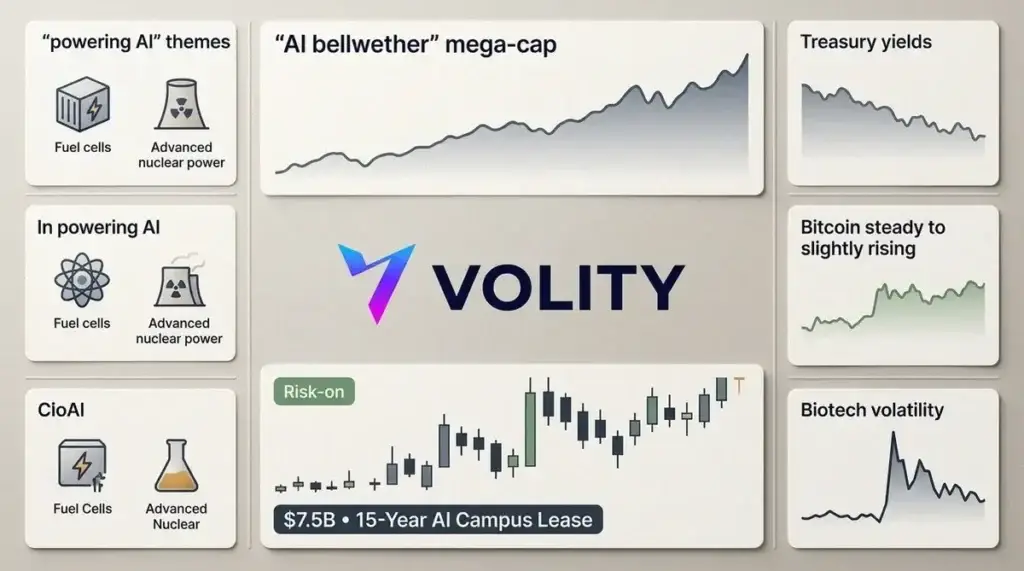
Applied Digital, ticker APLD, sat near the top of that map. The company’s fresh $7.5 billion, 15-year AI campus leasing agreement gave traders something larger than a routine press release.
For a smaller data-centre and AI infrastructure name, that kind of deal can alter the story. The market treated it that way, with a sharp gap higher and aggressive volume.
Still, the second day after a major gap can be treacherous. APLD may attract more AI infrastructure buyers, but it also carries classic gap-fill risk. Disciplined traders will key off the prior day’s low, the opening range and volume persistence.
The press release started the move. Price now has to defend it.
Speculation Spreads Across Smaller Catalysts
ASP Isotopes, ticker ASPI, offered the wilder version of the same market mood. Its restart of Silicon-28 enrichment stages supplied a clean operational catalyst. However, the stock trades like an event-driven momentum name, not a sleepy industrial.
Moves can be sharp, spreads can widen and thin order books can punish poor timing. As a result, ASPI remains short-term territory. Smaller sizing and hard stops are not decoration here. They are the trade.
SoFi Technologies, ticker SOFI, had a different setup. It was less about company-specific news and more about growth appetite. When QQQ trends higher and yields fall, SOFI often acts like a leveraged sidecar to that trade.
Without a fresh catalyst, traders should treat SOFI as an index-confirmation name. If QQQ rolls over, SOFI rarely enjoys standing alone for long.
Ai Power Becomes Its Own Trade
Bloom Energy, ticker BE, continued to draw attention after its deal with Nebius AI. The stock now sits inside one of the market’s busiest narratives: powering AI data centres.
That story has real appeal. Investors can see the physical bottleneck. Chips need buildings, buildings need electricity, and grids need help.
However, BE needs group confirmation. Traders will compare it with data-centre, grid, fuel-cell and power-equipment names. If the group lifts together, dips may attract buyers. If BE spikes alone, vertical chasing becomes a poor sport.
Oklo, ticker OKLO, carried another version of the power trade. The renewed focus on advanced nuclear helped the stock, while Energy Department progress under the Surplus Plutonium Utilization Program added fundamental oxygen.
Yet OKLO remains headline-sensitive. Early-stage nuclear names can reprice quickly on funding or regulatory progress. They can also give it back when follow-through news fails to arrive.
Biotech Volatility Cuts Both Ways
Outlook Therapeutics, ticker OTLK, reminded traders how fast biotech can compress time. A favourable FDA dispute-resolution outcome put months of expectations into one trading session.
That can create powerful upside. It can also lure uninformed buyers into bad entries near exhaustion. Risk must be defined before the order goes in.
Micro-cap biotech spikes often carry another danger. After a large move, traders must watch for financing risk. A dilutive offering can arrive when enthusiasm looks strongest.
Avalyn Pharma, ticker AVLN, had a gentler catalyst. A bullish analyst initiation put the name in front of momentum screens. On light floats, that can be enough to move a stock quickly.
Still, analyst-driven pops need price confirmation. If buyers fail to defend the breakout within a few sessions, the move can unwind with little ceremony.
Space, Security and Software Join the Screen
Rocket Lab, ticker RKLB, caught sympathy interest after fresh attention on Starlink and space infrastructure. Traders again looked for listed vehicles tied to satellites and orbit hardware.
RKLB’s SolAero solar unit gives it a clear satellite-power angle. However, sentiment sympathy is not the same as a contract win. Headlines and speculative flows will likely drive the near-term tape.
BlackBerry, ticker BB, drew a different crowd. A federal cloud security certification fits its push into cybersecurity and government-grade systems. In this market, security compliance can trade like a quasi-contract catalyst.
The close will matter. If BB holds above its news-day open on sustained volume, bulls can claim control. If it fades below that level, traders will file the move under another failed pop.
Zscaler, ticker ZS, brought earnings-season tension. Expectations around revenue and EPS are visible, but the reaction remains the trade. Options markets are pricing movement, and the first hour after results often reveals institutional positioning better than the release itself.
Weakness Still Has an Audience
VNET Group, ticker VNET, sat on short-biased screens after a quarterly loss of $1.20 a share on roughly $390 million in revenue. The stock traded lower before the open, putting earnings-driven downside momentum in play.
Even so, gap-down trades are rarely one-way. If VNET reclaims VWAP after a deep sell-off, tactical buyers may hunt a bounce. The broader picture would remain damaged, but intraday traders do not need a clean long-term story.
Elsewhere, SunCoke Energy, ticker SXC, and NewMarket, ticker NEU, flashed for a quieter reason. Both looked stretched after sustained advances.
Overbought readings alone do not make a short. Professionals usually wait for failed highs, bearish reversal candles, broken short-term moving averages or momentum divergence. Until then, a strong trend can stay rude.
Related coverage on Volity
- NVDA & TSM: 26 Daily Watchlists to Spot Risk and Profit Fast
- Bitcoin Price Slips as ETF Outflows Hit Yearly High
- Bitcoin Price Jitters as ETF Outflows Hit Crypto
- Stock Watchlist: Nvidia (NVDA) AI vs Weak Cyclicals
- Crypto Daily: Ripple vs XRP, Fed Banking, FBI Sting
By the Numbers
- $7.5 billion: value of Applied Digital’s 15-year AI campus leasing agreement.
- $1.20: VNET’s reported quarterly loss per share.
- $390 million: approximate VNET quarterly revenue.
- 15 years: duration of APLD’s new leasing deal.
- 3 risk gauges: QQQ direction, Treasury yields and NVDA’s intraday trend.
Nvidia Remains the Market’s Ai Thermometer
Broader risk appetite still runs through Nvidia, ticker NVDA, and the megacap AI group. Jensen Huang’s recent comment that AI “tokens are now profitable” put a sharper edge on the story.
The pitch has moved beyond distant promise. Investors increasingly want proof that AI workloads can become revenue, margin and cash flow.
NVDA remains the cleanest real-time gauge for that debate. Meanwhile, MSFT, GOOGL, META, AAPL, TSLA and AMZN help set the broader temperature. When that basket trends, smaller AI, data-centre and high-beta names usually follow.
There is also a longer-term complication. Future listings from AI-heavy private giants could redirect capital from today’s leaders. SpaceX, OpenAI or Anthropic would not be small additions to the menu.
For now, though, traders have a simpler task. They must separate story from setup. In this tape, the best trades still need a catalyst, confirmation and a clean exit before the crowd changes its mind.