The watchlist has a pulse, but needs a trading spine
The stock list works because it has a recognisable centre of gravity. It starts with AI infrastructure, moves into catalyst-driven biotech, then adds a handful of momentum names. That is a sensible map for a trader’s morning.
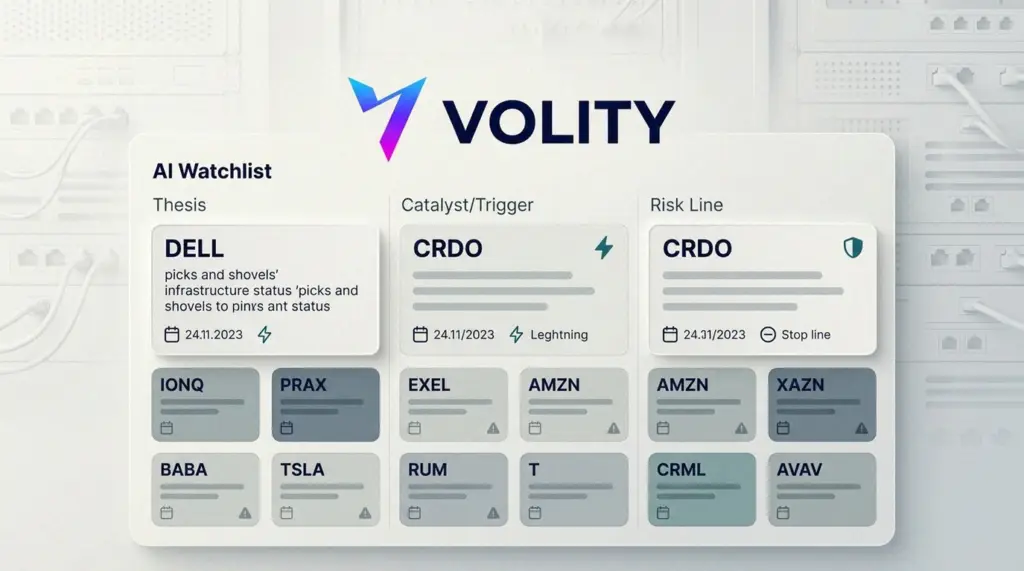
However, a good watchlist is not just a basket of interesting tickers. It needs a reason to act, a trigger to enter, and a risk line to leave. Without those, it becomes market gossip with ticker symbols attached.
The strongest names are easy to defend. Dell Technologies, ticker DELL, and Credo Technology, ticker CRDO, sit inside the AI data-centre supply chain. Dell carries the server angle. Credo carries the networking angle. Both are tied to spending that investors still treat as one of the market’s cleanest growth lanes.
Meanwhile, IonQ, ticker IONQ, belongs in the speculative corner. Quantum computing stocks can move sharply on upgrades, earnings, commercial wins, or guidance. That makes IONQ a valid trading name, although not necessarily a clean investment case.
Biotech names need a different standard. Praxis Precision Medicines, ticker PRAX, and Exelixis, ticker EXEL, can make sense only when tied to specific regulatory or trial events. In biotech, the calendar often matters more than the chart. A vague “positive setup” is not enough.
The list needs a sharper split. Some names are real trade ideas. Others are merely investor watch items. Traders should not treat those categories as interchangeable.
Best ideas near the top
DELL should stay near the front. Investors increasingly view the company as an AI server beneficiary, not just an old-line PC and enterprise hardware name. That shift matters because the multiple can change when the market changes the story.
However, the trade still needs a trigger. A continuation setup would require strength through recent resistance, backed by volume. A reversal setup would require a failed breakout or a break of short-term support. The current thesis is strong, but the entry rules need work.
CRDO also looks coherent. The company gives traders exposure to the pipes behind AI data centres, not the more crowded chip headline. That distinction helps. Networking, connectivity and high-speed data movement remain central to the AI build-out.
Still, CRDO is not a “buy because AI” line item. The setup should define whether traders are chasing momentum or buying a pullback. Otherwise, the name risks becoming just another crowded theme trade.
IONQ deserves a place, but only with smaller sizing and a tighter risk frame. The stock often trades more like an option on commercial quantum adoption than a conventional software or hardware name. As a result, headlines can overpower valuation work.
Meanwhile, PRAX has the right profile for an event-driven list. If a trial readout, FDA milestone or medical conference update is near, the stock can become tradeable. Without that date, it sits in the “monitor only” bucket.
WDC, or Western Digital, offers a cleaner technical question. If the stock looks overbought after a strong run, traders should not short it automatically. Strong stocks can stay stretched for weeks. The better setup is mean reversion after a confirmed loss of support.
Names needing cleaner catalysts
Amazon, ticker AMZN, is a good example of a vague but fixable idea. Saying the stock slipped before its biggest sales week is not enough. Traders need to know what they are actually trading.
Is the setup about consumer demand during a major sales event? Is it about post-event volatility? Or is it a read-through for discretionary spending? Each answer creates a different trade, with a different holding period.
Alibaba, ticker BABA, has the opposite problem. The story contains too much. Geopolitical pressure pulls one way. AI optimism pulls another. China sentiment adds a third layer. That may be analytically fair, but it is messy for a short-term setup.
BABA needs a time frame. A trader can play a China risk-on bounce, an AI re-rating, or a policy headline. But combining all three creates a foggy thesis.
Carvana, ticker CVNA, is more promising. Recovery after peer commentary can trigger sharp moves in heavily shorted or sentiment-sensitive shares. However, the trade needs a visible level. A reclaim of resistance gives one setup. A failure at that same level gives another.
Tesla, ticker TSLA, also needs fresher reasoning. It is always active, always argued over, and always headline-rich. That does not automatically make it a good idea. The stock needs a specific catalyst, such as delivery data, pricing action, margin commentary, or a regulatory update.
AT&T, ticker T, sits in a different universe. It is not naturally part of an AI infrastructure or high-beta momentum list. If the thesis is dividend yield, debt reduction, or defensive rotation, say so. Otherwise, it looks bolted on.
Weakest links in the chain
Rumble, ticker RUM, should be treated as headline-dependent. It can move abruptly, but the move often needs a political, platform, legal, or partnership spark. Without that spark, the setup feels thin.
Critical Metals, ticker CRML, carries similar issues. Resource and critical-minerals names can rip on policy, financing, offtake agreements, or commodity headlines. Yet those are discrete events. The watchlist should name the event, not just the theme.
AVAV, or AeroVironment, may have a defensible defence-tech angle. Still, the setup needs a current driver. Defence spending, drone demand and geopolitics are broad supports, not trade triggers by themselves.
EXEL belongs only if the watchlist clearly marks it as biotech event risk. Otherwise, it sits awkwardly beside AI server and consumer internet names. That does not make it wrong. It just means the format must do more work.
By the numbers
- 3 buckets: AI infrastructure, event-driven biotech, analyst or technical momentum.
- 7 strongest names: DELL, CRDO, IONQ, PRAX, WDC, AMZN and CVNA.
- 6 weaker entries: AVAV, RUM, T, EXEL, TSLA and CRML need sharper catalysts.
- 1 required formula: thesis, catalyst, risk.
- 9/10 target: every ticker should fit trend continuation, event risk, or mean reversion.
A cleaner trading format
The list would improve quickly if every entry followed one line of discipline. That line is simple: what is the trade, what wakes it up, and what proves it wrong?
For DELL, the format could be trend continuation. The thesis is AI server demand. The catalyst is a breakout or guidance support. The risk is a failed breakout or weaker enterprise spending commentary.
For CRDO, the format is also trend continuation, but with a networking lens. The catalyst is strength in data-centre connectivity names. The risk is a sector rotation away from AI infrastructure.
For IONQ, the format is event momentum. The thesis is speculative buying around quantum milestones. The catalyst is an upgrade, contract, earnings surprise, or guidance change. The risk is no follow-through after the headline.
For PRAX, the format is event risk. The thesis depends on clinical or regulatory timing. The catalyst must be named. The risk is binary, so sizing matters more than elegance.
For WDC, the format is mean reversion. The thesis is an extended chart. The catalyst is a support break after exhaustion. The risk is renewed momentum that traps early shorts.
For AMZN, the format needs a choice. Traders can play post-sales-event volatility, discretionary demand, or broader megacap sentiment. But they should not pretend those are the same trade.
For CVNA, the format is technical momentum. The catalyst is a reclaim of a key level or a squeeze after peer commentary. The risk is a failed move that confirms sellers remain in control.
Key takeaways
- Keep the AI chain high: DELL and CRDO are the cleanest theme-aligned names.
- Treat IONQ as speculative: headlines can matter more than conventional valuation.
- Demand dates in biotech: PRAX and EXEL need explicit trial or FDA catalysts.
- Rewrite mixed stories: AMZN, BABA and TSLA need narrower time horizons.
- Downgrade vague items: RUM, T, AVAV and CRML need sharper triggers before action.
The watchlist is close to useful. Its problem is not the ticker selection. Its problem is the lack of trading grammar. Add catalyst, trigger and invalidation to every name, and it stops reading like chatter. Then it starts reading like a desk note.