Crypto reaches Tuesday afternoon in a split mood. Prices look tired, rules look tighter, yet builders keep adding new rails. Meanwhile, stablecoins are inching from trading chips towards the internet’s working dollar.
For traders, this is not a clean tape. Macro, ETF flows, Washington, quantum security and synthetic private-market bets all want attention. The day rewards patience more than heroics.
Macro: fed nerves, iran risk and etf fatigue
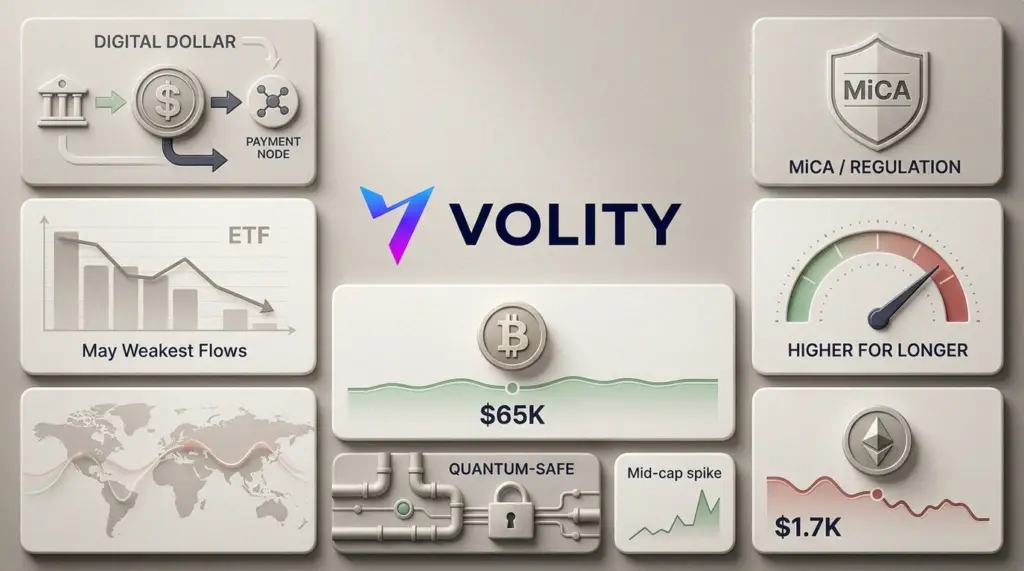
Digital assets are still working through a bruising June. US spot Bitcoin ETFs lost about $2.4 billion in net flows in May, the weakest month of 2026. That reversed the warm spring mood, when ETF buying helped hold the market together.
However, the bigger problem is rates. The story has moved from imminent cuts to higher for longer. Growth still looks stubborn, inflation has not quite behaved, and central banks have less room to help.
So every hawkish forecast lands hard on crypto. Bank of America’s talk of possible extra Federal Reserve hikes added to the unease. Meanwhile, US-Iran headlines have brought another reason to trim risk before the next shock.
Big tech has shown the same strain. AI revenues remain large, especially across chipmakers. Yet investors have started asking whether prices went too far. Crypto, as usual, gets dragged into that argument.
Prices
Bitcoin tried to look calm in Asia, rising less than 1 percent and hovering in the mid-$60,000s. Still, the bounce lacked bite. ETF selling, profit-taking and weaker risk appetite continue to define the short-term trend.
Ethereum also gained less than 1 percent, trading near the low $1,700s. That level feels uncomfortable for bulls who remember easier conditions earlier this year. In practice, ETH needs either clearer ETF demand or stronger on-chain activity.
The liveliest move came from DeXe, ticker DEXE. The token jumped more than 50 percent over 24 hours, one of the strongest moves among the top 100 coins.
Fast money usually follows that sort of print. However, it also shows how fragmented the market has become. Institutions now dominate Bitcoin and Ether flows, while mid-cap tokens remain reflexive, thin and narrative-led.
Derivatives
Coinbase is pushing pre-IPO perpetual contracts linked to names such as SpaceX, OpenAI and Anthropic. These products are synthetic. They are not shares, and they do not confer ownership.
Still, the signal matters. Crypto venues want to become the place where investors trade the future of private technology companies, with leverage, around the clock.
- Tech views: traders can express bullish or bearish opinions without entering private markets.
- Spread trades: synthetic exposure may eventually trade against listed peers and ETFs.
- Sentiment checks: perps can reveal where the crowd prices private-market hype.
That widens crypto’s remit. It is no longer only about coins, miners and exchanges. Increasingly, it is a market structure business trying to wrap anything with a story.
Quantum
Quantum computing keeps circling crypto, though mostly as future shock rather than today’s trade. The fear case is “Q-day”, when quantum machines could break current public-key cryptography. That would threaten wallets, exchanges and blockchains built on old assumptions.
Politicians have started using the phrase as a national-security shorthand. Whoever leads quantum, they argue, could shape the next financial rails. It is dramatic language, but the underlying issue is real.
Meanwhile, builders are taking a quieter route. A shared quantum computer for Web3 has gone live outside the usual centralised cloud stack. Its backers say developers can test quantum routines from decentralised environments.
For now, this matters less for price than for architecture. Chains will need credible paths to post-quantum security. Protocols that delay that work may hand rivals an easy attack line.
Stablecoins
Beyond the noon wobble, 2026 is looking like a year of settlement rails. Stablecoins are moving from crypto’s back office into mainstream payments, treasury and cross-border commerce.
Classic fiat-backed tokens already serve traders, remittance firms and market makers. Meanwhile, yield-bearing versions look more like tokenised cash management products. They package dollar access with exposure to Treasury or money-market returns.
That mix is attracting banks and fintechs. Some are testing stablecoins for card settlement, corporate cash movement and remittances. The argument is shifting from whether stablecoins survive to who controls distribution.
CBDCs sit on the other side of the table. In the US, Senate-backed resistance pushes a full Federal Reserve digital dollar towards 2030, at earliest. That delay gives private issuers a long runway.
- May: US spot Bitcoin ETFs lost roughly $2.4 billion.
- Bitcoin: traded around the mid-$60,000s in Asia.
- Ethereum: hovered near the low $1,700s.
- DeXe: rose more than 50 percent in 24 hours.
- 2030: the practical horizon for any US CBDC push.
Regulation
Washington remains busy. The CLARITY Act, aimed at drawing the line between securities and commodities, has become a magnet for lobby spending. Pro-crypto groups want friendlier treatment for staking, mining and token issuance.
However, the days of vague legal positioning are ending. Tax proposals, staking rules and exchange supervision now carry direct market consequences. A small wording change can alter revenues, yields and valuation models.
China is moving in the opposite direction. Authorities continue widening crackdowns on virtual-currency laundering. Hong Kong is also adding platforms to suspicious lists, which pushes activity towards licensed venues.
Europe, meanwhile, has chosen structure. MiCA is becoming a regulatory moat rather than merely a rulebook. Firms that win approvals in places such as Luxembourg can sell credibility across the single market.
For investors, that matters. Regulatory risk is now a factor, not footnote. A compliant token, custodian or exchange may deserve a higher multiple than a faster but legally murkier rival.
Institutions
ETF outflows have cooled the price action. Still, the institutional story has not vanished. It has simply become less theatrical.
Large banks are becoming more comfortable with Bitcoin and Ether as collateral, often through ETF exposure first. In time, some may move closer to spot holdings, provided custody and capital rules improve.
At the same time, crypto infrastructure is entering a busier deal cycle. Listed firms, stablecoin issuers, custody platforms and data businesses all look like parts of a new financial stack.
Expect more mergers. Also expect traditional asset managers to keep buying rather than building every capability. Custody, compliance, indexing and tokenisation are now expensive to assemble from scratch.
Ai: from trading tool to payment actor
AI is no longer only a token narrative. It is becoming part of how crypto markets trade, route and settle.
Execution platforms now sell AI-driven signals, order-book forecasts and anomaly detection to wider audiences. That does not make every user better. It does make speed and data hygiene more important.
Meanwhile, projects such as Ritual, Fetch.AI and Grass are pushing agent-to-agent commerce. The pitch is simple: software agents negotiate, buy, sell and settle using crypto rails.
Wallets are also changing. Coinbase, Solana and Polygon teams are working on AI features inside wallet stacks. Soon, users may ask a wallet to simulate trades, scan risk and route execution.
Trade
- Respect macro: rates, inflation and ETF flows are moving Bitcoin more than slogans.
- Split risk buckets: BTC, ETH, stablecoins, RWAs and AI tokens have different drivers.
- Treat perps carefully: synthetic SpaceX or OpenAI exposure is a satellite trade, not a core holding.
- Watch law as catalyst: MiCA approvals and US staking rules can move sectors quickly.
- Think rails: stablecoins and tokenised cash may compound while louder trades whipsaw.
The tape is nervous, and June has punished lazy conviction. Yet beneath the chop, crypto is moving deeper into payments, collateral, private markets and machine-driven commerce. Traders need to spot which parts are merely bouncing, and which parts are becoming plumbing.