Crypto Midday: from Japan’s Tax Shock to Litecoin’s Quiet ETF Revolution
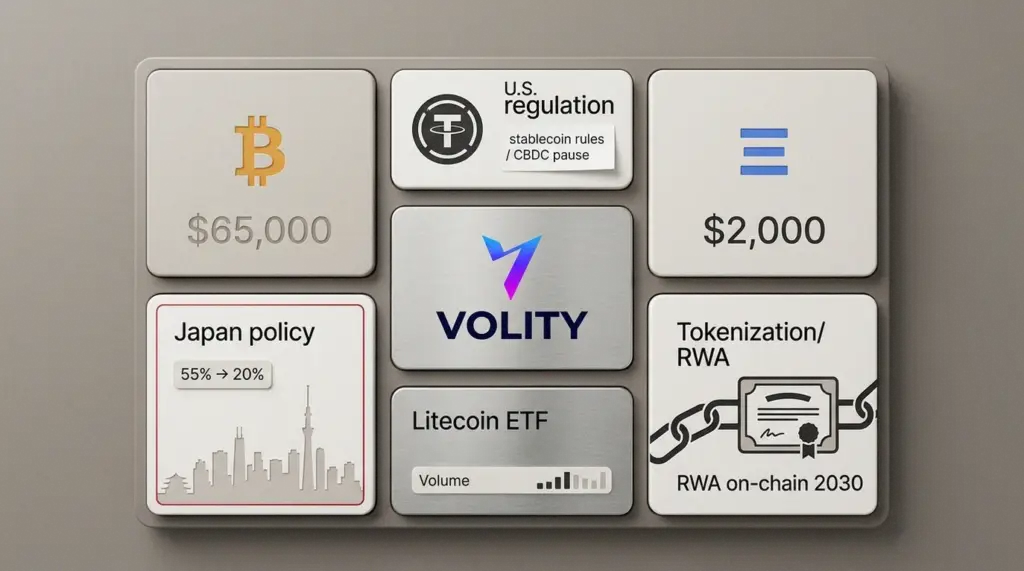
Crypto looked restless at midday, not quite weak, yet far from fearless. Bitcoin hovered near $65,000, while Ether struggled around $2,000. Traders were bracing for the Federal Reserve, but the bigger story sat beyond the price board.
Today’s tape is being shaped by tax policy, ETF engineering, tokenized assets and court-handled politics. In other words, the plumbing matters as much as the candles.
Market
Bitcoin’s drift towards the mid-$60,000s reflects a familiar squeeze. Rates remain the market’s weather system. Every Fed hint now lands harder across crypto than usual.
Ether has also looked fragile near $2,000. Meanwhile, some large wallets have been buying weakness, though the bounce lacks conviction. Solana, Uniswap and XRP have produced sharper single-name moves, but the wider market feels selective.
ETF flows remain the institutional tell. Several weeks of net outflows from U.S. spot Bitcoin funds suggest slower money is not chasing every dip. However, Wall Street keeps building new wrappers around crypto risk. That is not retreat. It is repackaging.
- BTC: key intraday zone sits around $65,000 to $66,000.
- ETH: the $2,000 area remains the psychological line.
- ETF flows: daily data matter more before Fed events.
- Altcoins: large dispersion suggests trades, not a broad melt-up.
Policy
Japan delivered the day’s loudest policy shock. Officials are moving to cut the top effective tax rate on individual crypto gains from as high as 55% to a flat 20%. That would align crypto with stocks and foreign exchange.
This is more than tidying up the tax code. Japan has long treated digital assets cautiously. Now, however, Tokyo is competing for traders, developers and exchange volumes.
If enacted cleanly, the change gives Japan a clearer pitch to crypto capital. It also pressures other large economies. High earners can move. Builders can move too. Liquidity usually follows paperwork, slowly at first, then suddenly.
Meanwhile, Illinois is testing the opposite direction. The state has moved towards a distinct tax treatment for some crypto transactions. For active traders, that means more friction if activity touches Illinois-based entities or platforms.
Other cash-hungry states will be watching. If the model raises revenue without driving business away, it may spread. If volumes leave, it becomes a warning label.
Washington
In Washington, a proposal to restrict a U.S. retail central bank digital currency until 2030 is moving through a broader banking debate. That pause would be a gift to private stablecoin issuers.
USDT, USDC and future bank-backed tokens would keep the field largely to themselves. However, that freedom will come with tighter rules.
The GENIUS Act has already drawn resistance from senators aligned with state regulators. They worry that federal oversight could sideline state supervisors. Separately, the CLARITY Act is heading towards a fight over conflicts, disclosures and market structure.
For traders, these bills are not background noise. They will influence listings, reserve rules, exchange access and custody models. They may also decide which tokens can sit comfortably on bank balance sheets.
China adds another pressure point. Its central bank is watching stablecoin use in cross-border trade. Payment processors serving China-linked commerce should expect more reporting demands and stricter data checks.
ETFs
The quiet surprise came from Litecoin. A Litecoin ETF has launched, giving LTC a regulated wrapper beyond the familiar Bitcoin and Ether lanes.
Trading is still thin. Symbolically, however, the launch matters. It tells the market that the altcoin ETF era may not begin with fireworks. It may begin with Litecoin, a coin many desks had filed under “still breathing”.
That matters for Solana, XRP and future basket products. If regulators tolerate one older altcoin product, issuers will test the boundary again. They always do.
BlackRock is also pressing deeper into structure. Its Bitcoin-linked product designed to harvest volatility offers investors yield-like exposure through options-style overlays. In plain English, it sells part of Bitcoin’s turbulence back to the market.
That may please allocators who want BTC exposure with less stomach-turning volatility. However, it also redirects capital that might otherwise have bought spot Bitcoin outright.
Tokenization
Citigroup has put a large marker on tokenization, projecting roughly $8 trillion in tokenized real-world assets by 2030. The category includes Treasuries, money market funds, real estate and private-company equity.
The forecast sounds grand, but the market is already moving. State Street is building stablecoin-based funds and custody rails. Coinbase is offering tokenized exposure to private names such as SpaceX. Binance has listed bStocks and related perpetual products.
For traders, this creates fresh basis opportunities. A tokenized product may not track its off-chain equivalent perfectly. Settlement timing, redemption rules and legal rights all matter.
Still, tokenization is no longer a conference panel term. It is becoming tradable inventory.
Protocols
Toncoin is trying a full narrative reboot. Its “Make TON Great Again” roadmap leans on Telegram integrations, mini-apps and a revived Gram brand.
The strategy is simple. Turn Telegram’s huge audience into active on-chain users. However, consumer crypto has always had a hard conversion problem. People click buttons. They do not always become durable wallets.
For TON traders, the setup is clear. Marketing can drive bursts of volume. Telegram-native tokens may follow. Yet the same history that gives TON recognition also brings regulatory sensitivity.
Ethereum’s coming Glamsterdam upgrade puts base-layer scaling back into view. Developers want lower costs and better throughput without abandoning the rollup-heavy roadmap.
If the upgrade lands well, ETH may reclaim more value from its layer-2 ecosystem. If it disappoints, Solana and other fast chains get a cleaner talking point.
Cardano, meanwhile, has pushed the Van Rossem hard fork into mainnet governance. That gives ADA holders another test of on-chain decision-making. As a result, contentious votes could become trading events.
Infrastructure
JustLend DAO has launched Supply and Borrow Market V2 with isolated lending markets. The design walls off riskier collateral, so one bad asset should not poison the whole protocol.
That is useful. It also adds complexity. During stress, isolated pools can liquidate in their own strange rhythm. Traders using leverage should read the small print before chasing yield.
Europe is adding more pressure through MiCA. Bitget EU has filed its MiCAR application with Austria’s regulator. BitGo is offering MiCA-ready infrastructure. OKX Europe is pitching deposit bonuses to users leaving less prepared venues.
Venue risk is becoming practical, not theoretical. Check where an exchange is registered. Also check what it may delist when deadlines tighten.
Politics
Crypto-backed political action committees are becoming more visible outside Washington. In Alabama, a Senate runoff victory for a crypto-backed candidate showed how quickly digital assets have become campaign material.
That matters before the 2026 midterms. Candidates will use “innovation” language. Donors will seek clearer rules. Regulators will feel the squeeze from both sides.
Meanwhile, talk of Sam Bankman-Fried launching a future coin is a reputational stress test. If speculators pile in, the market has learned little. If they reject it, the industry may be growing up.
Elon Musk has also revived the wealth-tax discussion after comparisons between his net worth and Bitcoin’s market value. The direct trading impact is small. However, the political framing is useful to tax hawks: crypto wealth looks visible, mobile and tempting.
Trading Read
- Keep macro first: Bitcoin’s defence of $65,000 to $66,000 remains the risk gauge.
- Track ETF flows: wrappers now shape spot demand, volatility and liquidity.
- Watch tax divergence: Japan is courting capital while some U.S. states add friction.
- Treat tokenization seriously: new products create basis trades and legal traps.
- Fade weak narratives: TON, LTC and governance coins need users, not just slogans.
Crypto is not in open mania today. It is being rewired beneath the screen. Taxes, ETFs, stablecoin rules and tokenized assets are doing the heavy lifting. The price candles still matter, of course. But the next real trade may start in the rulebook.