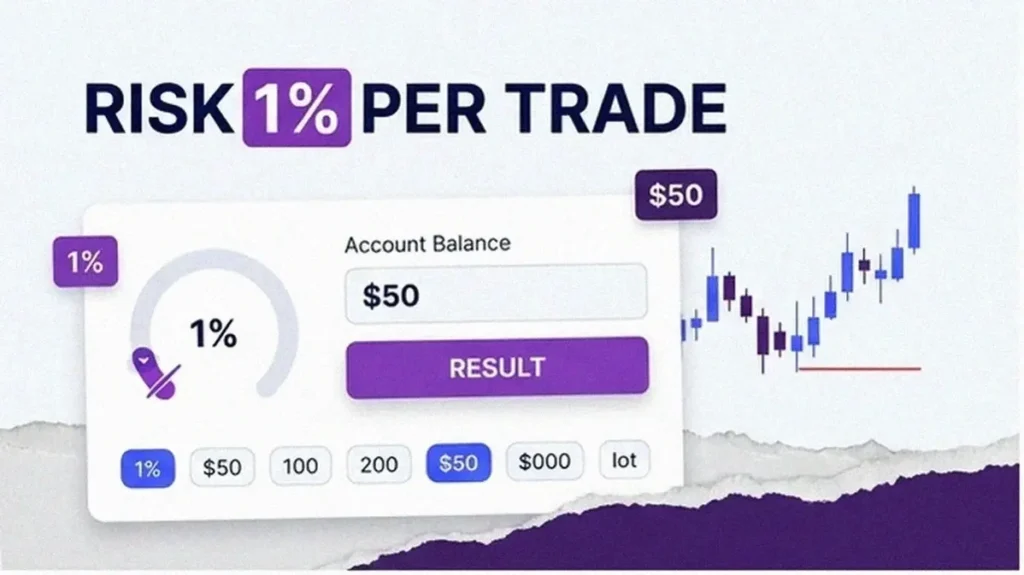
You found a clean setup, placed the trade, and one loss wiped out a week of green days. The problem usually is not your entry. It is your size. Position sizing is the simple math that decides how many shares, lots or coins to buy so a single losing trade costs only what you planned. Get it right and you control your downside on every trade – forex, stocks or crypto – before you click buy.
TL;DR / Quick answer: Position size is how big a trade you take, measured so one loss equals a fixed slice of your account. A lot size calculator turns that formula into an exact number of lots. Use one formula everywhere: Position Size = (Account Balance x Risk %) / Stop-Loss Distance. Pick a small risk per trade (many traders cap it near 1%), measure the distance from entry to stop, and divide. Only the unit changes by asset – dollars per share, dollars per pip per lot, or dollars per coin. Run it by hand, then confirm with a calculator before every order.
Most beginner guides are single-asset, so position sizing looks like three skills. It is one. The same formula sizes every trade across forex, stocks and crypto, and one Volity account holds all three.
Why position size decides survival, not your entry
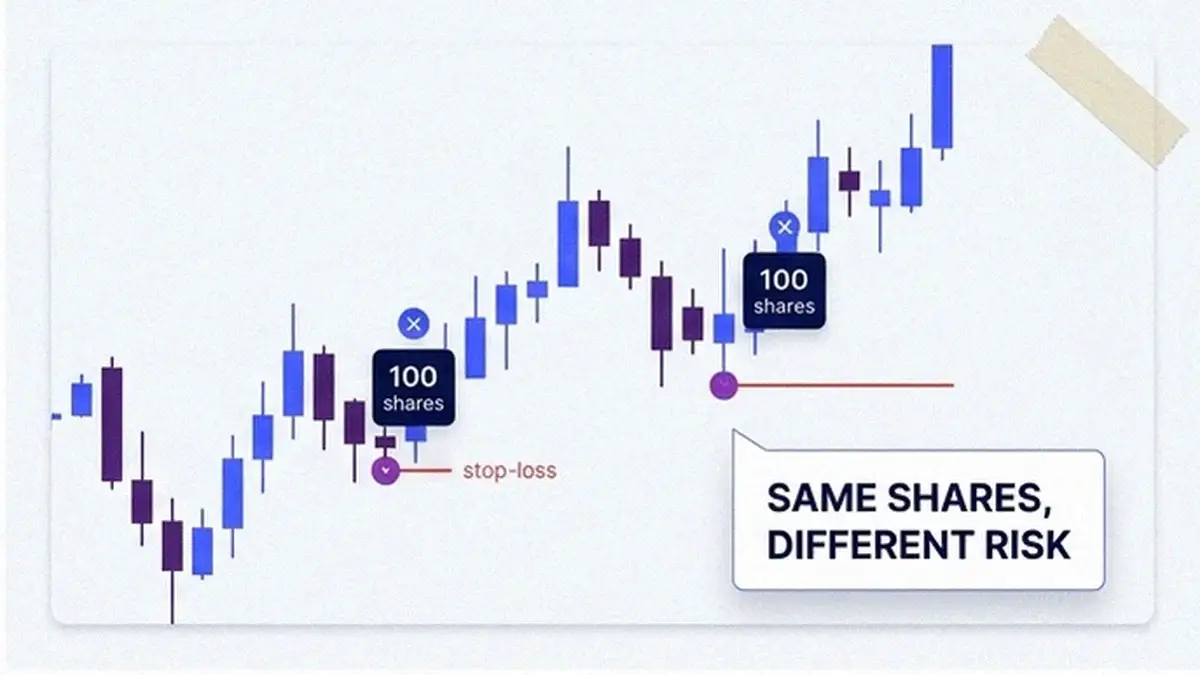
Your entry is a guess; even a strong setup loses often. Position size is the one thing you fully control, and it decides how much a wrong guess costs. The classic beginner mistake is buying a fixed number of shares no matter the chart. One trade has a 2% stop, the next a 10% stop, but you buy the same 100 shares both times, so your real risk jumps around without you noticing. Size by the math, every time, not by habit or gut conviction.
Do this first: Write down two numbers – your current account balance, and the single percentage of it you are willing to lose on one trade.
Pick your risk per trade in plain numbers
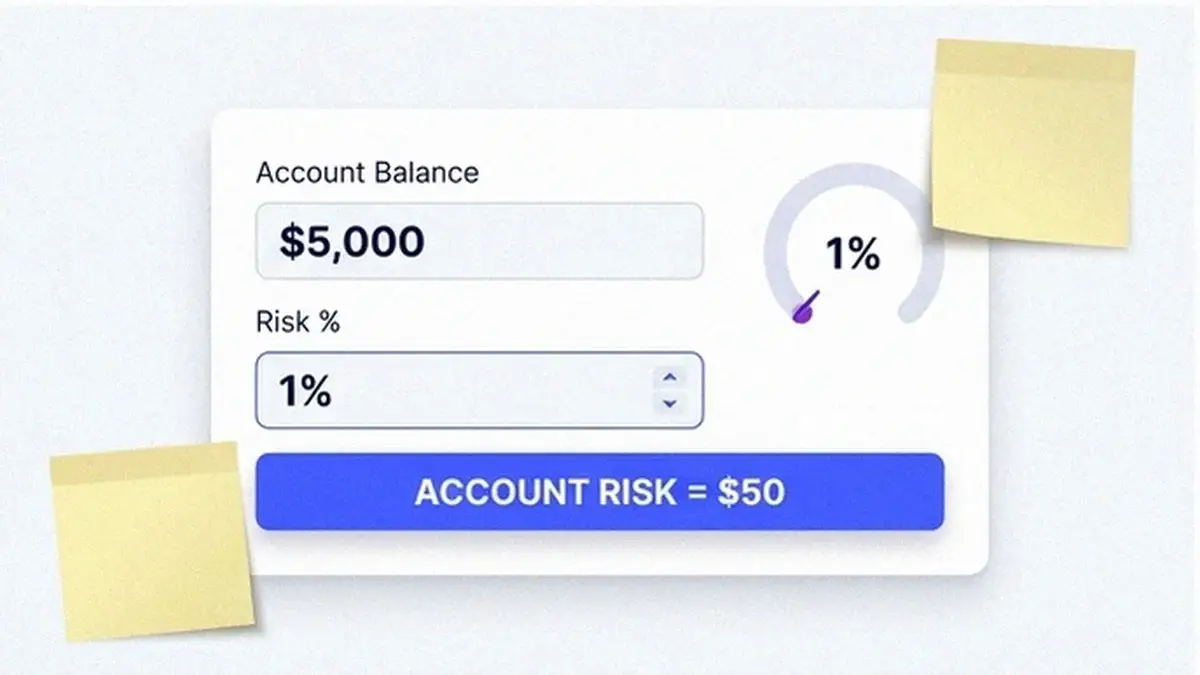
Risk per trade is the cash you accept losing if a trade hits its stop-loss – the price where you exit a losing trade automatically, capping the damage. Among traders, a widely used guideline is to risk only a small slice per trade, often around 1% and rarely more than 2%. This is general trading math, not a product rule or advice tied to any broker – pick what fits you.
Why small risk works: Account Risk = Balance x Risk %. On a $5,000 account at 1%, that is $50 per trade. Lose ten in a row and, as simple arithmetic, ten losses of about 1% leave you down roughly 9-10% – bruised, but still in the game. (Illustrative, not a statistic.) Risk 10% per trade instead and the same streak is account-ending.
Recommendation: Fix your risk percentage in advance and keep it the same. Do not raise it to “win back” a loss – that turns a drawdown into a blow-up.
Calculate position size step by step with one formula
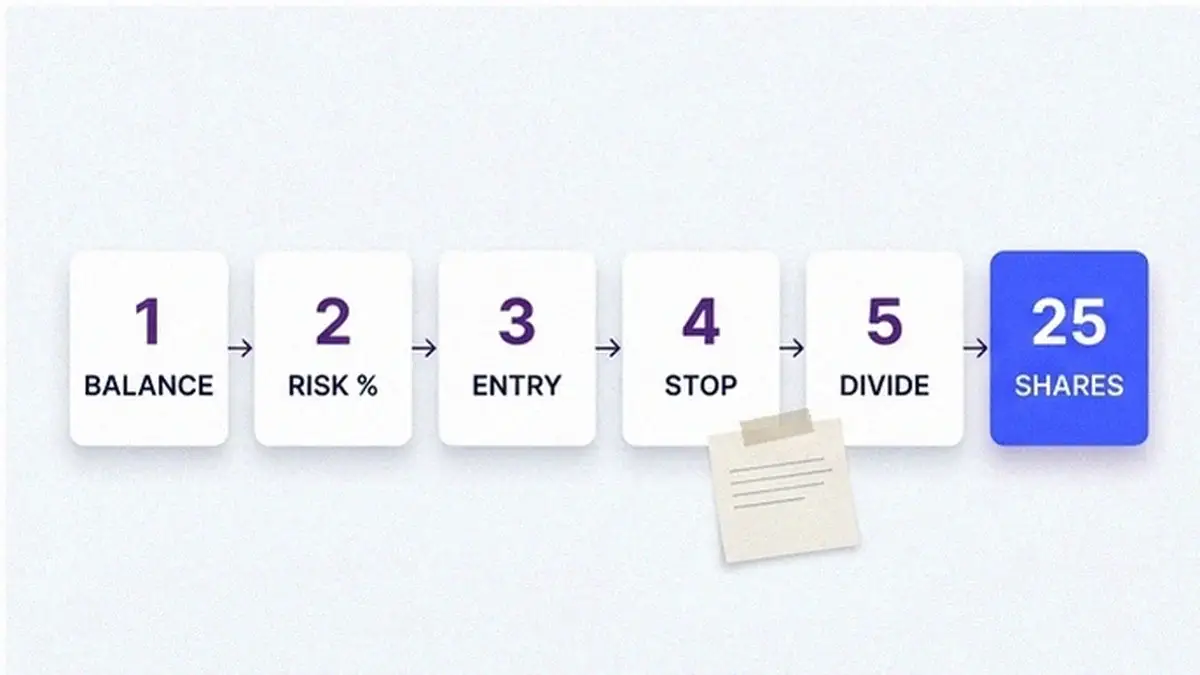
Here is the master formula, used everywhere:
Position Size = (Account Balance x Risk %) / Stop-Loss Distance
same as: Position Size = Account Risk ($) / (Entry Price – Stop Price)
Stop-Loss Distance is how far, in price, your stop sits from your entry. Break it into five steps, worked here on a $5,000 stock trade:
- Note your account balance. The real, current number: $5,000.
- Turn your risk % into dollars. Account Risk = Balance x Risk %. At 1%: $5,000 x 0.01 = $50, your loss budget.
- Write down your entry price. The price you plan to enter at: $20.
- Find the stop distance. Entry – Stop. A stop at $18 gives $2 per share.
- Divide. Account Risk / Stop Distance = $50 / $2 = 25 shares – your raw size before rounding.
The formula never changes; only the unit value does – dollars per share, per pip per lot, or per coin.
Recommendation: Plug in your own numbers and write down the raw size before rounding. Never start from “how many shares do I usually buy” – that habit blows accounts up.
Turn stop-loss distance into pips, dollars and lot size
Each asset measures distance in its own unit, so convert it before you re-run the formula. For stocks it is dollars per share (Entry – Stop); fractional shares let you hold an exact amount and keep risk at precisely 1% instead of rounding down. Crypto is the same in dollars per coin and also trades fractionally, so you never round.
Forex measures distance in pips. A pip is the smallest standard price move in a currency pair (for most pairs the fourth decimal, 0.0001). Lots are the trade size: a standard lot is 100,000 units, a mini 10,000, a micro 1,000. As an approximate teaching value on USD-quoted pairs, one pip is worth about $10 per standard lot, $1 per mini, $0.10 per micro (it varies with pair and rate). Forex sizing: Lot Size = Account Risk / (Stop in pips x Pip Value).
Recommendation: Convert stop distance into the right unit before sizing. New to the jargon? Our explainer on what a pip is and the Volity forex hub have you covered.
Run worked examples for forex, stocks and crypto
Same account, same 1% risk, three asset classes. Every number below is illustrative arithmetic, not a Volity quote or a sourced stat.
| Step | Stocks | Forex | Crypto (BTC) |
|---|---|---|---|
| Account balance | $5,000 | $5,000 | $5,000 |
| Risk % to dollars | 1% = $50 | 1% = $50 | 1% = $50 |
| Entry price | $20.00 | 1.1000 EUR/USD | $95,000 |
| Stop price | $18.00 | 25 pips away | $93,000 |
| Stop distance | $2 / share | 25 pips x ~$10 = $250 / lot | $2,000 / coin |
| Size = $50 / distance | 25 shares ($500) | 0.2 lots (2 mini lots) | 0.025 BTC (~$2,375) |
Three assets, one routine, one $50 risk budget. Leverage changes the margin you post but not your risk-based size; the stop distance still defines the loss. Volity offers leverage up to 1:500 (up to 1:50 on crypto).
Recommendation: Copy the example that matches your next trade, swap in your own entry and stop, and produce your real size. One Volity account trades shares, fractional shares, crypto and CFDs, so one routine sizes them all.
Sanity-check it with a position size calculator
Hand math teaches you why the number is what it is; a calculator is the fast path once you understand it. Use both: if they disagree you have a wrong input, almost always the pip value or stop price. Run your trade through the free Volity Position Size Calculator and check it returns the same size you got by hand. The Volity trader hub covers stops, journaling and strategy.
Recommendation: Make the hand math and the calculator agree before you order; a mismatch means a wrong input.
Run this pre-trade checklist before you enter
Run this list on every trade. If any box fails, do not enter until it is fixed.
- Account balance is current and correct (not an old number).
- Risk % is chosen in advance and fixed.
- Account Risk in dollars is calculated (Balance x Risk %).
- Stop-loss is placed beyond the key level, not right on it.
- Stop distance is measured in the right unit (dollars, pips, or dollars-per-coin).
- The unit value is correct (pip value, price per share, or price per coin).
- Position size comes from the formula, not a habitual share or lot count.
- Fractional shares or coins are used to hit exact risk instead of rounding down.
- Leverage is checked against the liquidation point so the stop triggers first.
- Total open risk fits your budget, and the order-ticket size matches your calculation.
The fastest way to clear box 7 is the Volity Position Size Calculator: enter the trade and confirm it matches.
Recommendation: Run all ten boxes before placing the order. Drill the routine on a free Volity demo account with zero money at risk. Volity holds forex, stocks, fractional shares and crypto in one commission-free Markets account, with spreads from 0.6 pip. Open a Volity account to size real trades from one login, and check the transparent fees and account types first.
Reviewed by: A. Bennett, Volity editorial desk.
Data integrity: the 1% risk rule and the position-size formula are universal trading math, taught as general principles, not a Volity recommendation. All drawdown and pip-value figures are clearly labelled illustrative arithmetic. Only verified fact-bank facts (commission-free Markets, spreads from 0.6 pip, leverage up to 1:500 and crypto up to 1:50, one multi-asset account, free demo) are stated as product claims.
Sizing still matters where the downside is capped by the design of the instrument. On an event contract the entire amount you commit is at risk, and our comparison of prediction markets and betting explains why a bounded loss is not the same thing as a small one.
Sizing works the same way on event contracts. Your stake divided by the share price gives the number of shares, and the whole outlay is what you stand to lose if the outcome goes the other way. Our guide to prediction market odds covers that payout maths.
Related coverage on Volity
- Forex Risk Management: A Position-Sizing Framework for Pairs
- How to Read a Forex Spread: Bid, Ask, Pips and Cost
- Market Order vs Limit Order: Which to Use and When
- How to Avoid Common Stock Trading Mistakes
- Forex Day Trading: Setup, Risk, and What Actually Works
Frequently asked questions
What is the 1% rule in trading?
It is a widely used guideline to risk no more than about 1% of your account on any single trade. Multiply your balance by 1% to get your loss budget – on a $5,000 account that is $50 – and size every trade so a stop-loss hit costs only that. It is general trading math, not a broker rule.
How do you calculate position size?
Use one formula: Position Size = (Account Balance x Risk %) / Stop-Loss Distance. Turn your risk % into dollars, measure the distance from entry to stop, then divide. The result is your size in shares, lots or coins; confirm it in a calculator before you order.
How much should I risk per trade?
Risk a small, fixed slice you could lose ten times in a row and still recover from – many traders settle near 1% and rarely above 2%. Pick the number once and apply it to every trade. This is a general principle, not advice for your situation.
What lot size should I use on a small account?
Let the math choose it. With a small balance and a 1% budget, run Lot Size = Account Risk / (Stop in pips x Pip Value); the answer is usually micro lots (1,000 units, about $0.10 per pip) or mini lots. Do not force a standard lot to feel “serious” – that breaks your risk rule.
Does leverage change my position size?
No. Leverage changes the margin you post, but your risk-based size still comes from the stop distance. The real danger is liquidation: on high leverage a far stop can sit past the point where the trade is force-closed. Keep your stop inside the liquidation buffer so it triggers first.
Sources
This guide draws on the following public sources.
- Nobel Prize – Thaler's Nobel work on behavioural economics
- Bank of England – Bank of England explainer on interest rates and risk
- IOSCO – IOSCO on retail distribution and digital engagement practices
- Nobel Prize – Kahneman's Nobel work on judgement under uncertainty
- Bank for International Settlements – BIS working paper on retail trading behaviour
- ESMA – ESMA warning on speculative retail trading risk
- CFA Institute – CFA Institute Research Foundation on investor behaviour
- Bank of England – Bank of England explainers on markets and risk
- IOSCO – IOSCO report on retail market conduct and online marketing