How to Calculate Profit and Loss on a Trade (Forex, Stocks, Crypto)
You closed a trade, the number in your account changed, but you are not sure why – or whether you really made money once the costs came out. Good news: every profit or loss, on every market, runs on one tiny piece of arithmetic. Learn it once and you can work out your result on a stock, a forex pair or a crypto coin by hand. No calculator, no jargon.
TL;DR / Quick insight: Profit or loss on any trade is one idea: take how far the price moved in your favour, multiply by your position size, and flip the sign if you sold first (a short). Stocks use shares times the price difference; forex uses pips times pip value; crypto uses coin amount times the price difference. Then subtract your costs – the spread, a 1% conversion fee, and an overnight fee if you held late – for the net result. Profit you have closed is “realized”; profit on a position you still hold is “unrealized” (paper) and can still vanish.
Most pages that rank here are just calculators that hand you a number and teach you nothing. We do the opposite: one formula, run three ways, costs made concrete.
Start with the one formula behind every trade
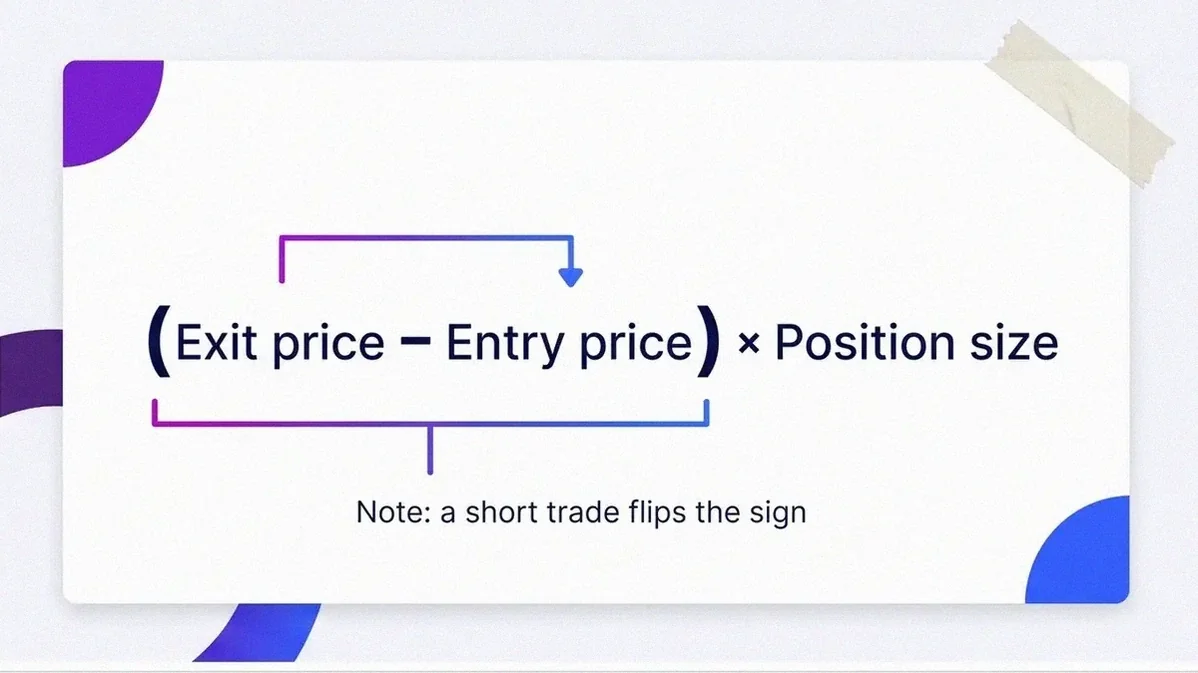
Every trade comes down to four inputs: your entry price (where you got in), your exit price (where you got out, or the current price if you still hold), your size (shares, lots, coins), and your direction (you bought first hoping for a rise, or sold first hoping for a fall).
Profit or loss = (exit price – entry price) x position size.
For a short (you sold first), flip the sign: (entry price – exit price) x position size.
That is the whole thing. Buy (“long”) and the price rises, the bracket is positive and you profit. Sell first (“short”) and the price falls, the sign flip makes it positive. A pip, a share and a coin are just ways of measuring “size”. One last term: gross is this raw result; net is what is left after costs – the number that hits your wallet.
Do this, not that: write your trade as those four inputs first. Do not eyeball profit from the chart – you will misread shorts.
Calculate a stock trade step by step
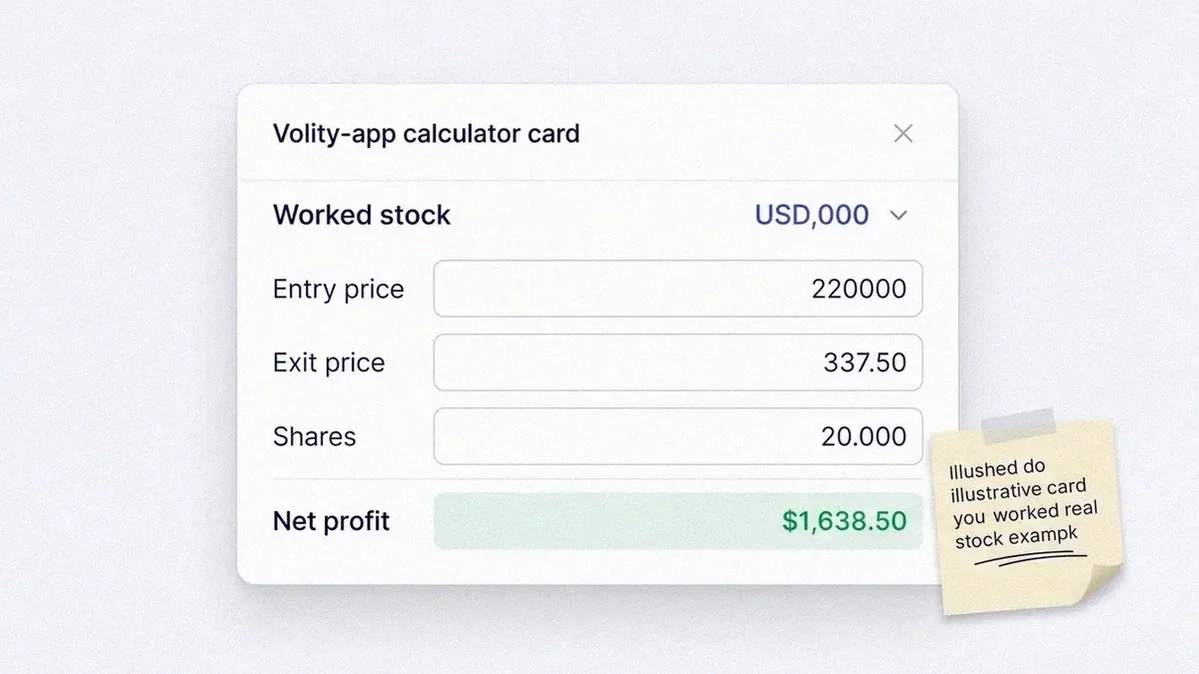
Stocks are the friendliest start: “size” is the number of shares. A worked long example – numbers are illustrative arithmetic, not a real price:
- Write the inputs. Buy 20 shares at $50.00. Size = 20, direction = long.
- Record the exit. You sell all 20 at $54.00.
- Price difference. $54.00 – $50.00 = $4.00 per share.
- Multiply by size. $4.00 x 20 = $80.00 gross profit.
- Check the sign. Long, price rose, result positive. Done.
A fall to $48.00 would give a $40.00 loss – the minus sign does the work. Fractional shares work identically: use a decimal share count.
Do this, not that: run this on your last share trade and write the gross figure down before you touch fees.
Calculate forex profit using pip value
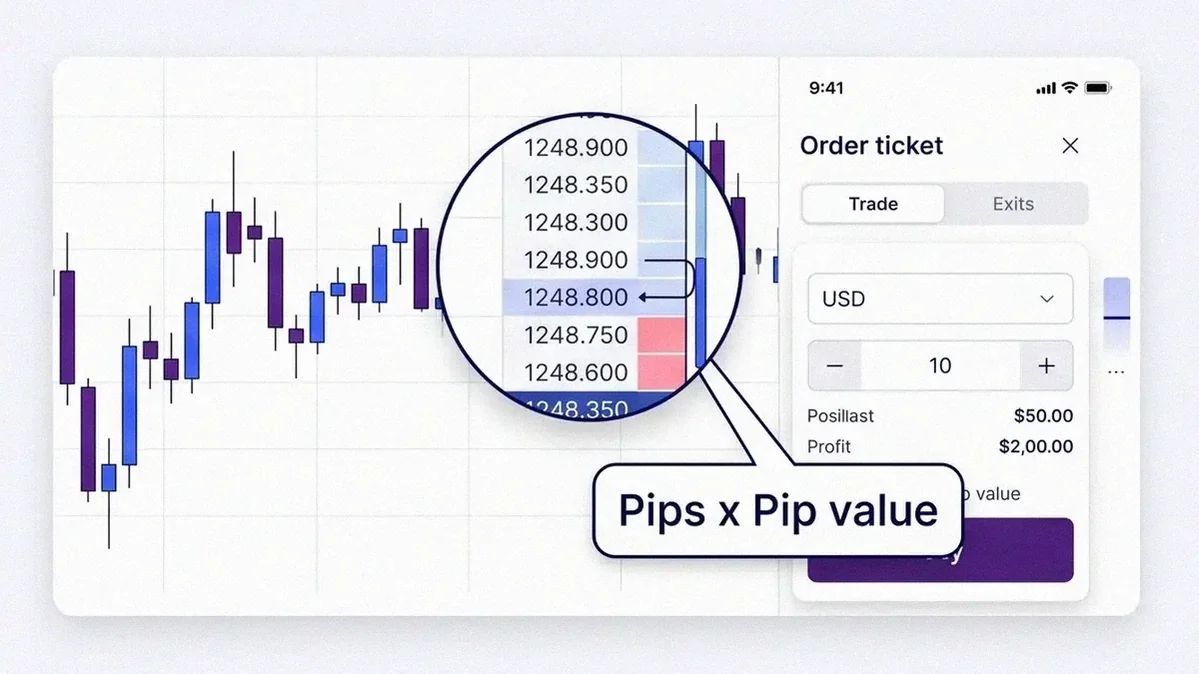
Forex only looks scarier because of two words. A pip is the standard smallest move in a pair’s price – the fourth decimal (0.0001), or the second (0.01) for yen pairs, so 1.1000 to 1.1010 is 10 pips. A lot is the bundle you trade in: standard = 100,000 units, mini = 10,000, micro = 1,000 units.
Forex profit or loss = pips moved x pip value (sign flipped for a short).
The only new task is finding your pip value – what one pip is worth in money. For a pair quoted in your account currency, that is lot size x pip size. A worked example with illustrative numbers:
- Pick your size. 1 mini lot = 10,000 units, USD account, USD-quoted pair.
- Pip value once. 10,000 x 0.0001 = $1.00 per pip.
- Count the pips. Long at 1.2000, exit 1.2025 = 25 pips your way.
- Multiply. 25 x $1.00 = $25.00 gross profit.
One cost beginners miss: the spread already cost you before you started. The spread is the gap between the buy and sell price; you enter at the worse side, so you begin a few pips behind and earn them back first. On Volity, Standard spreads start from 0.6 pip. The full forex picture lives in our forex hub.
Do this, not that: calculate pip value once for your lot size, then multiply by pips moved. Do not re-derive it mid-trade – lock it down before you enter.
Calculate a crypto trade’s profit
Crypto is the easy case: “size” is the amount of coin, and fractional amounts are normal. A worked long example with illustrative prices:
- Write the inputs. Buy 0.5 of a coin at $2,000, direction = long.
- Record the exit. You sell at $2,300.
- Price difference. $2,300 – $2,000 = $300 per coin.
- Multiply by size. $300 x 0.5 = $150.00 gross profit.
One thing genuinely changes the result: leverage – trading a larger position than your own cash by borrowing the rest, which multiplies both profit and loss. On Volity, crypto leverage goes up to 1:50, and your P&L is then figured on the full position, not your stake.
Do this, not that: multiply coin amount by the price difference, then confirm leverage before trusting the number.
Separate realized from unrealized, then subtract the costs
Two traders can run the same formula and mean different things by “exit”. This decides whether your profit is real money or just a number on a screen:
Realized vs unrealized: Closed position → “exit” is your actual sell price → profit is realized (locked in). Open position → “exit” is the current market price → profit is unrealized (paper, can still change).
Unrealized profit is what your open trade is worth if you closed it now – real, but not in your pocket, and it can turn red first. Now turn gross into net:
- The spread: already paid on entry. On commission-free Markets trading at Volity there is no separate commission on top – the spread is the cost, from 0.6 pip on Standard.
- Currency conversion: converting between currencies costs 1% on Volity. Hold in the same currency and there is nothing to subtract.
- Overnight (rollover): holding past 22:00 GMT triggers a fee, based on the inter-bank rate difference, so it can be positive or negative. Trade intraday and it never appears.
Take the stock example’s $80 gross: no conversion, closed the same day, so net realized profit is $80. Volity keeps this side lean – commission-free Markets, FX fee free – so gross and net stay close. Every line is on the fees page.
Do this, not that: recalculate your P&L as a NET number, then label it realized or unrealized. Never treat unrealized gains as banked.
Run this before-and-after P&L checklist
Calculating P&L pays off at two moments: before you enter, so you know your risk, and after you close.
Before you click buy:
- Confirm your four inputs: entry, planned exit, size, direction.
- For forex, calculate your pip value for that lot size.
- Work out your P&L at your target and at your stop-loss, in money.
- List expected costs: spread, conversion, overnight if held late.
- Confirm the worst case is a loss you can accept; if not, shrink the size.
After you close:
- Record your actual exit and recompute the gross.
- Subtract every cost that applied for the net result.
- Log entry, exit, size, costs and net P&L in your journal.
The cleanest way to practise is a free demo – the same formula on live prices, no real cash on the line, on every Volity tier. For the full path, our trader education hub covers risk and journaling.
What’s next
- Calculate one closed trade’s net, realized P&L by hand.
- Calculate your pip value once for the pair you watch most.
- Open a free demo and run the checklist on a practice trade.
When you are ready for real markets, open a Volity account – commission-free Markets trading and spreads from 0.6 pip keep the cost side small and transparent.
Reviewed by: the Volity editorial desk (A. Bennett byline).
Data integrity: all Volity figures are verified against the Volity fee schedule and product documentation as of June 2026. Every example price, pip value and coin amount is illustrative arithmetic shown to teach the method – not a market quote or a Volity claim.
The same profit and loss arithmetic applies to event contracts, where each share pays $1.00 or nothing and your profit is a dollar minus whatever you paid. Our guide to prediction market odds shows the payout at every entry price.
Related Volity guides
- How to read a forex spread and what it costs
- Market order vs limit order
- Volity trading tools and calculators
The arithmetic takes a different shape on an event contract, where every share settles at one dollar or at zero and there is no partial result. If you are working out the profit and loss on one of those, start with our comparison of prediction markets and betting.
Related coverage on Volity
- How to Size a Trade: Position Sizing and Risk Per Trade for Beginners
- How to Read a Forex Spread: Bid, Ask, Pips and Cost
- Market Order vs Limit Order: Which to Use and When
- Fractional Shares Explained: How to Start Investing With $50
- Demo vs Live Trading Account: A 7-Step Checklist Before You Go Live
Frequently asked questions
How do you calculate profit on a trade?
Take the price difference (exit minus entry) and multiply by your position size. If you sold first (a short), flip the sign to entry minus exit. That gives gross; subtract your costs for the net.
What is pip value and how do I find it?
Pip value is what one pip move is worth in money for your position size. For a pair quoted in your account currency the rule is lot size x pip size: 10,000 units x 0.0001 = $1.00 per pip on a mini lot. Calculate it once, then multiply by pips moved.
What is the difference between realized and unrealized profit?
Realized profit is locked in – you closed the position and the money is yours. Unrealized profit is paper profit on a position you still hold, measured against the current price, and it can change before you close.
Do spreads and fees count in my profit?
Yes. Net – the money you keep – subtracts the spread on entry, a 1% conversion if you converted, and an overnight fee if you held past 22:00 GMT. On commission-free Markets with spreads from 0.6 pip those costs stay small, but you still subtract every one that applied.
How do I calculate forex profit in my account currency?
Get your pip value in your account currency, then multiply by pips moved. If the pair is already quoted in your account currency, lot size x 0.0001 gives the per-pip value directly. Otherwise, convert the pip value once before multiplying.
Does leverage change how I calculate profit?
The formula stays the same, but leverage figures your P&L on the full position you control, not just your own cash, so both profit and loss are larger for the same move. Volity allows crypto leverage up to 1:50 and up to 1:500 on PRO and VIP. Check it before reading your result.
Sources
This guide draws on the following public sources.
- Bank of England – Bank of England explainer on interest rates and risk
- IOSCO – IOSCO on retail distribution and digital engagement practices
- Nobel Prize – Kahneman's Nobel work on judgement under uncertainty
- Bank for International Settlements – BIS working paper on retail trading behaviour
- ESMA – ESMA warning on speculative retail trading risk
- CFA Institute – CFA Institute Research Foundation on investor behaviour
- Bank of England – Bank of England explainers on markets and risk
- IOSCO – IOSCO report on retail market conduct and online marketing
- Nobel Prize – Thaler's Nobel work on behavioural economics