You keep hearing that the market is a bull market or a bear market, but nobody tells you what to do about it. The short version: a bull market is a sustained rise, a bear market is a sustained fall, and the practical difference is direction. In one you mostly look to buy; in the other you protect your money or look to sell short. This guide gives a one-line definition of each, a quick test for which one you are in, and a plan for both.
TL;DR / Quick insight: A bear market is commonly defined as a fall of 20% or more in an index from its recent high; a bull market is a sustained rise, often roughly a 20% gain from a recent low. To tell which you are in, check price structure (higher highs and lows means up, lower means down) and whether price is above a rising or below a falling 200-day moving average. In a bull you trade with the trend and look long; in a bear you cut risk, sit aside, or take a defined-risk short – always with a stop. One Volity account lets you go long or short across forex, stocks, crypto and CFDs.
Bull and bear are not moods – they describe where prices have been heading over weeks and months. The same word applies to a currency pair, a stock, an index or a coin, so once you read the phase you can read it on any chart.
The one-line difference (and a table to settle it fast)
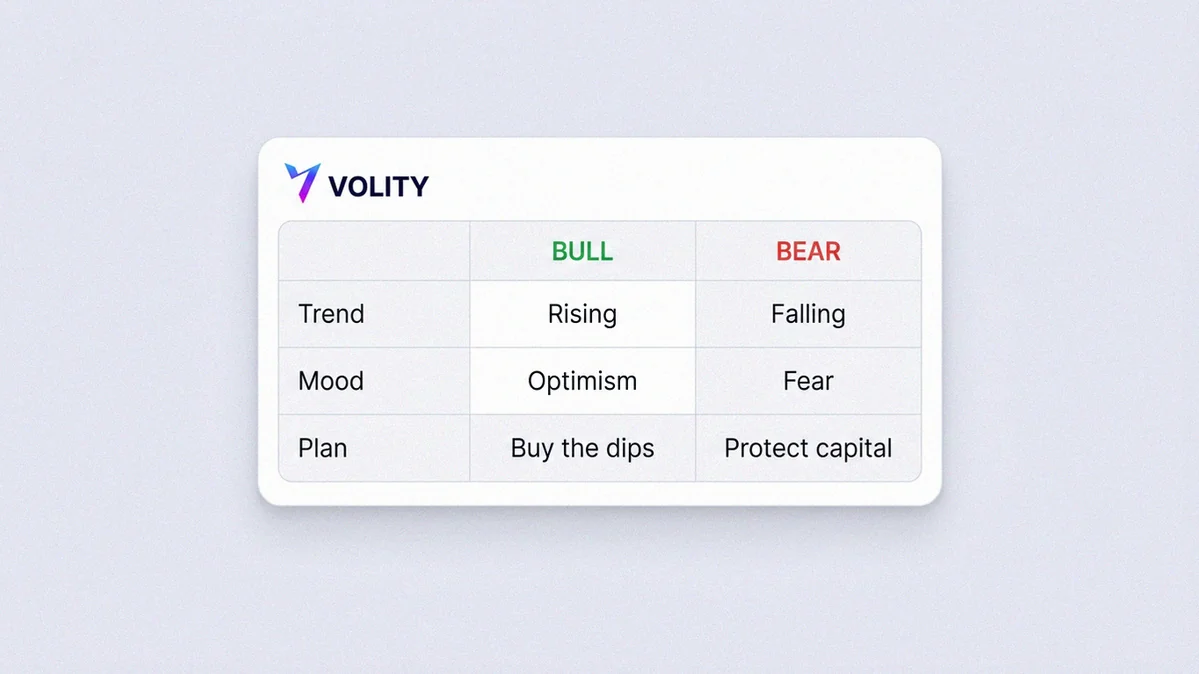
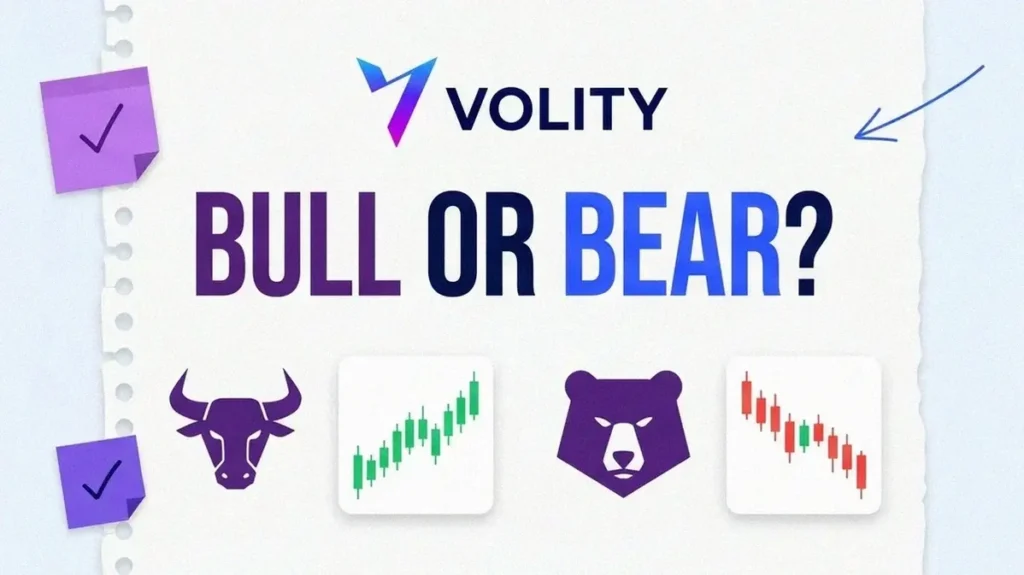
The plain-English version: a bull market is a period when prices are rising and broadly expected to keep rising – optimism is in charge. A bear market is a period when prices are falling and fear is in charge. The most quoted rule is the 20% line, the convention also used in the US SEC investor.gov glossary: a bear is commonly defined as a drop of 20% or more in an index from its recent high, and a bull is the opposite, roughly a 20% rise from a recent low. The bull threshold is looser, so treat both as conventions, not exact science. (An index is just a basket of assets tracked as one number.) Read the comparison below, then note which row matters most for how you trade.
| What you are comparing | Bull market | Bear market |
|---|---|---|
| Definition / trigger | Sustained rise, often roughly +20% from a recent low | Fall of 20% or more from a recent high |
| Market sentiment | Optimism, buyers in control | Fear, sellers in control |
| Typical approach | Trade with the trend, buy pullbacks, let winners run | Protect capital first, smaller size, be selective |
| Risk control that matters most | A stop under the trend so one reversal does not erase gains | Tight max risk per trade and a rule for stepping aside |
| Long vs short stance | Mostly long (profit if price rises) | Defensive, or short (profit if price falls), with a stop |
How to tell which one you are in right now
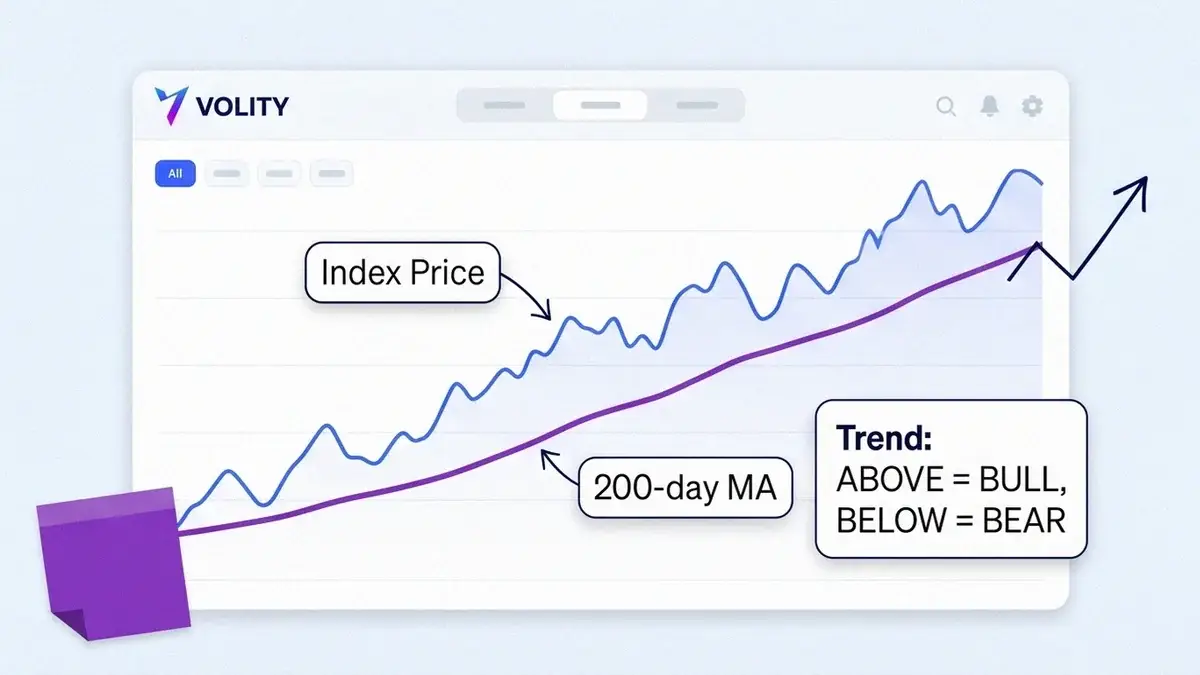
Here is a repeatable two-step test, based on standard technical-analysis convention (see Verified sources below), that works the same on any chart – forex pair, share, index or crypto.
The two-step phase test:
Step 1: Price structure. Higher highs and higher lows → uptrend (bull). Lower highs and lower lows → downtrend (bear).
Step 2: The 200-day line. A 200-day moving average is the average closing price over the last 200 days, drawn as one smooth line that shows the long-term direction. Price above a rising line → bull. Price below a falling line → bear.
When both steps agree, you have a clear read. When they disagree, you are in a transitional patch, so trade smaller or wait. A common mistake is judging the phase from one big red or green day; one day is noise, so look at the shape over weeks. Action: open the chart you actually trade and run both steps now.
How a bull market behaves and how to approach it
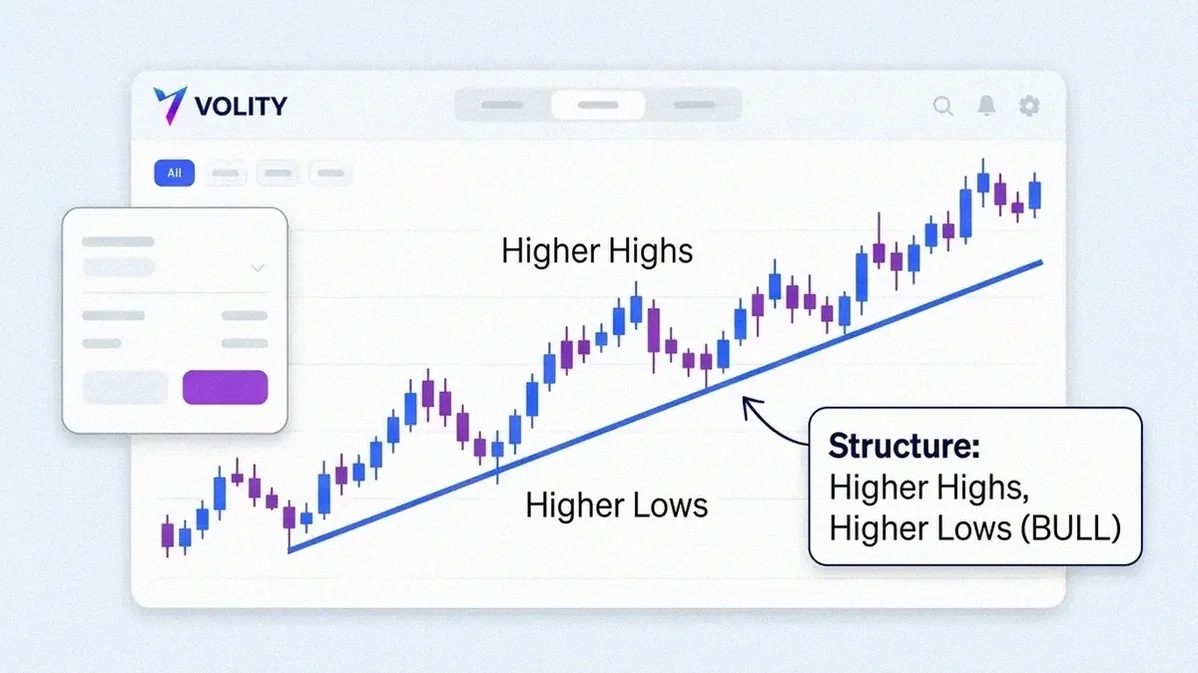
In a bull market prices grind higher, dips get bought, and sentiment improves. The trend is your friend: your odds are better trading with the move than fighting it, so look for entries on pullbacks – dips back toward the rising trend – not by chasing a candle that has already run far.
Going long means you buy expecting the price to rise. Even in a strong bull you need a stop – a preset exit price where you accept a small loss and get out – placed under the trend, so one reversal cannot undo weeks of gains. The classic error is letting optimism remove discipline: oversized positions and no stop. Action: before you open a position, decide your entry trigger and your stop, and size the trade so that stop is a loss you can absorb.
How a bear market behaves and how to protect capital
A bear market is a different animal. Prices fall, moves are sharper, and rallies fade fast. The first job is not to make money – it is to keep what you have. There is no fixed length, so do not bet on a quick bounce.
You have three honest options. First, trade smaller, so each loss is minor. Second, step aside and let capital sit safely; on Volity that can mean parking funds in the $0 multi-currency wallet (a no-fee account that holds several currencies) until a clearer setup arrives. Third, take a defined-risk short to profit from falling prices. If you hold a short overnight, an overnight (rollover) fee applies to positions held past 22:00 GMT. Never average down into a falling position with no plan. Action: set your maximum risk per trade and write down the one condition that makes you step aside.
Going long vs short in each market
This is where “how to trade each” gets concrete. Long = you buy first and profit if the price rises. Short (short-selling) = you sell first and profit if the price falls, then buy back lower, which lets a trader benefit from a bear instead of only surviving it. It is not risk-free: if the price rises against your short, the loss can keep growing, so a short needs a stop too.
To trade both directions you need a setup that supports buying and short-selling. One Volity account does both: you go long or short across forex, stocks, crypto and CFDs from a single login. A CFD is a “contract for difference” – an agreement that pays the difference between a price now and later, which makes shorting many assets practical. Direction is just a tool, and it only works paired with a stop; none of it promises a profit. Action: match your direction to the phase you identified, and write down the stop before you click. The Volity trader hub covers entries, stops and sizing; the stocks section shows these phases on indices.
Checklist: adjust your plan to the current market
Turn all of this into a habit. Run these six checks against your current and planned positions before every trade.
- Which phase am I in? Run the two-step test on this exact instrument.
- Is my direction aligned with it? Long in a bull, defensive or short in a bear.
- Is my position size right for this volatility? Smaller in a jumpy bear.
- Where is my stop? If you cannot name the price, set it before entry.
- What single signal would tell me the phase has flipped? Decide it now.
- Have I practised this setup on a demo first? Test new ideas with no money on the line.
Run these checks and the bull-or-bear question stops being abstract – it becomes a setting you tune. A practical way to rehearse both a bull long and a bear short with zero risk is a free demo account, which Volity offers on every tier. TRY A FREE DEMO ACCOUNT at volity.io.
The verdict: The phase does not decide whether you win – your discipline does. Use the bull/bear read to choose direction and size, and let the stop decide where each trade ends.
Because Volity trading on the Markets account is commission-free with dynamic spreads from 0.6 pip on Standard, switching stance when the market flips stays cheap; review every figure on the fees and account types page. When you are ready to trade both directions from one login – long in a bull, short in a bear – OPEN A VOLITY ACCOUNT at volity.io.
Reviewed by: A. Bennett, Volity editorial desk.
Data accuracy: the 20% bull/bear convention and the 200-day moving average rules are stated as widely-accepted financial-education conventions, not Volity figures; all Volity product details are verified against the published Volity fee schedule and product documentation as of June 2026.
Related Volity guides
Related coverage on Volity
- How to Size a Trade: Position Sizing and Risk Per Trade for Beginners
- Market Order vs Limit Order: Which to Use and When
- How to Avoid Common Stock Trading Mistakes
- Forex Day Trading: Setup, Risk, and What Actually Works
- Forex Swing Trading: A 5-Step Multi-Day Strategy
Frequently asked questions
What is the simplest difference between a bull and a bear market?
A bull market is a sustained rise in prices driven by optimism; a bear market is a sustained fall driven by fear. The most quoted line is the 20% convention, also used by the US SEC investor.gov glossary: a fall of 20% or more from a recent high is commonly called a bear.
How do I know which market I am in right now?
Run a two-step check on your chart. First, price structure: higher highs and lows point to a bull, lower to a bear. Second, check whether price sits above a rising 200-day moving average (bull) or below a falling one (bear).
How long do bear markets last?
There is no fixed length. Bear markets vary widely in duration and depth, so it is a mistake to assume a quick recovery or to time the exact bottom. Plan for the conditions in front of you.
Can you make money in a bear market?
You can position for falling prices by going short, which profits if the price drops. But shorting carries added risk because losses can keep growing if the price rises against you, and no outcome is guaranteed. Pair any short with a stop. This is information, not a promise.
What does going long or short mean?
Going long means you buy expecting the price to rise. Going short means you sell first, expecting a fall, then buy back lower. A bull usually favours longs; a bear is where shorts become useful.
Can I trade both directions in one account?
Yes. A single Volity account lets you go long or short across forex, stocks, crypto and CFDs from one login, so you can switch stance without a second broker, and rehearse both setups on a free demo first.