Crypto market today: fear, rulebooks and the stablecoin fight
Crypto opens July with a sour tape and a busier rulebook.
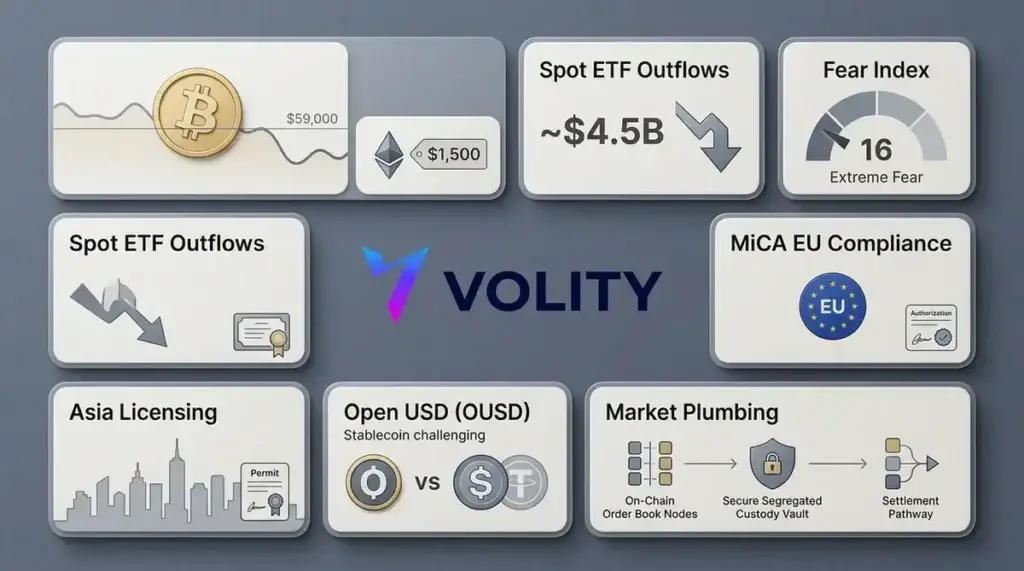
Bitcoin has slipped below $59,000, while June spot ETF outflows reached about $4.5 billion. That reverses one of the market’s strongest liquidity engines. However, the sell-off is not happening in a vacuum. Regulation, stablecoins and market plumbing are all moving faster than the price chart suggests.
For traders, the message looks uncomfortable but useful. The speculative bid has thinned. Meanwhile, the institutional structure around the market keeps hardening.
Market mood
Bitcoin’s break below $59,000 has put ETF flows back at the centre of the trade. When those products take in cash, they act like a steady buyer. When they bleed assets, they remove a buyer from the order book.
June’s $4.5 billion of outflows now hangs over every bounce. Traders are treating rallies with suspicion, at least until daily flows stabilise.
Sentiment has also collapsed. Crypto fear gauges sit near 16, deep in “extreme fear” territory. Historically, that zone has often appeared closer to late-stage sell-offs than fresh bear-market starts. However, fear alone is a poor entry signal.
- Bitcoin: below $59,000 after heavy ETF redemptions.
- ETF flows: June outflows near $4.5 billion.
- Sentiment: fear readings near 16.
- Ether: battling around the $1,500 support area.
Ether looks no cleaner. It is trying to hold $1,500, with funds and structured products adding pressure. At the same time, some corporate buyers are adding exposure into weakness. That split captures the market well. Near-term liquidity looks poor, yet long-term believers are still shopping.
Still, traders should separate bravery from timing. A durable turn needs improving ETF flows, negative funding and clear seller exhaustion. Without those, “cheap” can become cheaper.
Regulation shock
Europe’s crypto market faces its sharpest rule change yet. The EU’s Markets in Crypto-Assets Regulation, known as MiCA, has reached full force. From today, platforms serving EU clients need recognised authorisation, unless a national transition rule still explicitly protects them.
That sounds procedural. In practice, it changes where money can safely sit.
More than 1,200 crypto firms previously operated under scattered national regimes. Only about 210 have secured MiCA-compliant authorisation. More than 80 per cent of firms remain outside the new pan-European framework.
National regulators have warned platforms against serving clients without approval. France’s AMF has been especially blunt about the risks. Exchanges now face a choice: get licensed, restrict services, or lose serious clients.
Binance has already started adjusting services for EU users. Meanwhile, it is also leaning into off-exchange settlement with regulated custodians such as Anchorage. That tells traders where the market is going. Large clients want exchange liquidity, but they no longer want exchange custody risk.
The old European model was messy but permissive. The new one rewards scale, lawyers and clean balance sheets.
Asia tightens
Asia is not moving in one direction, but the pattern is clear. Governments want licensed activity onshore. However, they still punish capital flight, manipulation and opaque flows.
- Taiwan has passed a broad crypto law covering exchanges and stablecoins.
- South Korea has referred a major whale-flow case to prosecutors.
- China has punished crypto-linked illegal foreign-exchange activity in Shanghai.
The message is not “crypto is over”. Instead, the message is narrower. Trading may survive under licence. Stablecoins may grow under reserves rules. But using tokens to dodge capital controls remains a fast route to court.
Stablecoin wars
The day’s most important fight may not be Bitcoin at all. It may be the dollar onchain.
A consortium of more than 140 businesses, including Visa and Mastercard, has launched Open USD, or OUSD. The pitch is simple. Stablecoin economics should not sit only with the issuer. Merchants, payment firms and network participants want a share of the revenue.
That model directly challenges incumbents. Circle, issuer of USDC, saw its shares fall about 17.5 per cent after index-related selling and fresh competitive worries hit the stock. Meanwhile, BlackRock-linked structures have deepened the same anxiety. Traditional finance wants the interest income that stablecoins generate.
For investors, this is a banking story wearing crypto clothes. The winners will control reserves, distribution and trust. The losers may still have good technology, but not enough balance-sheet gravity.
Ripple question
Ripple is pushing into the same stablecoin lane with RLUSD, its dollar token on the XRP Ledger. Network trading volume linked to the stablecoin has already reached about $2.5 billion.
Meanwhile, Ripple has outlined an XRP Ledger lending framework for banks. The plan would offer onchain credit without relying on constant XRP token sales from Ripple itself. That may calm regulators and some investors.
However, it also raises an awkward question. If Ripple eventually lists its shares, does XRP automatically benefit?
The answer is not obvious. Equity investors would own a claim on Ripple’s business. Token holders own an asset that needs direct utility. Unless banks, borrowers or payment firms demand XRP as collateral or a bridge asset, the token may lag the company.
That distinction matters. In crypto, a great company can still create a mediocre token trade.
Market plumbing
Under the surface, crypto market structure keeps improving. Nasdaq has started sending Wall Street order-book data onchain through Pyth. That gives DeFi protocols clearer institutional reference prices.
At the same time, newer venues are trying to blend traditional market controls with crypto execution. Ouinex, a French trading start-up, is pitching lower latency, tighter settlement and fewer liquidity gaps. Meanwhile, institutional custodians are becoming part of the trading stack, not just back-office providers.
This matters because the next cycle may not look like the last one. The market is moving from “send coins to an exchange and hope” towards segregated custody, off-exchange collateral and regulated data feeds.
Ai and crypto
Crypto firms are also racing to package artificial intelligence into trading and payments. OKX has launched an AI-agent marketplace where software agents can perform onchain tasks and get paid. Phantom, known for its Solana wallet, has hired a small team from Ventuals as it builds perpetuals trading tools.
These moves sound futuristic, but the commercial logic is plain. Wallets do not want to remain buttons on a screen. They want to become prime apps for trading, yield, automation and identity.
However, traders should keep position sizes modest in AI-linked tokens. Narratives can move faster than revenues. Liquidity can vanish faster still.
Politics and courts
The industry’s political footprint keeps growing. US crypto-linked election spending has reached roughly $189 million, with Ripple-backed committees among the most active forces. That makes digital assets a Washington industry, not a fringe argument.
Meanwhile, the legal docket remains busy. A venture executive has pleaded guilty in a $400 million crypto Ponzi case. Separately, director Carl Rinsch was sentenced after diverting Netflix production funds into Dogecoin and speculative trades.
Prediction markets also face pressure. Kalshi is fighting fresh scrutiny over sports-linked contracts. Regulators still worry that event contracts can blur into gambling, especially when retail users trade them like overnight options.
Trading guide
- Watch ETF flows first. Bitcoin needs stabilising flows before rallies deserve trust.
- Treat MiCA as a liquidity event. Unlicensed venues may lose balances, products and serious clients.
- Scrutinise stablecoins like banks. Reserves, legal status and distribution matter more than slogans.
- Separate stocks from tokens. Ripple equity upside would not automatically lift XRP.
- Keep AI trades smaller. The story is powerful, but volatility remains punishing.
This is a tricky phase. Prices look tired, sentiment looks washed out and liquidity has thinned. Yet regulation, custody, stablecoins and data rails are becoming more professional. The easy trades are gone for now. Still, the foundations for the next serious move are being poured quietly, one licence and one settlement upgrade at a time.
Related coverage on Volity
- How to Avoid Crypto Scams: A Beginner Safety Checklist
- How to Choose a Trading Platform: A 10-Point Checklist
- Demo vs Live Trading Account: A 7-Step Checklist Before You Go Live
- How to Size a Trade: Position Sizing and Risk Per Trade for Beginners
- Risk-Reward Ratio Explained: How to Set It and Why It Matters
- ETF vs Index Fund: The Difference and Which to Pick