Crypto’s uneasy comeback
Crypto has stopped falling, at least for now. Yet the rebound feels less like relief and more like a ceasefire. Bitcoin is holding near the low $60,000s, Ether is edging toward the mid $1,700s, and traders are again arguing over whether this is a base or a trap.
However, the more interesting story sits below the price chart. Banks are creeping deeper into tokenisation. Prediction markets are colliding with Wall Street compliance desks. Miners are chasing AI data-centre money. Meanwhile, wallet security has returned as a very expensive daily lesson.
Market pulse
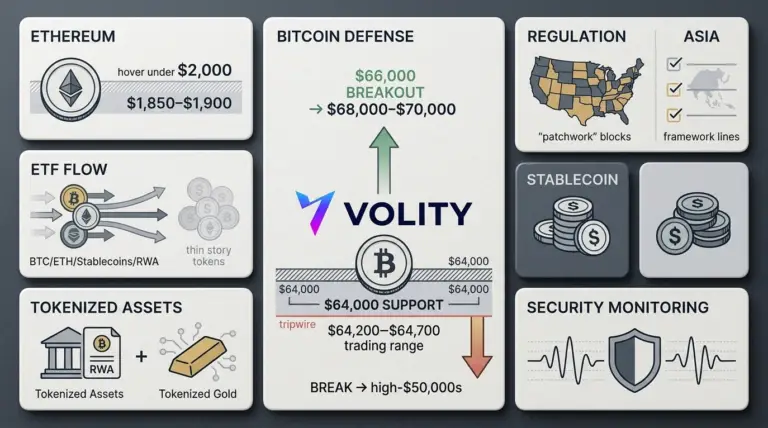
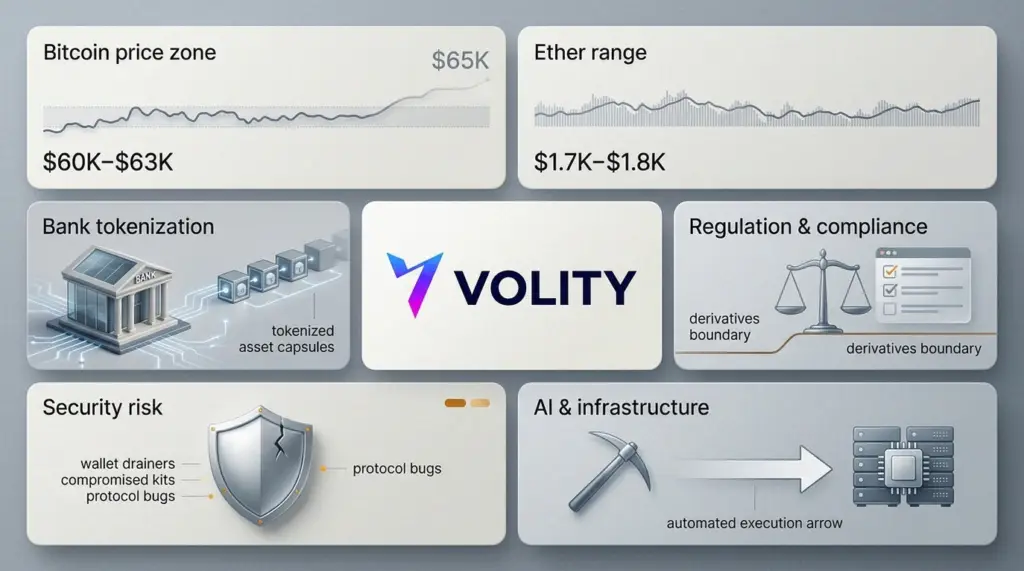
Bitcoin’s first test remains the $60,000 to $63,000 zone. Desks are treating that band as the market’s emotional floor. A clean break lower would reopen talk of ETF fatigue and summer deleveraging. However, a steady hold could invite momentum funds back toward $65,000.
Ether has recovered more quietly. It is grinding toward $1,750 after shorts reduced exposure into the latest bounce. Still, conviction looks thin. Traders are buying strength, then cutting risk quickly when rates or the dollar twitch.
Bitwise says crypto has just endured its longest losing streak since 2022. That matters because rallies now meet faster selling. Investors are not giving tokens the benefit of the doubt. Flows matter more than slogans.
By the numbers
- $60,000 to $63,000 – Bitcoin’s key near-term support zone.
- $1,700 to $1,800 – Ether’s current trading battleground.
- $500 million – Uniswap volume reported on Robinhood Chain in eight days.
- $70 million plus – Ether bridged to Robinhood Chain after launch.
- July 28 – Zcash’s planned Ironwood activation date.
Security risk returns
Security headlines are again shaping trading behaviour. Wallet drainers remain the nastiest retail problem. They hide malicious permissions inside ordinary-looking approval requests. Once users approve them, funds can vanish without a dramatic hack.
Meanwhile, a compromised Injective SDK reportedly sent wallet keys through fake telemetry. That is the kind of infrastructure failure that frightens builders, not just retail users. If a software kit leaks secrets, many projects can inherit the wound.
Zcash is also moving quickly. The privacy network plans to activate its Ironwood upgrade on July 28 after an Orchard circuit bug. Privacy tools promise elegance. However, advanced cryptography becomes unforgiving when real capital touches production code.
The Ethereum Foundation has dissolved a protocol coordination team, even as its developers explain why AI still misses subtle bugs. That pairing is awkward but useful. Automation can help review code. Still, humans remain the last defence against clever failure.
For active traders, the practical lesson is blunt. Use hardware wallets for meaningful balances. Limit token approvals. Separate experimental wallets from main holdings. In this market, operational hygiene is not housekeeping. It is risk management.
Banks move in
Traditional finance is not leaving because tokens had a bad month. In fact, the institutional plumbing keeps getting built.
Circle has secured final OCC approval for a U.S. national trust bank charter. That gives USDC a cleaner regulated wrapper for institutions that want on-chain dollar liquidity without explaining every operational detail to a risk committee.
HSBC has completed its first tokenised structured product pilot for institutional investors. The point is not that every structured note needs a blockchain. Rather, large banks are testing whether issuance, settlement and reporting can become faster and less manual.
Italy’s Intesa Sanpaolo accessed XRP through a trust structure, showing how banks usually hold crypto in practice. They do not behave like a trader with a browser wallet. Instead, they use custodians, trusts and fiduciary layers built for audit trails.
However, public-sector appetite remains limited. New Hampshire rejected a proposed $100 million Bitcoin-backed bond. In Japan, Metaplanet and JPYC are studying Bitcoin-backed credit products instead. That contrast matters. Private credit can move faster than politics.
Prediction markets collide with compliance
Prediction markets are expanding just as banks grow more nervous about them. North Carolina has passed a law that opens a path for CFTC-regulated event markets. Polymarket, meanwhile, has filed three NFA applications linked to U.S. margin trading.
The direction is clear. Event contracts want to move from grey-zone speculation into formal derivatives territory. However, Wall Street is already drawing lines around staff behaviour.
Goldman Sachs has blocked employees from trading prediction markets tied to elections and finance. Other large banks are tightening similar restrictions. Their concern is obvious. A banker trading election odds, rate decisions or deal-sensitive events creates compliance headaches fast.
DeFi firms are pushing from another angle. Hyperliquid and Phantom want CFTC rules tailored for decentralised finance. They argue that old derivatives rules do not map neatly onto automated protocols. Still, regulators rarely move at protocol speed.
For traders, this creates a strange opportunity. Event markets may become more legitimate, liquid and diverse. Yet some of the best-informed participants may face tougher internal bans.
AI enters the trading stack
The AI story is no longer separate from crypto. It now runs through miners, brokers, research desks and retail trading apps.
TeraWulf is seeking about $3.5 billion in debt financing for an Anthropic-linked AI data centre. MARA is also leaning into a Texas AI hub as its shares outperform many crypto peers. Miners are trying to sell something broader than hash rate.
Cheap power, land, cooling and grid relationships now matter to two industries. Bitcoin mining needs them. AI data centres need them even more. That overlap gives some miners a second narrative when block rewards and token prices disappoint.
On the trading side, Revolut now lets AI assistants place crypto trades on its Revolut X venue. That pushes automation closer to ordinary users. However, easier execution does not mean better judgement.
AI can scan charts, summarise filings and highlight abnormal flows. It can also amplify weak strategies at greater speed. Traders should use it as a research assistant, not as a pilot with the keys to margin.
Retail chains and token mechanics
Robinhood Chain has become one of the week’s livelier side stories. It reportedly handled about $500 million of Uniswap volume in eight days. It also attracted more than $70 million of bridged Ether after launch.
That activity came despite roughly $21 million in launch liquidity. The message is simple. Distribution still beats ideology. If users already trust an interface, they may move on-chain faster than DeFi veterans expect.
Elsewhere, DeXe led gainers with a move of about 20 percent. In a choppy tape, traders keep hunting idiosyncratic breakouts. Thin markets can reward those trades quickly. However, they can reverse just as sharply.
Japan is also inching forward. CRYL is expanding the country’s Bitcoin lending market with about $6.2 million in loans. Japan often moves slowly on crypto. But when it moves, it usually leaves a paper trail regulators can live with.
Meanwhile, traders are paying more attention to token mechanics. Fully diluted valuation, market capitalisation and bonding curves are no longer academic concepts. They increasingly decide whether a token is genuinely cheap or merely waiting for unlock pressure.
Trading implications
- Respect the range. Bitcoin needs to hold $60,000 before traders can trust a push toward $65,000.
- Watch ETF flows. Price rallies without institutional inflows may fade quickly.
- Prefer cleaner structures. BTC, ETH, regulated stablecoins and bank-tested tokenisation themes carry fewer narrative risks.
- Tighten wallet controls. Approval risk, compromised software and protocol bugs are live market risks.
- Track policy closely. CFTC rules, prediction-market approvals and stablecoin oversight can shift liquidity fast.
Crypto prices still look indecisive. However, the market itself is changing quickly. Regulation is tightening, banks are experimenting, AI is entering execution, and security failures are punishing the careless. In this tape, discipline beats swagger.
Related coverage on Volity
- How to Avoid Crypto Scams: A Beginner Safety Checklist
- How to Choose a Trading Platform: A 10-Point Checklist
- Demo vs Live Trading Account: A 7-Step Checklist Before You Go Live
- How to Size a Trade: Position Sizing and Risk Per Trade for Beginners
- Risk-Reward Ratio Explained: How to Set It and Why It Matters
- ETF vs Index Fund: The Difference and Which to Pick