Crypto market briefing: the week that could decide bitcoin, ethereum and xrp
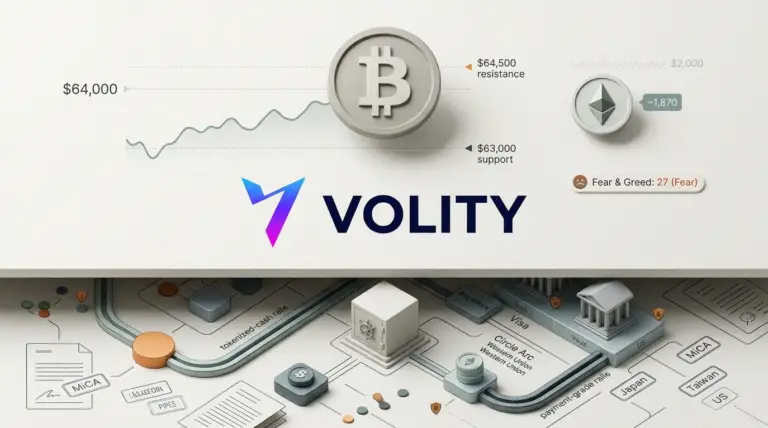
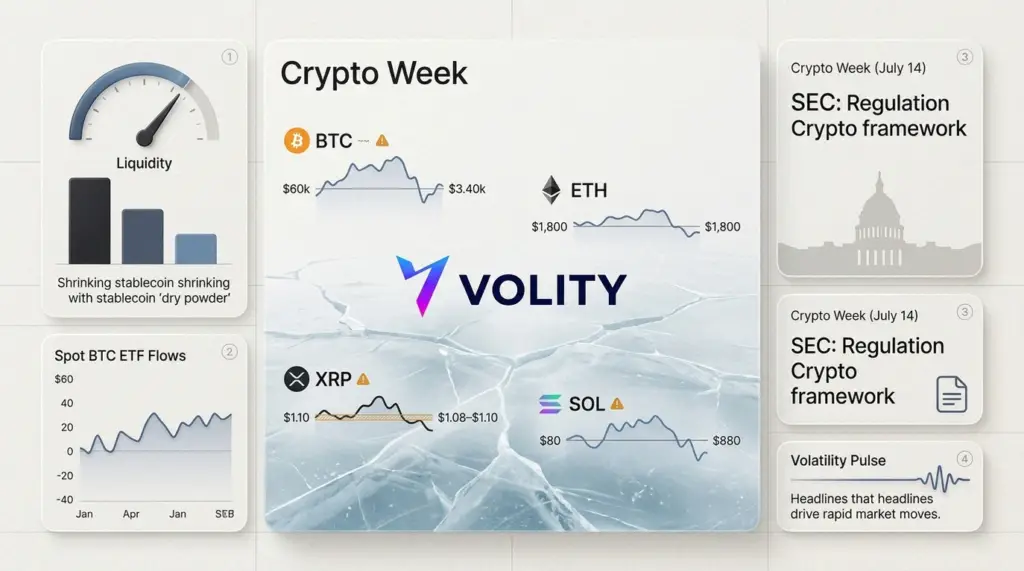
The crypto market opens the week with a thin cushion and a loud policy tape. Bitcoin is holding above the low-$60,000 area, while Ethereum has slipped under $1,800. XRP, meanwhile, is trying to stabilise near $1.10 after a sharp sell-off.
For traders, the price action is only half the story. The other half sits in Washington, where the House has labelled the stretch starting July 14 as “Crypto Week”. The SEC is also preparing a possible “Regulation Crypto” proposal, which could give some projects temporary exemptions for fundraising and development.
That combination makes this week awkward. A soft chart can turn quickly on policy relief. However, a promising regulatory headline can also fade if ETF flows weaken again.
Liquidity is the first problem
The market’s weakest point is liquidity. Stablecoin supply has contracted by roughly $10 billion, which matters more than many price charts. Stablecoins often act as crypto’s dry powder. When they shrink, traders usually have less cash ready for dip-buying.
Bitcoin remains the market’s anchor, but the bullish case looks more conditional than confident. Buyers have defended the low-$60,000 zone several times. Even so, rallies have looked laboured whenever macro risk rises or ETF inflows cool.
Recently, spot Bitcoin ETF flows returned to positive territory after a shaky patch. That helped BTC hold above $62,000 during a run of Middle East headlines. However, the reaction also showed how jumpy positioning has become. A single macro headline can now trigger a fast move in both directions.
There is another technical wrinkle. Bitcoin is trading near a long-term support band watched by many trend traders. Therefore, this area may attract patient buyers. Yet it also needs a catalyst, not just a line on a chart.
XRP is again the market’s most politically charged large token. The price has fallen toward $1.08, then hovered around $1.09 to $1.10. That range now matters because it separates a possible base from another breakdown.
The token’s story is unusually tied to courts, institutions and identity. Ripple’s earlier legal victory against the SEC turned XRP into a symbol for investors who think regulation has restrained the industry. This week, that symbolism may matter again as Congress debates crypto market structure.
Still, traders should separate the legal narrative from the order book. Whale demand has cooled, and ETF-related sentiment has not brought sustained buying. As a result, XRP needs more than anniversary posts and policy optimism.
Ripple is also pushing beyond litigation. The company backs a UK tokenisation plan that its supporters say could add £33 billion a year. Meanwhile, Evernorth is expanding in Japan as its $1 billion XRP treasury plan moves ahead.
That gives XRP a broader institutional angle. However, usage and valuation do not always move together. Traders have seen that lesson often enough in crypto, usually at inconvenient moments.
Ethereum waits for proof
Ethereum has slipped below $1,800, putting pressure on a market that expected better from the second-largest token. Bulls still point to a possible recovery toward $2,140 if support holds. Yet the chart now requires proof rather than promise.
The Ethereum debate remains familiar. Supporters argue that Wall Street will eventually use Ethereum rails for tokenised funds, settlement and stablecoin activity. Critics counter that competing chains offer cheaper transactions and simpler user experiences.
Meanwhile, institutional interest has not produced a clean price breakout. That matters because ETH often needs a narrative strong enough to pull capital from Bitcoin. At present, Bitcoin still gets first call on most conservative crypto allocations.
Tom Lee has argued that Ethereum may be ready to outperform Bitcoin and connect Wall Street with crypto. That view will get attention. However, traders will likely demand stronger volume before treating it as a signal.
Solana tries to reset
Solana is also working through a technical reset. SOL has formed a falling wedge pattern, a setup traders often watch for reversals. The $80 level now acts as a psychological marker.
A clean reclaim of $80 would improve sentiment quickly. However, failed breaks at round numbers can punish late buyers. That makes volume and follow-through more important than the first green candle.
On the business side, Solana continues to attract payments and stablecoin interest. Japan’s SBI has partnered with the network on stablecoins, real-world assets and payments. Therefore, the asset remains on institutional watch lists even while its chart looks unsettled.
Regulation moves to the front page
Regulation no longer sits in the background. The House’s “Crypto Week” brings market structure, stablecoins and disclosures back into the centre of trading desks. Coinbase is also pressing lawmakers as the CLARITY Act vote approaches.
At the same time, Senate Democrats are renewing pressure for hearings into Donald Trump’s crypto holdings. That adds a political edge to an already crowded week. Traders may prefer clean rules, but they rarely get clean politics.
Outside the United States, regulators are acting with increasing speed. Thailand is targeting high-value USDT trades in a grey-capital crackdown. The Bank of Thailand is probing stablecoin transactions. China is proposing a legal framework for virtual-currency money-laundering cases.
Turkey has gone further, charging 504 suspects in a crypto-linked $1 billion money-laundering case. Those actions point in the same direction. Stablecoins have become too large, useful and mobile for regulators to ignore.
Institutions keep building
The institutional story has not disappeared. It has simply moved away from the old retail boom template. Webull has gained MiCAR approval to launch crypto services across Europe. Circle has deepened its push into South Korea’s financial sector.
Meanwhile, SBI plans a lending service for its JPYSC stablecoin with a proposed 3 percent yield. That type of product may sound dull beside meme-token rallies. Still, dull products often pull in serious money.
Tokenisation is also becoming more concrete. BlackRock’s BUIDL fund has reached about $900 million on Avalanche. Progmat has moved ¥452 billion in tokenised securities to the same network. Ripple is pushing similar themes in the UK and Japan.
For investors, that changes the map. Crypto is no longer only a market for coins. It is also a contest over custody, settlement, compliance, yield and rails.
By the numbers
- Low-$60,000s: Bitcoin’s key defence zone heading into the week.
- Below $1,800: Ethereum’s uncomfortable starting point.
- $1.08 to $1.10: XRP’s immediate support band.
- $80: Solana’s near-term psychological hurdle.
- $10 billion: Estimated contraction in stablecoin liquidity.
Key takeaways
- Bitcoin: ETF flows matter as much as chart support this week.
- Ethereum: Bulls need volume before the $2,140 target looks credible.
- XRP: The legal story helps sentiment, but support must hold first.
- Solana: A real break above $80 needs follow-through, not just noise.
- Policy: SEC and House headlines could move prices faster than technicals.
The cleanest read is that crypto has stopped trading as one block, yet still reacts as one story. Liquidity is thinner, regulation is louder, and traders are watching three clocks at once: ETF flows, Washington and support levels.
Related coverage on Volity
- How to Avoid Crypto Scams: A Beginner Safety Checklist
- How to Choose a Trading Platform: A 10-Point Checklist
- Demo vs Live Trading Account: A 7-Step Checklist Before You Go Live
- How to Size a Trade: Position Sizing and Risk Per Trade for Beginners
- Risk-Reward Ratio Explained: How to Set It and Why It Matters
- ETF vs Index Fund: The Difference and Which to Pick