Investing in financial products involves risk. Losses may exceed the value of your original investment.
Crypto bithumb bitcoin is a core topic for traders in 2026. The complete guide follows.
Crypto digest: regulators bare their teeth, whales circle, Solana coils under $100
Seoul just told the crypto market it has finished asking politely. Meanwhile, traders keep buying dips in Bitcoin near $71,000. However, altcoins still depend on one thing: whether liquidity holds when regulators tighten the screws.
South Korea makes an example of Bithumb
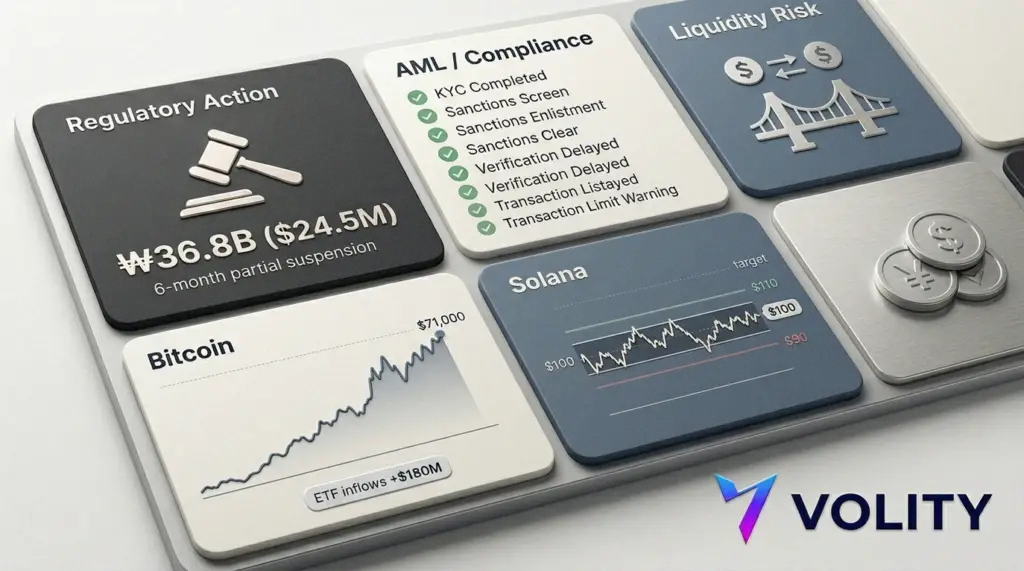
South Korea’s Financial Intelligence Unit, housed under the Financial Services Commission, hit Bithumb with a record 36.8bn won fine, about $24.5m. It also imposed a six-month partial business suspension for broad failures in anti-money laundering controls.
Regulators said they identified about 6.65m individual breaches tied to customer checks, transaction monitoring and recordkeeping. Meanwhile, they flagged 45,772 crypto transfers linked to 18 unregistered overseas VASPs. They also accused the exchange of ignoring repeat warnings to stop servicing unregistered venues.
The key sanction runs from 27 March to 26 September. During that window, Bithumb cannot process external crypto transfers for new users. However, existing clients can continue trading and withdrawing cryptoassets. New users, therefore, face a walled garden: buy, sell and use the local Korean on-ramp.
This is not a local slap on the wrist. Instead, it reads like a regional stress test for every compliance department in Asia. The fine is the largest in South Korea’s crypto exchange history, edging last year’s Upbit case at 35.2bn won with shorter restrictions.
There is also an operational-risk footnote that will bother any institution scouting counterparties. Bithumb has faced separate scrutiny after an internal error credited clients with a phantom 620,000 BTC. Even if no money left the building, the episode raises ugly questions about controls.
A regulatory wave from Seoul to Canberra and Washington
Bithumb fits into a wider pattern, as policymakers stitch crypto into mainstream financial rulebooks.
- Australia: a Senate committee is pushing a framework that would treat crypto platforms more like traditional financial service firms, with clearer requirements around custody, client protection and capital.
- United States: Treasury and the State Department sanctioned a network tied to North Korea that allegedly used remote IT work and crypto laundering routes, tightening the link between geopolitics and compliance.
- Binance: US senators continue to press the Justice Department inquiry around potential Iran-sanctions evasion, which keeps a risk premium attached to the venue.
For investors, the message is blunt. Regulatory risk is no longer theoretical. It shows up as bans, fines and sudden changes to flows and liquidity.
Bitcoin: ETF money and whale appetite, with the Fed in the background
Bitcoin traded above $73,000 over the weekend, with macro headlines and on-chain behaviour tugging in the same direction. Oil rose amid an Iran-linked flare-up, while rate expectations leaned slightly friendlier. Risk appetite returned.
Under the surface, the market still looks like it is being financed through familiar pipes.
- US spot Bitcoin ETFs posted about $180m in net inflows in one session, keeping the institutional bid alive even as spot stalls near resistance.
- Large wallets kept accumulating around $71,000, turning that zone into a live “defend it or lose it” level.
- Crypto funds took in $1.06bn for a third straight week, with Bitcoin taking the bulk as the market’s default macro proxy.
The near-term question sits with the Federal Reserve. Traders are split on whether BTC reclaims $75,000 before the decision, or only after a relief rally.
Solana: the $100 line and a hunt for liquidity
Solana traded near $94 and kept tightening into what technicians call a rising triangle. Meanwhile, price action stayed inside a rising channel, which often signals continuation when sentiment holds.
- Higher lows keep pressing price towards the top of the channel, which increases the odds of a sharp move.
- The 20-day SMA is close to crossing above the 50-day, a setup many trend traders treat as a green light.
- RSI has turned up from neutral, which suggests momentum is rebuilding rather than fading.
Two levels matter for the short-term tape. If SOL clears $100 with conviction, traders will likely eye $110 next, around the 100-day average. However, a breakdown below $90 would damage the structure and brings $80 back into view.
Ethereum: institutions lean into staking as a story
Ethereum has its own institutional narrative, built around yield. A staking-focused ETH ETF tied to BlackRock’s ecosystem launched to strong early reviews, which strengthens the pitch of ETH as an income-bearing asset.
Price moved above $2,000 as derivatives activity picked up. Open interest has pushed beyond $30bn, which implies more leverage in the system. Meanwhile, the Ethereum Foundation sold about 5,000 ETH into strength, a minor cooling signal that does not yet break trend.
It also published a clearer mandate emphasising censorship resistance and privacy. Ethereum’s political posture is sharpening just as regulation spreads.
Retail finds its adrenaline again
While institutions buy through ETFs, retail is taking the scenic route.
- Robinhood reported crypto volumes rising to $25bn, even as equities and options activity cooled.
- Polymarket and Kalshi have leaned into ultra-short crypto bets, including five-minute contracts that trade volatility more than any asset.
- The memecoin TRUMP jumped 52% after a holder leaderboard was tied to a lunch invitation at Mar-a-Lago, a reminder that politics can still move on-chain prices fast.
By the numbers
- Bithumb fine: 36.8bn won and a six-month partial suspension
- AML breaches cited: about 6.65m
- Transfers linked to unregistered VASPs: 45,772 across 18 entities
- Spot Bitcoin ETF net inflow: about $180m in one session
- SOL levels in focus: $100 upside trigger, $90 downside line
Key takeaways
- Exchange risk is back in the foreground, so venue selection now matters as much as token selection.
- Bitcoin’s dip-buying near $71,000 looks organised, yet the Fed can still reset positioning quickly.
- SOL remains a clean technical trade, but only if $90 to $94 holds as a base.
- ETH’s “yield plus policy” narrative attracts institutions, although rising open interest raises liquidation risk.
- Retail speculation is accelerating again, which can boost upside but also sharpens drawdowns.
Regulators are raising the price of doing business. Meanwhile, ETFs keep feeding the bid, whales keep lurking below the market, and Solana keeps coiling under $100. This is a tape where you must read both charts and rulebooks.
For more on this topic see our deep-dives on XRP, Bitcoin and Blockchain in Healthcare: Crypto Investment Trends, European Banks and Stablecoins: What MiCA-Era Crypto Means for BTC, and Bitcoin, Solana and AI Tokens: How Crypto Narratives Shift the Tape.
For more on this topic see our deep-dives on Tron USDT Supply Soars: Stablecoin Volume and Counterparty Risks Explained, Crypto Whales Pivot to PayFi: Pepe vs Remittix and the Memecoin Shift, and Cryptocurrency Market News: Bitcoin, Ethereum and Stablecoin Trends.
What our analysts watch: Three reads convert the regulatory enforcement tape into a position thesis rather than a headline reaction. Compliance-cost-of-execution differential (the Bithumb fine and the wider Asia-Pacific enforcement cycle raise the marginal compliance cost for venues that fail the AML and VASP-counterparty checks; the constructive read is that compliant U.S.-licensed and CySEC-supervised venues gain margin advantage as the offshore cost gap widens).
Whale accumulation pattern at 71,000 dollar BTC support (large wallets continuing to buy at the technical defence level confirms the structural bid even through the regulatory tape, which is the diagnostic that the institutional positioning thesis remains intact). Solana coiling pattern under 100 dollars (the speculative-tier proxy compressing into the resistance level while the regulatory tape runs is the structural test of whether the altcoin majors break with the regulatory backdrop or absorb it; a clean break above 100 dollars on volume is the thesis-confirmation signal).
The FATF virtual asset guidance documents the international compliance framework that anchors the cross-jurisdictional read, the CoinDesk regulatory coverage tracks the live enforcement cycle, and the UK FCA cryptoassets AML regime covers the parallel UK supervisory posture. Volity offers BTC, ETH, and major altcoin CFD execution under CySEC oversight via UBK Markets (licence 186/12), with entities in Saint Lucia and Cyprus.
Frequently asked questions
What does the Bithumb six-month partial suspension actually restrict for users?
It restricts new-user external crypto transfers between 27 March and 26 September, which means new users cannot deposit or withdraw cryptoassets to external wallets during the window; existing clients retain trading and withdrawal capacity. The structural effect is that Bithumb cannot onboard new users into the global crypto economy during the suspension window, which compresses the venue customer-acquisition pipeline. The competitive read is that South Korean retail flow rotates to compliant peers (Upbit, Coinone, Korbit) for the duration of the window, with the marginal user permanently captured by the peer that absorbs the flow.
How does the Bithumb 620,000 BTC phantom credit incident affect institutional counterparty risk?
It affects the institutional counterparty risk meaningfully even though no money left the building. The internal control failure that allowed the phantom credit signals operational-risk infrastructure that institutional desks treat as a counterparty disqualifier, regardless of whether the specific incident produced a loss. The structural read is that institutional flow that previously could touch Bithumb at the margin now routes around the venue entirely, which compounds the regulatory penalty with a structural revenue impact that lasts beyond the six-month suspension window.
Should the Australian Senate framework be read as additive or substitutive to existing rules?
It should be read as additive in posture and substitutive in implementation. The framework treats crypto platforms more like traditional financial service firms (additive in the sense that it raises the compliance bar and broadens the supervisory perimeter) but it also replaces the prior fragmented rule set with a unified regime (substitutive in the sense that compliant venues file one structured framework rather than navigate cross-agency overlap). The structural read is that the Australian regime converges toward the EU MiCA model, which compresses the cross-jurisdictional compliance-cost differential and favours venues that can operate at the higher unified standard.
What does the third consecutive week of 1.06 billion dollar crypto fund inflows reveal during the regulatory cycle?
It reveals that the institutional bid is structurally indifferent to the regulatory enforcement tape, which is the most important diagnostic the cycle has produced. The historical pattern is that regulatory enforcement compresses retail flow first and institutional flow second; the persistence of 1 billion-plus weekly inflows during the active enforcement cycle indicates that the institutional allocator base treats the enforcement as competitor-eliminating rather than category-threatening. The structural read is that the institutional thesis has matured beyond the regulatory-overhang stage that defined the 2022 to 2023 cycle, which is the foundation for the next leg of the structural rally.
Related guides
- Bitcoin explained
- Cryptocurrency trading
- Crypto trading platforms
- Best crypto investments
- Risk management
Volity operates a trading platform and also publishes educational and analytical content about trading. The content on this page is for educational purposes only and should not be considered financial advice. Volity may benefit commercially when readers open trading accounts through links on this site.
Our content is produced and reviewed under documented editorial standards; see our comparison and review methodology.