GER40 is a CFD ticker for Germany’s benchmark stock index, the DAX. GER40 and DAX track the identical 40 companies, and the name differs only because DAX is a registered trademark. Trade the GER40 and you are trading the same German blue-chip index under a generic label. This page sticks to the ticker itself. If you want the deeper dive into the index, its weighting method and full constituent list, that sits in our companion Germany 40 explainer.
What is the GER40 index?
The GER40 index is the German blue-chip benchmark, better known by its official name, the DAX. It measures the 40 largest companies listed on the Frankfurt Stock Exchange and traded on the Xetra electronic market. Deutsche Börse owns the index and STOXX calculates it. The DAX launched in 1988 with a base value of 1,000, and it grew from 30 members to 40 in September 2021, which is where the “40” in GER40 comes from.
One feature sets the DAX apart from most national indices. The headline version is a total-return index, so it reinvests company dividends back into the calculation. Benchmarks like France’s CAC 40 and the UK’s FTSE 100 quote a price-return figure that leaves dividends out. That is why the DAX tends to look stronger over long periods: it is measuring something slightly different. A separate price-only version, the DAX Kursindex, also exists for anyone who wants the like-for-like comparison.
Why does the DAX have two ticker names?
The short answer is trademark licensing. “DAX” is a registered trademark of Deutsche Börse. A trading provider that licenses the name can display the instrument as “DAX.” One that does not license it reaches for a generic label instead, and GER40 is the most common of those. The underlying data, the constituents and the index value stay identical either way. GER40 is the same German market as the DAX, just written without the trademarked word, so nobody is handing you a cheaper or watered-down version of the index.
This naming pattern repeats across the market. You will see the UK benchmark shown as UK100 rather than the trademarked FTSE 100 name, and France’s index shown as FRA40 instead of CAC 40. Once you know the rule the tickers stop being confusing: a number attached to a country almost always points to that country’s flagship index.
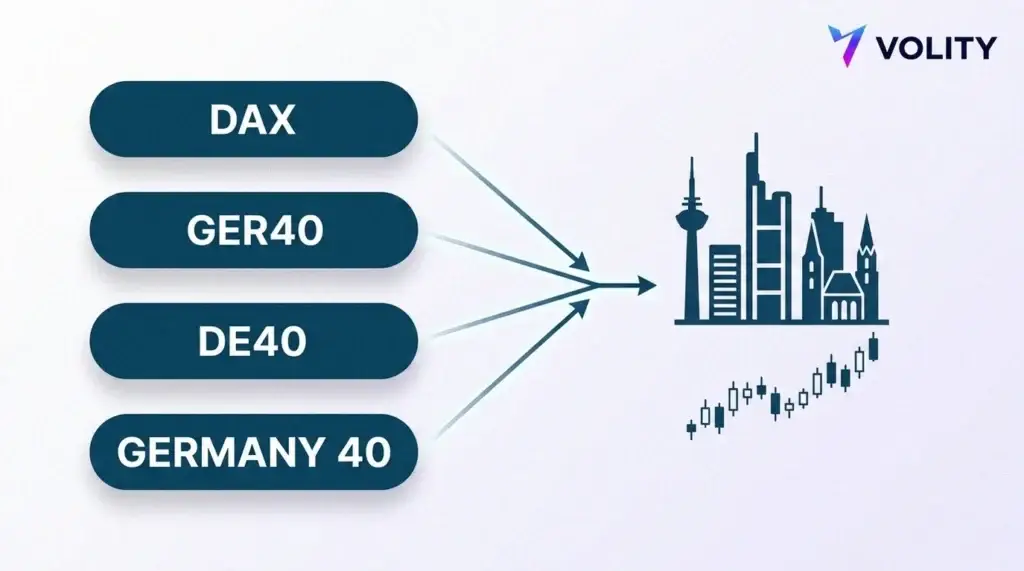
GER40, DE40, DAX and Germany 40: are they all the same?
Yes. Every one of these labels resolves to the same 40-company German index. The table below maps the aliases you are most likely to meet across platforms and data feeds. The one that trips people up is the price-feed symbol .GDAXI, which is how data houses such as Reuters quote the index rather than a broker’s tradable ticker.
| Label | Where you see it | What it refers to |
| DAX | Deutsche Börse, licensed platforms, news | The official index name |
| GER40 | Many CFD platforms | The same index, generic ticker |
| DE40 | Some CFD platforms | The same index, DE is the country code for Germany |
| Germany 40 | Platforms and headlines | The same index, written in full |
| .GDAXI / ^GDAXI | Data providers and financial sites | The DAX price feed symbol |
Where do you find GER40 on TradingView?
On TradingView the German 40 appears under more than one symbol, because the platform pulls data from several providers. Search “GER40” and you may see it listed by a specific broker feed. Search “DAX,” “DE40” or “DEU40” and you will find versions tied to Deutsche Börse or other data partners. The official cash index usually shows as XETR:DAX or under the symbol DEU40, while broker CFD feeds carry names like GER40. The chart shape is the same, and only the last price and the spread can differ slightly between a cash-index feed and a CFD feed.
A practical tip when you set up a GER40 TradingView chart: check the exchange or data source printed next to the symbol. A cash-index source reflects the underlying market during Xetra hours, whereas a CFD source may quote for longer and include the provider’s spread. Either works for learning price structure. If you want the chart to match what you actually trade, chart the feed that lines up with your account.
How do you trade the GER40 as a CFD?
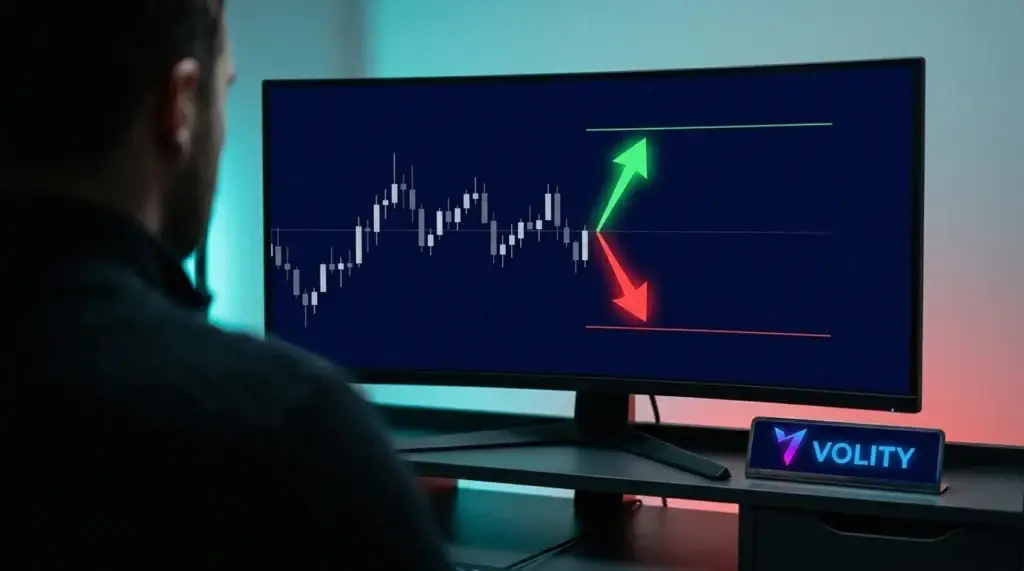
Trading the GER40 as a contract for difference means you speculate on the index level without owning any of the 40 shares. You open a position that gains or loses value as the index moves, and a single trade gives you exposure to the whole German blue-chip market at once. You can go long if you expect the index to rise or short if you expect it to fall. Opening a Volity account costs nothing, you can rehearse on a demo, and you can start trading from $1. Here is the sequence.
- Open and verify a Volity account, then fund it or stay on a demo to practise first.
- Find the German 40 instrument, listed as GER40 or DE40 depending on the view.
- Choose your direction and size the position from the risk you are willing to take rather than the maximum the platform allows.
- Attach a stop-loss and a take-profit before you commit, so the trade has defined boundaries.
- Manage the position through the session and record the result for review.
Index CFDs are leveraged, so a small deposit controls a larger position. Volity offers leverage of up to 1:500 on some products, applied on a product-by-product basis, and index instruments carry their own margin rates. Leverage amplifies gains and losses in equal measure, which is why position sizing matters more than the headline ratio. The exact margin and overnight financing for the GER40 are set out on the charges and fees page.
A quick example shows how the numbers behave. Say the GER40 is quoted at 18,000 and you expect it to rise, so you open a long position sized so each index point is worth one unit of your account currency. If the index climbs to 18,150, that 150-point gain is worth 150 units. If instead it slips to 17,880, you lose 120 units. The point value works the same in both directions, so your real risk comes down to how big you size the trade far more than the headline leverage figure. Set the size so a normal adverse move is a loss you can absorb, and the leverage looks after itself.
What moves the GER40?
The GER40 is a barometer for Europe’s largest economy and for global industry. European Central Bank policy and the direction of the euro feed straight into it, and German and euro-area data, from manufacturing surveys to inflation prints, move it on release. Because the index is heavy with exporters, carmakers and industrial names such as SAP, Siemens, Allianz, Airbus and Mercedes-Benz, it reacts to global trade, supply chains and the health of China as an export destination. When world markets turn risk-off, the GER40 often travels further than steadier benchmarks, which is where a lot of its appeal to active traders comes from, and a lot of its risk.
When can you trade the GER40?
The underlying cash market runs on Xetra from 09:00 to 17:30 CET, which is 08:00 to 16:30 UK time. Most GER40 CFD feeds quote for a longer window, roughly 08:00 to 22:00 CET, so you can trade around the German open and into the afternoon overlap with the wider market, though liquidity is thinnest outside core hours. When you are ready to act on any of this, you can trade the German 40 alongside global indices, forex and commodities on the Volity indices platform.
Related guides
Frequently asked questions
Is GER40 the same as the DAX?
Yes. GER40 and DAX are two names for one index, the benchmark of the 40 largest companies on the Frankfurt Stock Exchange. GER40 is a generic ticker used by providers that do not license the trademarked DAX name. The constituents, the index value and the chart are identical.
Is GER40 the same as DE40 and Germany 40?
Yes. GER40, DE40 and Germany 40 all point to the same German index. DE40 uses Germany’s country code, GER40 uses the country abbreviation, and Germany 40 spells it out. They are labelling choices, not different products.
What is the GER40 called on TradingView?
On TradingView the German 40 appears under symbols such as DEU40, DE40, GER40 or XETR:DAX, depending on the data provider. A cash-index feed reflects the Xetra market during German hours, while a CFD feed may quote for longer and include the provider’s spread. The chart shape matches across feeds.
Can I trade the GER40 on Volity?
Yes. Volity offers GER40 as an index CFD alongside other global benchmarks, so you can go long or short on Germany’s blue-chip market from one account. Index CFDs are leveraged and carry risk, so start on a demo, size positions from your risk tolerance, and check margin on the charges and fees page.