Crypto market tests traders with whales buying and regulators circling
Crypto is trading like a market waiting for permission to move. Bitcoin sits in the low $60,000s, Ethereum remains below $2,000, and traders keep staring at the same narrow price bands.
Yet beneath that quiet tape, the market is anything but dull. Whales are buying, ETF investors are wavering, prediction markets look calm, and regulators are sharpening pencils on both sides of the Pacific.
Prices stall, but do not break
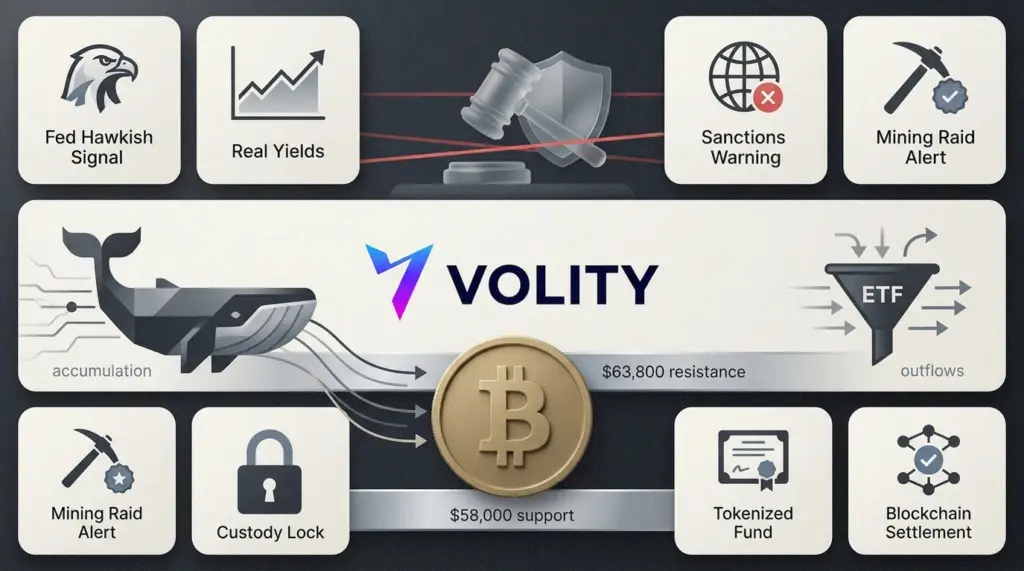
Bitcoin has spent recent sessions grinding between roughly $58,000 support and $63,800 resistance. So far, sellers have failed to force a clean breakdown.
However, buyers have also failed to reclaim momentum. That leaves BTC in an untidy middle, where both bulls and bears can sound convincing.
Ethereum looks weaker on the surface. ETH trades in the mid-$1,700s, with $2,000 acting less like a target and more like a ceiling.
Meanwhile, XRP sits near $1.10 after modest weekly gains. Fresh activity on the XRP Ledger has kept the token in play.
The broader crypto market still holds above $2 trillion in value. Even so, the mood feels cautious, not celebratory.
Bitcoin traders see calm, desks see risk
Prediction markets are sending one clear message: no crash yet. One major crypto market priced a 99.8% chance that Bitcoin finishes above $54,000 at the July 30 resolution.
That price leaves only a sliver for an abrupt flush. Still, prediction markets measure crowd confidence, not gravity.
Risk desks remain more guarded. A hawkish Federal Reserve, real yields, and spot ETF withdrawals still matter for Bitcoin’s next leg.
Additionally, long-term holders have started to show strain. When patient wallets realise losses, market confidence can wobble quickly.
Whales, however, have taken the other side. Large wallets reportedly absorbed about 270,000 BTC near recent lows, worth roughly $16.7 billion.
At the same time, spot Bitcoin ETFs have seen about $7 billion in outflows. That makes the trade wonderfully uncomfortable.
Either whales are quietly building the next floor, or they are providing liquidity to nervous institutional sellers. Traders should care which side wins.
By the numbers
- $58,000-$60,000 – Bitcoin’s near-term support zone.
- $63,800 – The level bulls need to reclaim convincingly.
- $54,000 – The prediction-market threshold watched into July 30.
- 270,000 BTC – Reported whale accumulation near recent lows.
- $7 billion – Approximate spot ETF outflows during the same stress period.
Regulators keep the pressure on
Washington remains a large, unpriced variable. Odds of a quick Digital Asset Market CLARITY Act passage have slipped to about 27% after a Senate delay.
Therefore, the Securities and Exchange Commission may not wait politely. If Congress stalls, regulators can still move through rule-making and enforcement.
The fight has also become more political. Patrick Witt has pushed back against 134 bank leaders criticising the CLARITY Act.
He framed their opposition as protection for incumbents. Banks, meanwhile, argue that consumer risk remains too high without stricter guardrails.
Law-enforcement headlines add weight to that view. The United States has sanctioned an Iranian maritime firm over Bitcoin-denominated payments.
In Malaysia, police arrested two people and seized 73 mining rigs in an alleged power-theft case.
Separately, Chinese media have warned companies about Bitcoin extortion scams. Attackers demand BTC, then threaten reputational damage if firms refuse.
Even Telegram has entered the regulatory weather system. An Australian lawsuit accuses the platform of leaving terrorist content online.
For investors, these cases are not background noise. They shape the extra return institutions demand before buying crypto size.
Tokenisation keeps moving
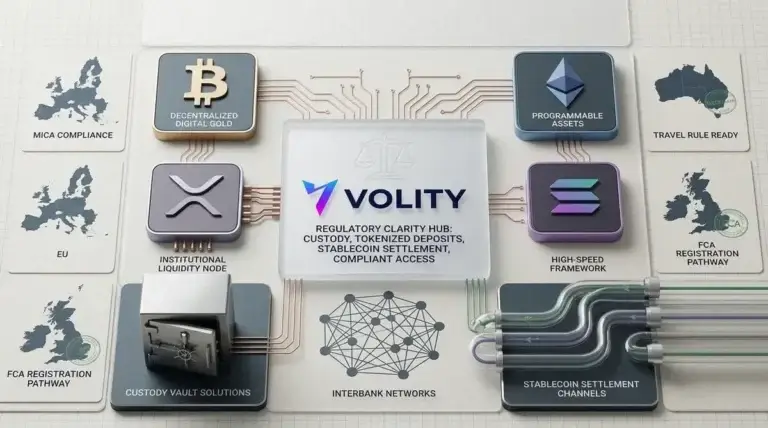
Despite the policy fog, traditional finance continues to test blockchain plumbing. This is the quiet part of the story.
The Bank of Korea is piloting tokenised reserve transfers through BIS Project Agora. The trial focuses on wholesale settlement and cross-border efficiency.
Meanwhile, Samsung SDS plans stablecoin infrastructure with Dunamu. That pairing connects Korean enterprise technology with one of the country’s largest crypto players.
Capital markets are also edging forward. Aviva Investors has launched its first tokenised fund on the XRP Ledger.
BNY is adding blockchain recordkeeping to institutional fund services. That may sound dull, but dull pipes often move the most money.
Tokenisation is no longer just conference theatre. It is becoming the back office experiment nobody wants to miss.
DeFi grows more selective
Aave is moving to wind down operations on six chains as part of a roughly $98 million clean-up.
That decision says something important. After years of “launch everywhere” expansion, serious protocols now want less sprawl and deeper liquidity.
For yield traders, the change forces choices. Bridging strategies, collateral placement, and chain exposure all need another look.
Security also remains painfully practical. Ostium blamed an off-chain breach for a $23.75 million USDC exploit, not a smart-contract failure.
That distinction matters. Traders love code audits, but weak key management can still empty a vault.
Meanwhile, BitGo has introduced four quantum-resistant controls for Bitcoin wallets. The risk is distant, but custody firms prefer early rehearsals.
Privacy projects are also pushing ahead. Canopy and Fhenix are building systems that make private on-chain activity the default.
That goal fits a growing institutional demand: disclose enough for compliance, but not every trading intention to the world.
Retail platforms chase event trading
Retail crypto is also changing shape. Luno has cut about 20% of staff as tougher funding and compliance conditions bite.
However, Robinhood reported a $1.31 billion quarter helped by prediction-market expansion. Retail traders are embracing event bets alongside stocks, options, and crypto.
Binance.US is reportedly pursuing a CFTC licence to offer prediction markets. That suggests exchanges now see event contracts as a core product.
In Hong Kong, the SFC froze HK$125 million of client assets connected to Futu. Local reports say Futu itself is not under investigation.
That nuance matters. Markets often sell first on regulatory headlines, then read the fine print later.
OpenSea also continues its post-boom reshuffle. Chief marketing officer Adam Hollander has stepped down after 18 months.
The American Arbitration Association has created a Web3 panel. Crypto disputes are slowly moving from Discord arguments to formal arbitration rooms.
Altcoins find their own stories
Outside Bitcoin and Ethereum, story-driven trades still work. Pi Network rose about 7% after its Protocol 26 upgrade.
Uniswap’s UNI token reclaimed the $4 level after an 8% move. Renewed chatter around governance and fees helped the bid.
In Japan, a game developer is expanding its crypto push through a partnership with SBI. The focus appears less speculative than earlier play-to-earn experiments.
Instead, the aim is to tuck Web3 features into mainstream games. That slow route may prove sturdier than another token launch.
Key takeaways
- Respect the range. Bitcoin needs a decisive break beyond $58,000-$63,800 before direction looks clean.
- Watch ETF flows. Stabilising outflows would support the whale-accumulation case.
- Track the Fed. Softer language could lift risk assets, while hawkish tones may hit crypto first.
- Treat prediction markets as sentiment. They show consensus, not certainty.
- Do not ignore custody risk. Off-chain failures can hurt as much as broken code.
Crypto is not waiting for one headline. It is balancing price fatigue, regulatory impatience, and real institutional build-out. For traders, the edge sits in that overlap.
Related coverage on Volity
- How to Avoid Crypto Scams: A Beginner Safety Checklist
- How to Choose a Trading Platform: A 10-Point Checklist
- Demo vs Live Trading Account: A 7-Step Checklist Before You Go Live
- How to Size a Trade: Position Sizing and Risk Per Trade for Beginners
- Risk-Reward Ratio Explained: How to Set It and Why It Matters
- ETF vs Index Fund: The Difference and Which to Pick