Crypto morning: yields roar, tokens regroup, and a 14-day clock starts ticking
Government bonds are rattling markets again, yet Bitcoin has not buckled. Meanwhile, tokenised securities are pulling public equities deeper into crypto’s settlement rails.
Washington adds another moving part. A September procedural vote could decide whether US crypto legislation advances this year.
Bond pain meets Bitcoin’s staying power
UK government borrowing costs opened at levels that would have looked extraordinary only a few years ago. The 10-year gilt yield sits near 5.27%, its highest level in roughly 18 years.
Meanwhile, the 30-year gilt yield hovers around 5.9%, near levels last seen during the late 1990s. Those moves matter well beyond Britain’s borders.
Higher sovereign yields lift discount rates across equities, property, private credit and venture capital. Therefore, risk assets must offer investors more return simply to stand still.
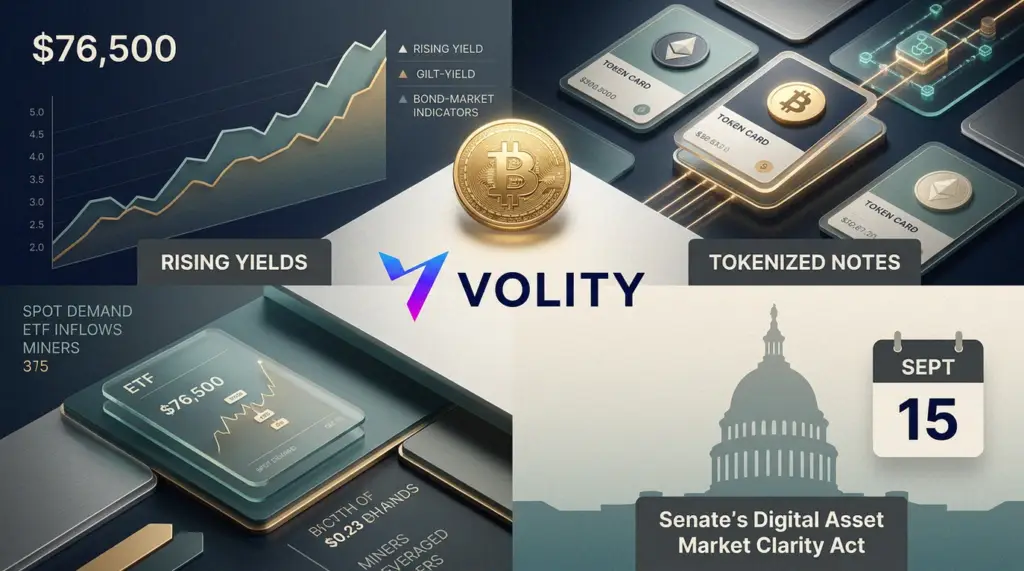
Bitcoin, however, remains notably resilient. It traded near $76,500, down modestly on the day but well above its pre-rally range.
The token recently traded above $81,000. Even so, Bitcoin has not escaped the broader argument over tightening financial conditions.
Spot buying and exchange-traded fund demand appear to have cushioned recent weakness. Yet a sustained bond sell-off could still force leveraged investors to reduce exposure.
For now, the market sends two conflicting messages. Bonds warn that capital is becoming expensive, while Bitcoin suggests buyers still see scarcity value.
Tokenised notes put Bitcoin treasury stocks on crypto rails
Bitfinex Securities has listed five tokenised notes linked to Bitcoin-treasury companies. The underlying names include Strategy, Metaplanet, H100 Group and Capital B.
Another note tracks the economic rights attached to Strategy’s variable-rate perpetual preferred stock, STRC. Consequently, investors can target a particular layer of Strategy’s complicated capital structure.
These products are not direct shares in the operating companies. Instead, they are securitised notes backed by shares held through regulated custodians.
The notes use compartments within a Luxembourg umbrella fund structure. They trade on the Liquid Network, a Bitcoin sidechain designed for asset issuance and fast settlement.
Eligible non-US investors can trade using dollars, USDT or Bitcoin. Bitfinex says tokenised assets on its venue now exceed $500 million.
That figure remains small beside global equity markets. However, the product design points towards a more tightly connected crypto capital market.
Bitcoin holders can now gain exposure to companies that borrow, issue shares, or sell preferred stock to buy more Bitcoin. In effect, the structure can amplify Bitcoin’s own price cycle.
A rally in Bitcoin may lift treasury-company shares and these tokenised notes together. Conversely, a sharp sell-off could expose how little diversification the wrapper actually provides.
Washington faces a narrow legislative window
The Digital Asset Market Clarity Act now faces a high-stakes September. The Senate returns from recess on September 14, leaving a narrow working window.
A cloture vote on the motion to proceed is scheduled for 2:15 p.m. Eastern time on September 15. Crucially, supporters need 60 votes to begin formal floor debate.
That vote would not make the bill law. Nevertheless, defeat would likely end its prospects for 2026.
Prediction markets have grown markedly less optimistic. Contracts recently put the chance of enactment this year in the mid-teens to about 20%.
Those odds once exceeded 80% earlier this year. Therefore, traders increasingly treat comprehensive legislation as an upside surprise rather than a base case.
Even a successful procedural vote starts a longer race. Senators would still need to resolve amendments, pass final legislation and reconcile it with the House measure.
The bill would then require a presidential signature before December 31. Midterm politics will make every remaining legislative day more expensive.
Failure would preserve the current patchwork. The SEC, CFTC, Treasury, OCC and accounting bodies would continue setting different pieces of the framework.
That outcome could widen legal-risk discounts across US-facing crypto businesses. It may also revive volatility in exchange shares, miners, stablecoin issuers and token listings.
What the tape is saying
- Rates remain the immediate macro threat. UK yields near multi-decade highs raise the hurdle for every high-beta asset.
- Bitcoin has held up better than many expected. Its $76,500 level suggests spot demand has not disappeared.
- Tokenisation is becoming more specialised. New notes package Bitcoin-treasury equity exposure inside crypto-native settlement systems.
- US regulation has become a binary event. The September 15 vote could move valuations before any final law passes.
How traders can frame the next fortnight
- Rework rate scenarios. Test Bitcoin, miners and altcoin holdings against higher yields, wider credit spreads and a stronger dollar.
- Separate spot exposure from corporate Bitcoin exposure. Treasury companies can outperform in rallies, but their financing risks often worsen during declines.
- Watch liquidity before chasing tokenised products. Novel wrappers can offer useful access, although thin trading may magnify price gaps.
- Prepare for both Senate outcomes. Failure may pressure US-exposed names, while procedural progress could spark a relief rally.
Nothing in today’s trading screams panic. However, the market has begun charging more for time, leverage and regulatory uncertainty.
Bitcoin’s resilience remains impressive, but resilience is not immunity. Over the next 14 days, yields and Washington may matter as much as the blockchain.
Related coverage on Volity
- How to Avoid Crypto Scams: A Beginner Safety Checklist
- How to Choose a Trading Platform: A 10-Point Checklist
- Demo vs Live Trading Account: A 7-Step Checklist Before You Go Live
- How to Size a Trade: Position Sizing and Risk Per Trade for Beginners
- Risk-Reward Ratio Explained: How to Set It and Why It Matters
- ETF vs Index Fund: The Difference and Which to Pick