Crypto friday: bitcoin stalls, Wall Street moves onchain, and regulators sharpen their knives
Friday’s crypto market looks sturdy from a distance and unsettled up close. Prices remain elevated, institutional money is returning, and stablecoin infrastructure is attracting serious names.
However, scam data, smart-contract losses and looming legislation keep risk firmly on the screen. Traders have plenty to watch beyond the next candlestick.
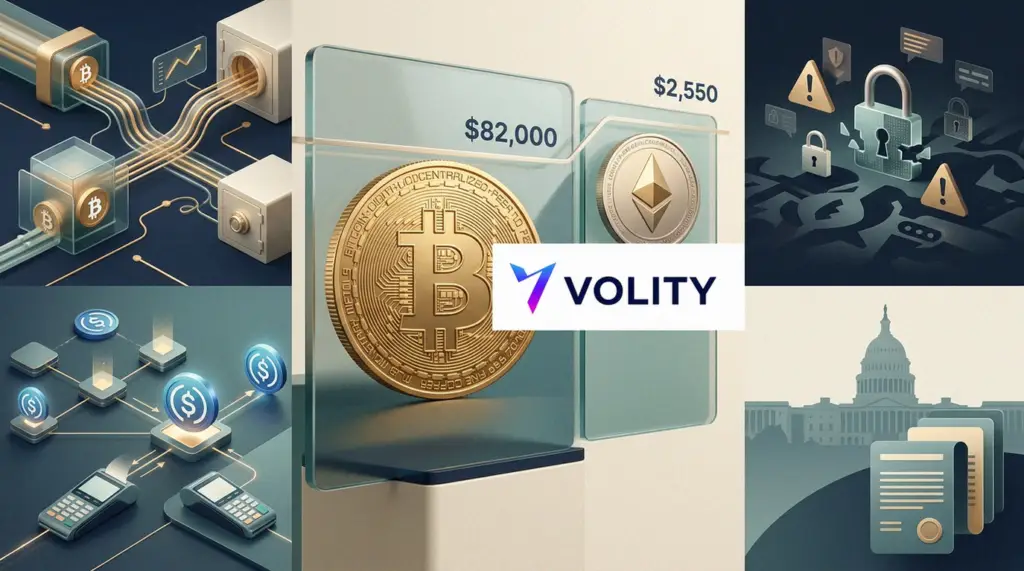
Bitcoin stalls below $82,000
Bitcoin briefly pushed above $82,000 on September 4 before slipping into the low $81,000s. Profit-taking followed a short squeeze driven by softer Federal Reserve expectations and renewed spot ETF demand.
BTC remains above the $80,000 level regained during the previous session. Yet the $82,000 to $83,000 area has become an obvious ceiling for short-term traders.
Meanwhile, futures positioning has turned more cautious. A growing short bias could fuel another squeeze, although it also leaves the market vulnerable to abrupt reversals.
Initial support sits between $80,500 and $80,000. Below that, traders will focus on the $79,000 to $78,500 range, where recent buyers may start defending positions.
The more striking signal comes from funds rather than derivatives. US spot Bitcoin ETFs recorded about $731 million in net inflows, their largest daily intake since January.
That demand does not guarantee a breakout. However, it suggests that the marginal buyer remains a fund manager or adviser, rather than a late retail entrant.
Ethereum rises, but momentum tightens
Ether has retested $2,550 as buying broadens beyond Bitcoin. Its relative strength index has approached 67, indicating strong momentum without crossing conventional overbought levels.
ETH still has room to attract rotation flows if Bitcoin remains trapped beneath resistance. Higher-beta majors often benefit when BTC pauses without collapsing.
Yet the setup remains sensitive to wider markets. If rate expectations shift or equities weaken, $2,550 could become a crowded level for leveraged longs.
For now, Ether’s advance looks more orderly than euphoric. That is useful, although orderly markets can reverse quickly when perpetual-futures funding starts climbing.
Circle brings Wall Street onto the rails
The day’s most consequential development may not involve a token price. Circle plans to launch Arc, its USDC-native Layer 1 network, on September 16.
Arc treats USDC as its gas token. Users would pay transaction fees and settle payments in dollars, rather than in a fluctuating native coin.
Circle has built the chain for institutional settlement, foreign exchange and payments. It uses an EVM-compatible execution layer and targets finality in under 500 milliseconds.
Arc’s founding validator group also includes BlackRock, DTCC, Visa, Mastercard, ICE, Standard Chartered, Galaxy, MoneyGram and SBI Group. Circle selects those validators, rather than relying on anonymous stakers.
The ARC token would serve staking, governance and validator rewards. USDC, meanwhile, would handle transaction fees and settlement.
That distinction matters. Wall Street firms may accept blockchain rails more readily when operating costs remain dollar-denominated and compliance controls sit closer to the protocol.
Circle’s existing Gateway product adds another layer. It allows a single USDC balance to move across seven chains with rapid attestation, aiming to reduce fragmented stablecoin liquidity.
- Arc launch: September 16
- Transaction currency: USDC
- Target finality: under 500 milliseconds
- Initial ARC supply: 10 billion tokens
FinCEN counts $12.7 billion in suspected scams
Regulators have supplied an uncomfortable measure of crypto fraud’s scale. FinCEN reviewed 33,904 suspicious activity reports filed from September 2023 through December 2025.
The agency identified roughly $12.7 billion in activity tied to suspected digital-asset investment scams. About 1,300 institutions submitted the reports.
Crypto money-services businesses accounted for about 55% of filings. Banks generated roughly 41%, showing that suspicious flows cross between digital platforms and traditional finance.
USDT, USDC and Ether feature prominently in the reported transactions. However, FinCEN found that illicit proceeds frequently ended in USDT before moving through DeFi protocols or offshore venues.
The human cost is sharper still. Many alleged scam compounds operate in Cambodia, Laos and Myanmar, often involving trafficking and deceptive recruitment.
Compliance risk around stablecoin routing and DeFi counterparties is rising. Transaction monitoring now matters as much as custody arrangements or liquidity access.
Hacks and legislation keep pressure on the market
Security remains another stubborn weakness. DeFi protocols have lost about $1.3 billion to hacks during 2026, often through recurring design flaws and faulty oracle assumptions.
That pattern should worry investors more than an isolated exploit would. Developers still appear to repeat errors in systems holding large pools of customer capital.
Elsewhere, Pocket Bitcoin disclosed a breach involving 5,411 customer records. Smaller platforms can offer convenience, yet they increasingly draw the attention of attackers.
Meanwhile, US and UK authorities are expanding co-operation against crypto fraud networks. Cross-border transfers linked to known scam jurisdictions may therefore receive tougher scrutiny.
The Senate is scheduled to vote on the CLARITY Act on September 15. The legislation could define rules for digital-asset classifications, custody and disclosures across the United States.
Supporters expect clearer rules to unlock regulated products and keep capital onshore. Critics, however, fear last-minute provisions could burden DeFi and non-custodial services.
What traders should watch
- Bitcoin’s range: Watch $82,000 above and $80,000 below. ETF inflows support the market, but resistance remains real.
- Ether rotation: ETH may benefit from a stable Bitcoin market. A broader risk-off move would quickly test $2,550.
- Stablecoin infrastructure: Arc puts institutional settlement at the centre of Circle’s strategy, with USDC rather than ARC driving transaction use.
- Policy risk: The CLARITY Act vote could reshape US trading, custody and DeFi expectations within days.
- Operational risk: Repeated hacks and scam-linked flows demand stricter counterparty checks, especially around DeFi routing.
The market is buoyant, but it is not carefree. Prices may grab attention today; the institutional rules and rails beneath them may matter far longer.
Related coverage on Volity
- How to Avoid Crypto Scams: A Beginner Safety Checklist
- How to Choose a Trading Platform: A 10-Point Checklist
- Demo vs Live Trading Account: A 7-Step Checklist Before You Go Live
- How to Size a Trade: Position Sizing and Risk Per Trade for Beginners
- Risk-Reward Ratio Explained: How to Set It and Why It Matters
- ETF vs Index Fund: The Difference and Which to Pick