Crypto’s week of big money, faster chains and an expensive alarm bell
Saturday, 26 September 2026
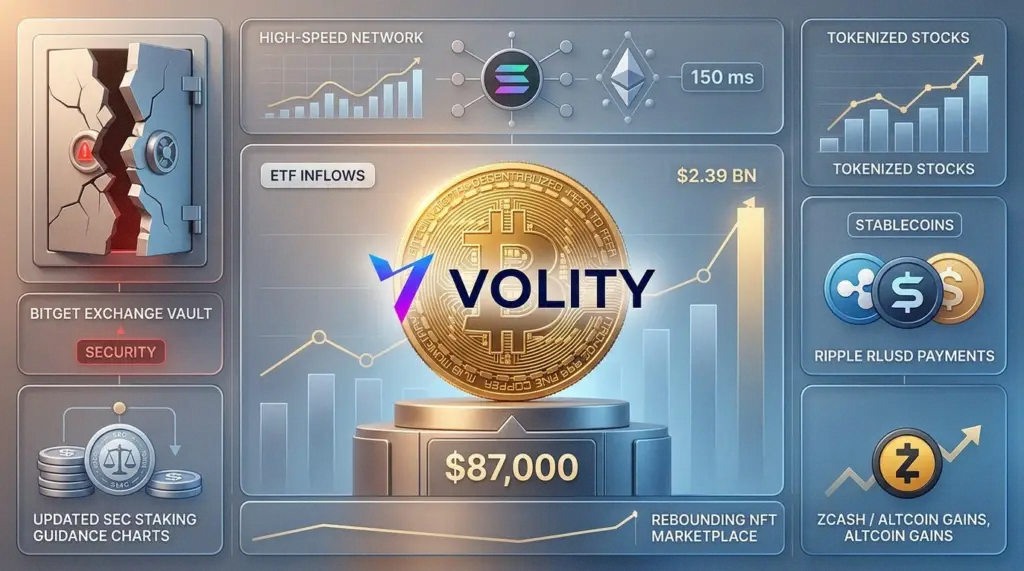
Crypto ended the week split between growing institutional demand and a fresh lesson in operational fragility. Bitcoin rose above $87,000 as US spot ETFs absorbed roughly $2.39 billion during the week. At the same time, Bitget’s suspected theft climbed to about $387.5 million. That gap between rising prices and fragile plumbing defined the market’s mood.
Bitget raises the stakes on recovery
Bitget has offered a 5% bounty for funds frozen by outside parties. It will pay another 5% for assets successfully recovered. The programme includes exchanges, blockchain projects, security firms, investigators and independent researchers.
Initial estimates put the loss at $351.6 million. After further on-chain tracing, Bitget raised that figure to roughly $387.5 million. The exchange says it fixed the vulnerability and protected customer assets held in cold wallets.
Withdrawals will return in stages, starting with Bitcoin at 08:00 UTC on 28 September. Ethereum withdrawals should follow on 29 September. Selected USDT withdrawals are scheduled for 30 September, while other services may return on 2 October.
That timetable gives Bitget room to watch its systems. Yet it also leaves traders unable to move every asset freely. For an exchange, a withdrawal queue can test confidence more sharply than any reassuring statement.
Bitcoin meets sellers above $85,000
ETF flows supplied the week’s clearest bullish signal. US spot Bitcoin funds attracted about $2.39 billion, extending a powerful run of institutional buying. One session brought around $134 million, led by BlackRock’s fund and supported by Fidelity.
Price action has proved less obedient. Bitcoin met resistance near $85,000 before trading above $87,000. Short-term momentum indicators have also weakened, with a bearish four-hour MACD signalling active selling at higher prices.
While ETF buyers continue to add exposure, existing holders appear to be taking profits. If Bitcoin holds the low-to-mid-$80,000 area, traders may view the pause as healthy consolidation. If that support fails, the ETF inflow story faces a harder market test.
- Bitcoin: traded above $87,000 during the week.
- Spot ETF inflows: roughly $2.39 billion over five sessions.
- Bitget funds traced: about $387.5 million.
- Solana target finality: approximately 150 milliseconds.
Solana chases millisecond settlement
Solana’s Alpenglow upgrade has reached a public development network. Its proposed architecture targets transaction finality of roughly 150 milliseconds. That would mark a dramatic change from the current finality period of about 12.8 seconds.
Speed matters because trading systems, payments and tokenised assets dislike waiting. Near-instant confirmation could make on-chain markets feel closer to conventional electronic venues. Before that happens, developers must test failures, congestion and validator behaviour under real pressure.
A fast demonstration network is not a production guarantee. Still, the target places Solana directly in the race for applications demanding rapid settlement. Reliability, rather than a headline latency figure, will decide whether users stay.
Backpack’s chief executive has outlined plans for as many as 10,000 tokenised stocks on Solana. The proposal reflects a wider push to bring equities, funds and fixed-income products onto blockchain rails.
Ethena is taking its USDe basis-trading model towards tokenised US equities. Aave V4 is also adding support for Coinbase’s tokenised stocks. If these projects gain traction, users could trade crypto, shares and yield products through linked on-chain venues.
Technology cannot settle every problem alone. Tokenised shares need valid ownership rights, dependable price feeds and compliant issuance structures. They also need clear processes for dividends, voting, splits and trading suspensions.
Stablecoins gain scale and scrutiny
Ripple’s RLUSD supply is nearing $2.5 billion, while activity on the XRP Ledger has increased. As more institutions use digital dollars, stablecoins are moving beyond their old role as exchange collateral.
The Federal Reserve has drafted rules governing eligible stablecoin issuers. Meanwhile, Circle’s foundation is supporting payment trials involving the United Nations Development Programme and the World Food Programme. Japan has begun a six-month eJPY trial with Toshiba and more than two dozen companies.
Digital dollars offer round-the-clock transfers and programmable settlement across borders. Their risks remain equally plain. Reserves, redemption rights, sanctions screening and intermediary failures can quickly matter more than software design.
Staking guidance offers a narrower path
SEC staff have clarified situations where staking-related token activity may avoid securities treatment. The guidance does not create a blanket exemption. Control of assets, marketing language, reward structures and intermediary roles remain important.
A service passing through network rewards may receive different treatment from one promising managed returns. For exchanges, the message is practical: product design and disclosure still carry weight.
Altcoins find their own bursts of heat
Zcash gained roughly 100% over a month, reviving speculation around a possible $5,000 target. After such a sharp move, forecasts deserve caution. Privacy tokens can attract sudden attention when traders look beyond Bitcoin and Ethereum.
Quant, Ethena and Bitway also ranked among the week’s stronger performers. Their next moves will depend on liquidity, token supply and whether buyers continue chasing momentum. NFT sales rose 57.17% to about $55.5 million, with Ethereum leading the market.
As prices climb, traders should watch more than charts. Withdrawal schedules, reserve disclosures and regulatory wording may shape the next move. Bitget’s breach showed how quickly a promising market can meet its weakest operational link.
Related coverage on Volity
- How to Avoid Crypto Scams: A Beginner Safety Checklist
- How to Choose a Trading Platform: A 10-Point Checklist
- Demo vs Live Trading Account: A 7-Step Checklist Before You Go Live
- How to Size a Trade: Position Sizing and Risk Per Trade for Beginners
- Risk-Reward Ratio Explained: How to Set It and Why It Matters
- ETF vs Index Fund: The Difference and Which to Pick