Can you trade at weekends? Yes, but only in markets that do not close. Stock exchanges such as the NYSE, the London Stock Exchange and Xetra trade on weekdays only, and forex runs from Sunday evening to Friday evening, New York time. Crypto trades around the clock, and on Volity so do gold, silver, US500, US100, WTI and a growing range of other markets. Here is which markets shut, why Monday can open at a new price, and how to plan a weekend position.
TL;DR: Stock exchanges shut at the weekend, and forex pauses from Friday 22:00 to Sunday 22:00 London time in most weeks. Crypto never closes. On Volity, crypto and a growing range of other markets, including gold, silver, US500, US100 and WTI, trade 24/7; forex trades 24/5. Weekend markets can be thin, and Monday’s first price can differ from Friday’s last. Check each instrument’s hours and practise on the free demo first.
Every hour below comes from the venue or committee that publishes it, read on 10 November 2026. Where we convert times between cities, we say so.
Which markets close at the weekend
Most organised markets trade on weekdays only. IOSCO, the global body of securities regulators, noted in a May 2026 report on extended trading hours that “in many jurisdictions, trading venues currently do not offer trading outside of core or regular trading hours”.
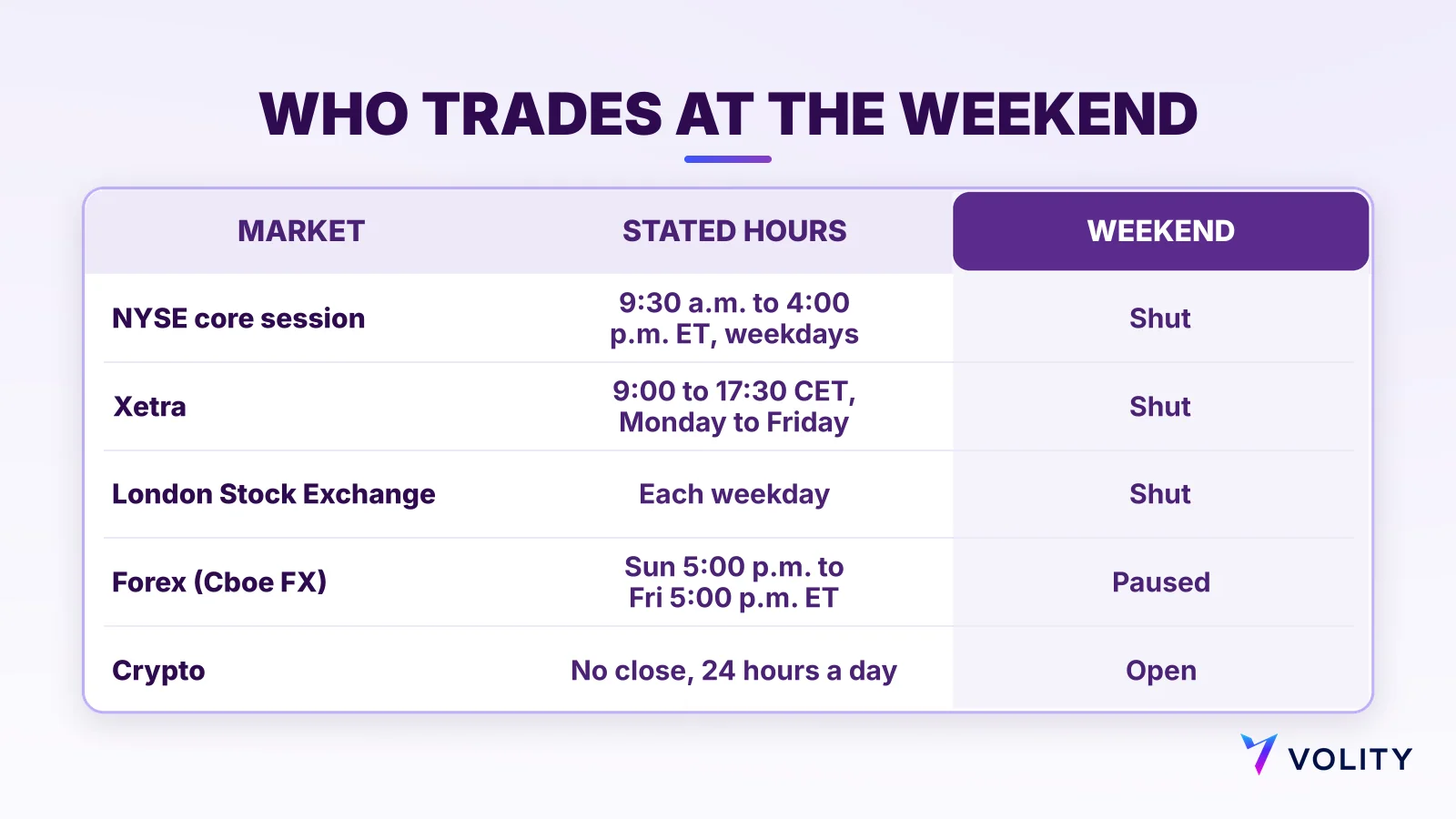
The London Stock Exchange “generally operates its Trading Services each weekday”. Deutsche Boerse states that “trading on Xetra takes place from Mondays to Fridays from 9 until 17:30 CET”, where CET is Central European Time. In New York, the NYSE core session runs from 9:30 a.m. to 4:00 p.m. ET (New York time), and the exchange’s 2026 trading-day table lists 251 trading days. By our count, 2026 has 261 weekdays and 10 NYSE holidays, so no Saturday or Sunday is a trading day.
Forex, the currency market, has no single exchange; banks and venues trade with each other worldwide. The Bank for International Settlements Triennial Survey measured turnover at $9.6 trillion a day in April 2025, up from $7.5 trillion in 2022. The Australian Foreign Exchange Committee (AFXC), hosted by the Reserve Bank of Australia, says forex “can operate 24 hours a day”. It adds that “normal trading commences from 5.00 am (Sydney time) on Monday and closes at 5.00 pm (New York time) on Friday”. Cboe FX, a currency trading venue, lists its spot trading hours as starting “Sunday 5:00 p.m. ET” and ending “Friday 5:00 p.m. ET”.
There is no single official bell, and venues differ at the edges. We converted both descriptions into local times below; the times are our working, not quotes.
| Boundary (our conversion) | New York | London | Sydney |
|---|---|---|---|
| Cboe FX week opens | Sun 17:00 | Sun 22:00 | Mon 09:00 (summer: Mon 07:00) |
| Cboe FX week closes | Fri 17:00 | Fri 22:00 | Sat 09:00 (summer: Sat 07:00) |
| AFXC normal trading starts | Sun 13:00 (summer: Sun 15:00) | Sun 18:00 (summer: Sun 20:00) | Mon 05:00 |
Times use the clocks in force since 1 November 2026, with northern-summer times in brackets. London’s clocks went back on 25 October 2026 but New York’s daylight saving time ended on 1 November 2026, so for that week the Cboe close fell at 21:00 London time. Sydney’s daylight saving time began on 4 October 2026. For UK readers, the simple anchor is Friday 22:00 to Sunday 22:00 London time in most weeks. From the Cboe close to the AFXC start, the pause lasts about 44 hours in the northern winter and about 46 hours in the northern summer.
Which markets stay open
Crypto is the clearest case. The European Central Bank wrote in its 2019 Economic Bulletin that “unlike any other market, the crypto-asset market operates 24 hours per day, with no standardised ‘close of business’ time”. A January 2025 joint report by ESMA and the EBA, the EU’s securities and banking authorities, describes crypto-assets as “typically available for trading 24 hours a day and 7 days a week globally”.
The design explains why. Bitcoin’s network adds new blocks “approximately every 10 minutes on average”, according to the bitcoin.org FAQ, and nothing in that design calls for a weekly pause. IOSCO’s 2020 report on crypto trading platforms adds that trading runs “24 hours a day” with participants “from around the world”. Our guide to crypto trading hours shows when volume is highest within the week.
Gold sits in between. The World Gold Council estimates that London’s over-the-counter market, where banks and dealers trade directly, makes up about 70% of global notional trading volume, and that London has “a time zone advantage, bridging Asian and US trading hours”. The LBMA describes the London bullion market as “running 24 hours a day through London”. Neither page mentions weekends, so the safe reading is that the wholesale market runs around the clock on weekdays. Our guide to the best time to trade gold covers the busiest hours.
Broker access is a separate question from the underlying market’s hours. On Volity, crypto and a growing range of other markets, including gold, silver, US500, US100 and WTI, trade 24/7, and forex trades 24/5. Spot gold is offered as a CFD on XAU/USD and XAU/EUR, long or short. A CFD, or contract for difference, tracks a price, so you gain or lose on the move without owning the asset. US500 and US100 are index CFDs, and WTI is a crude oil benchmark.
How weekend prices and gaps behave
A weekend gap is a jump between a market’s last price before it shuts and its first price when it reopens, with no trades in between. On a price chart it shows as an empty space between Friday’s last candle and Monday’s first.
Gaps form because news does not stop when a market does. Elections, central bank comments and political events can all happen on a Saturday. While a market is shut, nobody can trade on that news, so the price adjusts in one step at the open. IOSCO’s 2026 report records the view of supporters of longer hours, who suggest that extending trading “could mitigate volatility at market open by enabling price adjustment closer to the time at which information becomes available”. That is an argument, not a measured result, but it describes the mechanism.
Take a hypothetical case. You hold a EUR/USD position when the forex week closes on Friday, with a stop-loss below the last price. A stop-loss is an order that closes your position automatically at a level you choose. If weekend news pushes Monday’s first price below your stop, no trade ever happened at your level. The stop then fills at the first available price after the open, which can be worse than your level. That difference is called slippage.
FINRA, a US brokerage regulator, notes that “the pricing dynamics at market open might differ from the prior extended-hours trading session”. After a weekend, the last price on your screen is a record of Friday, not a promise for Monday.
A 24/7 market has no weekend gap of this kind, because trading never stops. Its weekend risk is different: fewer traders, wider spreads and sharper moves.
Risks of thinner weekend liquidity
Liquidity means how many buyers and sellers are ready to trade, and in what size. With fewer traders, each order moves the price further. The spread, the gap between the buy and sell price that you pay on every trade, also tends to widen.
IOSCO’s May 2026 report states it plainly: “Across markets, trading activity outside regular trading hours is generally characterised by lower liquidity and wider bid-ask spreads, with execution conditions differing from those observed during regular trading hours sessions.” In the same report, a Canadian group of venues put trading volume outside regular hours at “less than 0.1% of regular hours”, and a Japanese venue reported “less than 1%”. These are stock venues outside regular hours, not weekends, but they show how fast activity fades.
A May 2026 staff advisory from the CFTC, the US derivatives regulator, made a similar point. Its staff said that extending trading hours to a 24/7 schedule for certain markets or products could bring “reduced liquidity, increased volatility, widened bid/ask spreads”.
Leverage makes these moves matter more. Leverage lets a small deposit, called margin, control a larger position, and it magnifies losses as well as gains. On Volity, leverage goes up to 1:500 on forex, metals, index CFDs and commodities, and up to 1:50 on crypto CFDs. On a thin Saturday market, a move that would be small without leverage can use up a large share of your margin. Our risk management guide explains how to size positions and set stops.
Holding a position over the weekend also has a cost side. Positions held past 22:00 GMT may pay or receive an overnight amount, called a swap. It is based on the interest-rate difference between the two currencies, or on the cost of leverage for other CFDs. The rate for each instrument is shown on the platform, and the full schedule is on the charges and fees page.
How to plan a weekend position
Plan before Friday afternoon. These steps suit a position held through a market pause and one opened in a 24/7 market.
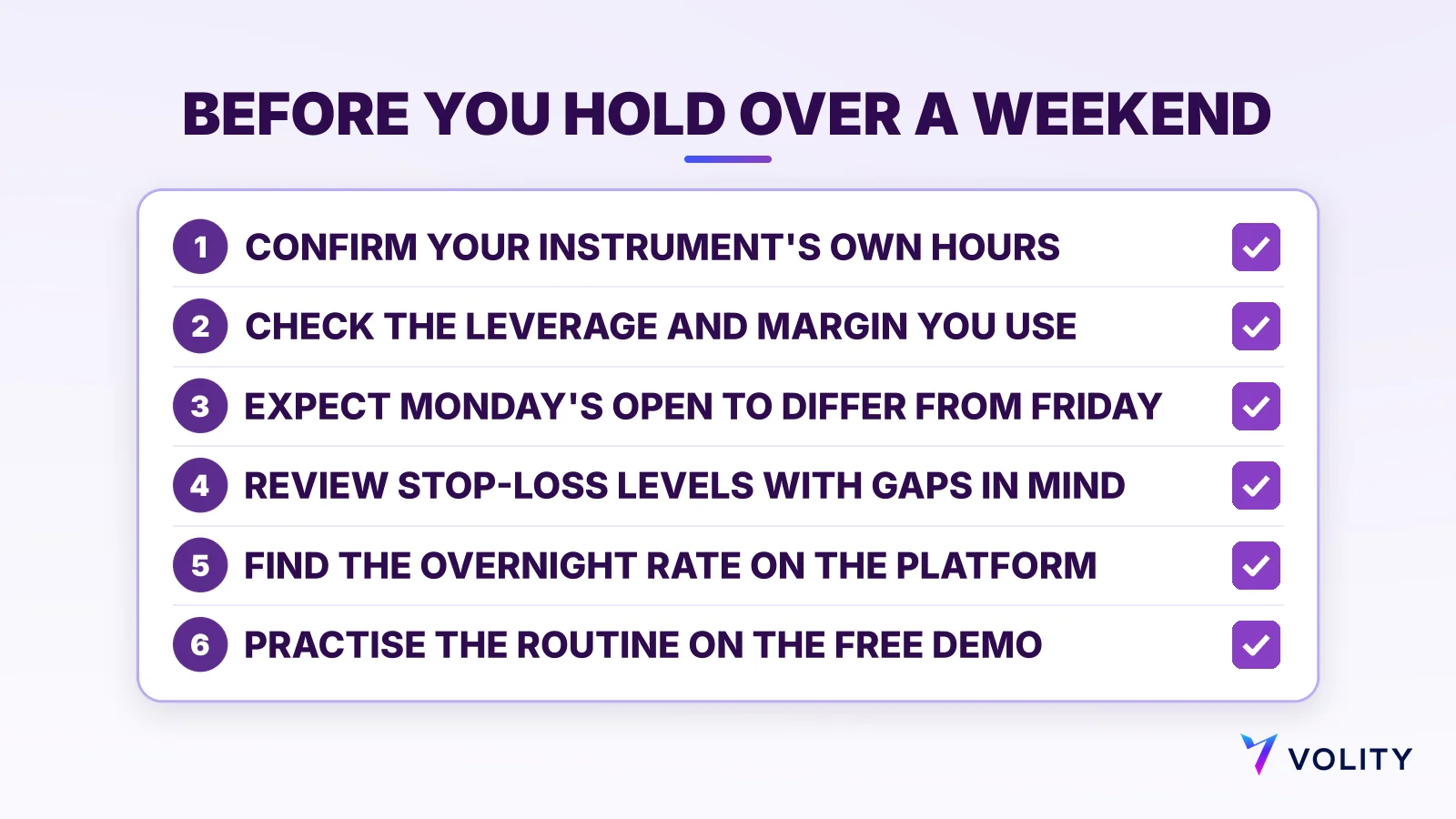
- Confirm the hours of the exact instrument you trade. Venues and brokers differ at the edges, and a clock change can move them by an hour. Our guides to forex trading sessions and the best time to trade forex show how activity moves through the week.
- Decide before the Friday close whether each position stays open. If it does, accept that Monday’s first price may sit some distance from Friday’s last.
- Check the leverage and margin you use. A position that feels comfortable on a busy Tuesday can be too large for a quiet Saturday.
- Review stop-loss and take-profit levels with gaps in mind. A stop limits losses in normal trading, but it cannot fill at a price that never traded.
- Look up the instrument’s overnight rate on the platform before you hold past 22:00 GMT.
- In a 24/7 market, check the live spread before each weekend order. A limit order, which trades only at your price or better, gives you control over the fill.
- Practise the whole routine on a demo account first, so you see how prices behave on a Saturday before you risk money.
A free demo account comes with every Volity account tier.
Trade 24/7 markets from one account
One Volity account covers both clocks. Forex trades 24/5, while crypto, gold, silver, US500, US100, WTI and a growing range of other markets keep trading through Saturday and Sunday. You can hold a currency position during the week and trade bitcoin or gold on a Saturday.
Funding works at weekends as well. Deposits and withdrawals can be started 24/7, and crypto and card withdrawals are processed in as little as 5 minutes. A bank transfer leaves straight away, and its arrival time is set by the receiving bank.
The Markets account is commission-free, with spreads from 0.6 pip. A pip is a small unit of price change in a currency pair. Crypto deposits are free, all withdrawals are free, the multi-currency wallet costs $0 and real-time market data is free for active traders.
Whichever market you choose, the weekend rule stays the same: know when your instrument trades, and size each position for the quietest hour you will hold it through.
Fact check: Hours come from Cboe FX, the Australian Foreign Exchange Committee, the NYSE, the London Stock Exchange and Deutsche Boerse. Crypto sources are the ECB, ESMA and the EBA, IOSCO and bitcoin.org. Liquidity evidence comes from IOSCO’s May 2026 report, a CFTC staff advisory and FINRA, market size from the BIS, and gold from the World Gold Council and the LBMA. Local-time conversions are ours, using timeanddate.com. All sources were read on 10 November 2026.
Frequently asked questions
Can you trade forex on weekends?
The main forex market pauses at the weekend. Cboe FX lists its week as Sunday 5:00 p.m. to Friday 5:00 p.m. New York time, which is Sunday 22:00 to Friday 22:00 London time in most weeks, so the pause runs from Friday 22:00 to Sunday 22:00. On Volity, forex trades 24/5.
Is the stock market open on Saturday?
No. The NYSE, the London Stock Exchange and Xetra trade on weekdays only, and the NYSE’s 2026 table lists 251 trading days, and by our count none falls at the weekend. On Volity, index CFDs such as US500 and US100 trade 24/7.
Can you trade crypto at the weekend?
Yes. Crypto has no closing time; the ECB, ESMA and the EBA all describe it as trading 24 hours a day. On Volity, crypto trades 24/7, with leverage up to 1:50 on crypto CFDs.
Can you trade gold on weekends?
Wholesale gold trades mainly in London, across time zones on weekdays. On Volity, gold and silver trade 24/7 as CFDs, including spot gold on XAU/USD and XAU/EUR.
What is a weekend gap?
A weekend gap is the jump between a market’s last price before the weekend and its first price after it, with no trading in between. It forms when news arrives while the market is shut, so the price adjusts in one step at the open.
Is weekend trading riskier?
It can be. IOSCO reports that trading outside regular hours generally has lower liquidity and wider bid-ask spreads. With fewer traders, prices can move sharply, and leverage magnifies losses.