Investing in financial products involves risk. Losses may exceed the value of your original investment.
The Crypto Trading Starter Kit
A plain-English PDF: what to check before you trade, how orders and risk really work, and the mistakes to skip. Get it free.
Quick answer
Crypto markets trade 24/7/365 with no closed session, but volume is heavily uneven across the day. Most of it lands in three or four windows tied to the Asia, London and US financial centres. The thin stretches are roughly 03:00-06:00 and 16:00-20:00 UTC, and the whole weekend, where spreads widen and slippage spikes on alts. Bitcoin volume is the most consistent; smaller-cap coins are far more concentrated into the busy windows.
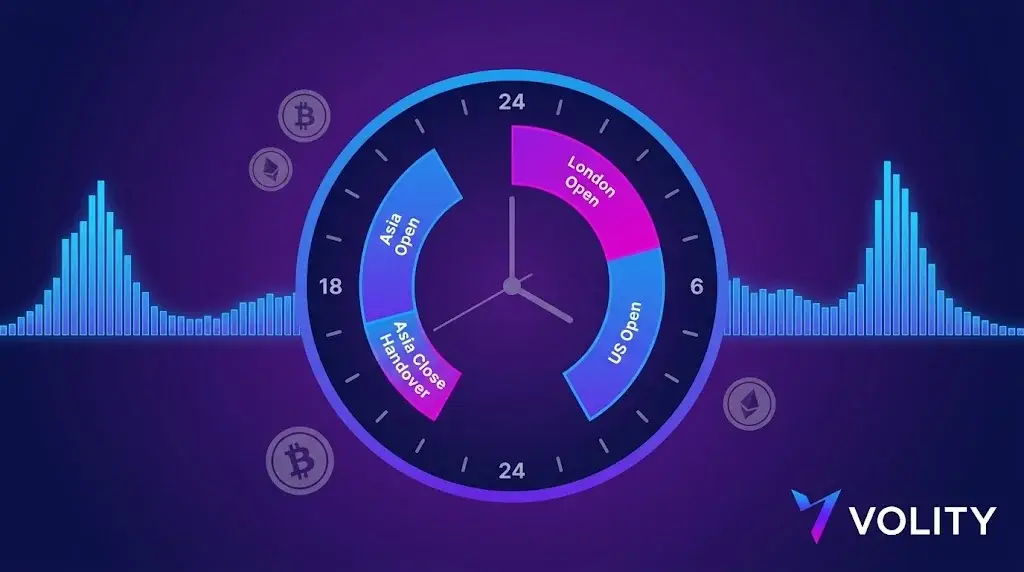
Crypto markets run 24 hours a day, 7 days a week, 365 days a year. Trading hours, in the equity-market sense, do not exist. What does exist is a heavily uneven distribution of volume across the day. Most daily BTC and ETH volume clusters in a small number of windows tied to the major financial centres: Asia open, London open, US open, and the US close into the Asia handover. The dead zones in between produce wider spreads, fake breakouts, and the kind of price action that punishes anyone trading them.
Are crypto markets really open 24/7?
Yes, with caveats:
- Spot markets: open continuously on every major centralised exchange.
- Crypto CFDs at regulated brokers: most run 24/7 with brief weekly maintenance windows of 1-2 hours, typically Saturday or Sunday off-peak.
- Bitcoin and ether futures on regulated US venues (CME): equity-style hours with weekend gaps. Spot crypto trades through those gaps; futures do not.
For retail CFD traders on Volity, the practical answer is: 24/5 with weekends available on most majors, brief maintenance windows aside.
When is the real volume?
The hourly volume profile across BTC and ETH spot is consistent from year to year, and it maps to financial-centre hours. Times in UTC:
- 00:00-03:00 UTC: Asia open. Active in Asia-listed alts and JPY crosses.
- 07:00-10:00 UTC: London open. Typically the highest BTC/ETH spot volume slot of the day.
- 13:30-16:00 UTC: US open and macro-data window. The main US macro releases print just before it, so the window opens with a repriced market.
- 20:00-22:00 UTC: US close into Asia handover. Often the cleanest trend-day continuation window.
Those three or four windows carry the bulk of the day. The rest, spread across the remaining fourteen to sixteen hours, is thin.
Why does it matter when you trade?
Three concrete effects of trading inside the high-volume windows:
- Tighter spreads. BTC bid-ask is at its narrowest during the London and US opens and widens materially in the dead zones.
- Cleaner technicals. Real participation produces real signals. Breakouts hold, volume confirms, levels respect.
- News-reaction speed. A CPI print at 12:30 UTC moves BTC in 30 seconds because everyone is at the screen. The same print at 03:00 UTC moves BTC slowly and unevenly because liquidity is fractured.
What happens in the dead zones?
The 03:00-06:00 UTC and 16:00-20:00 UTC windows are the thinnest of the day. In them we see:
- Wider spreads, and disproportionately wider on alts than on BTC.
- Fake breakouts driven by single-actor flow rather than crowd behaviour.
- Higher slippage on stops.
- Patterns that look clean but fail to follow through.
Our desk rule: trade the windows, not the gaps. The gaps are when we journal, study, and update the watchlist.
What about weekends?
Saturday and Sunday volume runs well below weekday levels. The implications:
- Wider spreads, sharper wicks. An order that would barely register on a Tuesday can move BTC noticeably on a Sunday morning.
- News asymmetry. Macro-news risk is parked (no economic releases), but crypto-specific news (exchange exploit, regulatory leak, ETF rumour) hits a thin book and moves prices violently.
- Position sizing: half the weekday size, or skip entirely.
How does the news calendar shape the hours?
Five recurring catalysts that shift volume on top of the baseline:
- US CPI: monthly, 13:30 UTC in winter and 12:30 UTC when the US is on daylight time. Volume spikes hard for about thirty minutes.
- FOMC rate decision and press conference: 19:00 and 19:30 UTC in winter, an hour earlier when the US is on daylight time. Often the highest-volume hour of the month.
- Non-farm payrolls: usually the first Friday of each month, at the same clock time as CPI.
- BTC and ETH spot ETF flow data: published end-of-day US time, drives Asia-open continuation.
- COIN earnings: quarterly, after-hours US. Spillover into Asia.
The desk schedule we actually run
- Pre-market review: 06:30-07:00 UTC. Overnight news, Asia closing levels, watchlist update.
- London-open block: 07:00-10:00 UTC. Highest-conviction setups.
- Mid-session journaling: 10:00-13:30 UTC.
- US-open block: 13:30-16:00 UTC. Macro-driven trades.
- Late-session block: 20:00-22:00 UTC. Trend-day continuation.
Trading hours at Volity
Volity offers CFD exposure on 20+ cryptocurrencies with 24/7 access on majors, subject to brief maintenance windows. MT4 and MT5 supported. Retail crypto leverage is capped at 1:2 under ESMA. Negative balance protection applies. Execution is by UBK Markets Ltd (CySEC 186/12).
Volity operates a trading platform and also publishes educational and analytical content about trading. The content on this page is for educational purposes only and should not be considered financial advice. Volity may benefit commercially when readers open trading accounts through links on this site.
Our content is produced and reviewed under documented editorial standards; see our comparison and review methodology.