Investing in financial products involves risk. Losses may exceed the value of your original investment.
The Crypto Trading Starter Kit
A plain-English PDF: what to check before you trade, how orders and risk really work, and the mistakes to skip. Get it free.
Quick answer
Day trading crypto vs stocks differs on five dimensions: hours (24/7 vs a roughly 6.5-hour equity session), regulation (crypto and equity CFDs sit under different ESMA rules), retail leverage (1:2 EU crypto vs 1:5 EU single-equity CFDs), volatility (crypto realised volatility 3-5x equity averages), and asset universe (thousands of altcoins vs thousands of listed equities globally).
Day trading crypto vs stocks looks like the same job from a distance: stare at charts, manage risk, take setups. Up close it is two different professions. Hours, volatility, leverage, regulation, and tax all differ enough that a strategy paying you in equities can lose money in crypto, and vice versa. The five differences below are the ones that actually change behaviour on the desk.
Difference 1: when the market is open
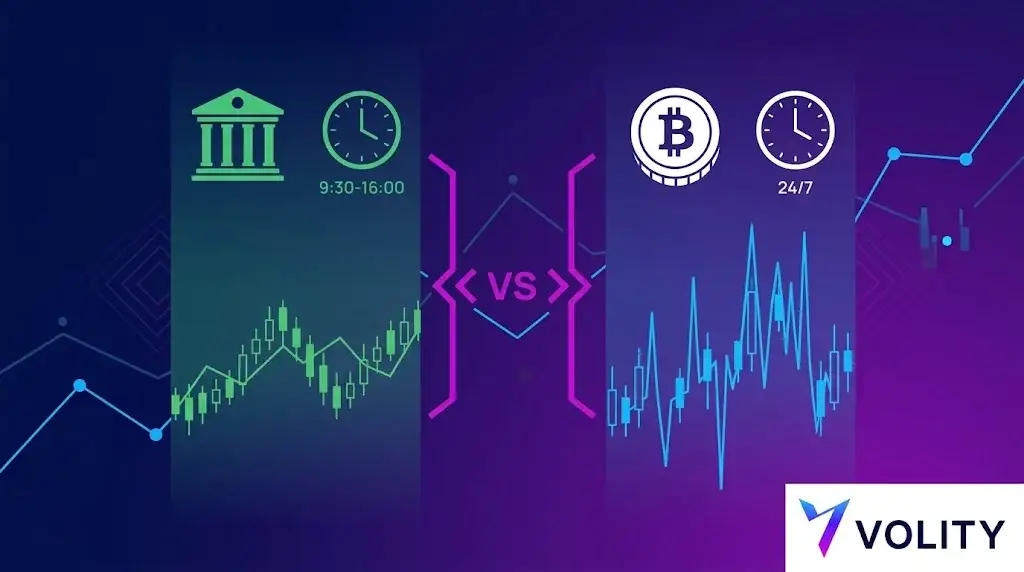
Stocks trade roughly 6.5 hours a day, 5 days a week, with a fixed open and close. The session has structure: opening volatility, midday lull, closing auction. Strategies anchor to those rhythms.
Crypto trades 24/7. There is no open and no close. Volume clusters in three windows (Asia open, London open, New York open) but the market never sleeps. The implications:
- Crypto traders need a hard schedule discipline. Without one, screen time creeps to 14+ hours and execution quality collapses.
- Crypto positions carry overnight gap risk every night, including weekends.
- Stock traders get 17.5 hours a day off, by design. Crypto traders have to take it deliberately.
Difference 2: how much it actually moves
Realised volatility, annualised, in 2026:
- SP 500: 12-18%.
- Median SP 500 single-name stock: 25-35%.
- High-vol single names (small-cap, biotech, recent IPOs): 50-90%.
- Bitcoin: 45-55%.
- Ether: 55-70%.
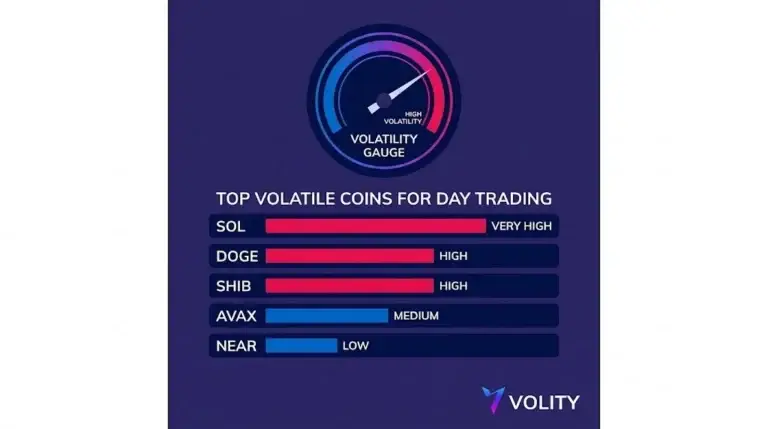
- Top-20 alts: 70-120%.
The practical effect: a 1% intraday move is normal in stocks, big in indices, and small in crypto majors. Stop placements scale accordingly. A trader bringing equity-style 0.5% stops to BTC will be stopped out by routine noise.
Difference 3: leverage caps and the regulatory frame
Under ESMA in the EEA:
- Major equity indices (SP 500, DAX, Euro Stoxx 50): 1:20 retail.
- Single-name equities: 1:5 retail.
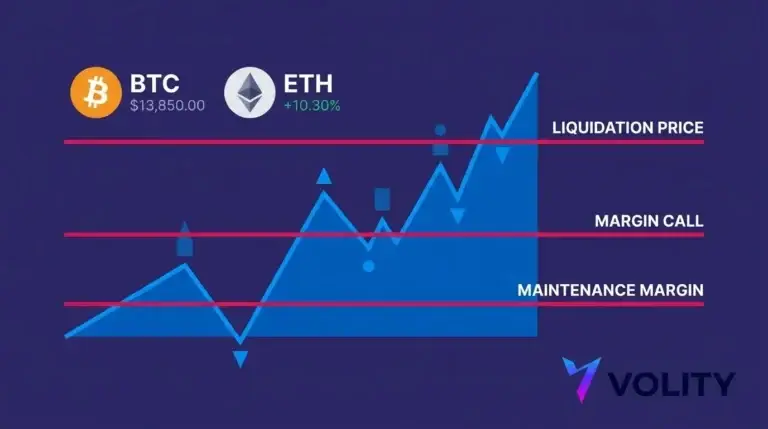
- Cryptoassets: 1:2 retail.
Cash equities trading via a securities broker has its own rules: MiFID II appropriateness and suitability checks in the EEA, and FCA conduct rules in the UK. CFD frameworks share the ESMA leverage caps and apply the same negative balance protection across asset classes. Crypto sits in its own bucket: low leverage, broad access.
Difference 4: the cost structure
Round-trip costs differ in shape, not just size:
- Stocks via a major broker: commission-free or low-commission dealing on many venues, with costs embedded in the spread plus small regulatory or exchange fees. Effective cost is 1-3 bp on liquid names.
- Stock CFDs: spread + commission, typically 5-15 bp round-trip.
- Crypto on a centralised exchange: 0.1-0.5% per side, plus withdrawal fees. 20-100 bp round-trip.
- Crypto CFDs: spread-only on most retail platforms, 5-15 bp round-trip on majors.
For active day traders the CFD path is competitive on cost in both markets. The catch is the leverage cap and the underlying not actually settling.
Difference 5: tax and reporting
Stocks have decades of clean tax infrastructure. Brokers issue annual statements, and share-matching, holding-period treatment, and capital-gains rules are well established in most jurisdictions.
Crypto tax in 2026 is more variable across jurisdictions. Spot trades, perpetual P&L, funding rate income, and CFD gains may each be treated differently. Self-custody adds the burden of tracking on-chain movements. CFD-reference exposure (single broker statement) simplifies reporting compared to multi-exchange spot trading. Always consult a local tax advisor.
Which one is easier for retail?
An honest take from desk experience:
- Crypto is more accessible: lower account minimums, no day-trade-count restrictions, 24/7 hours so working professionals can trade.
- Stocks have cleaner structure: defined sessions, deeper liquidity in any given second, more reliable patterns.
- Crypto rewards volatility tolerance: strategies that ride 5-10% intraday swings work in crypto and would never trigger in equities.
- Stocks reward fundamental research: earnings, guidance, and macro flow create durable edges that crypto only partly replicates.
Can the same strategy work in both?
Some yes, some no. Trend-following on the daily timeframe travels well. Momentum breakouts travel with adjusted thresholds. Mean reversion on overbought conditions works in both. Strategies that depend on equity-specific structure (opening auction, closing auction, earnings drift) do not translate. Strategies that depend on crypto-specific structure (funding rate, exchange-listing flows, weekend thinness) do not translate the other way.
Day trading both at Volity
Volity offers CFD exposure to 20+ cryptocurrencies, major equity indices, individual equities, forex, and commodities through MT4 and MT5. Retail leverage caps under ESMA: 1:30 majors FX, 1:20 major indices, 1:10 commodities, 1:5 equities, 1:2 cryptoassets. Negative balance protection applies. Execution is by UBK Markets Ltd (CySEC 186/12).
Volity operates a trading platform and also publishes educational and analytical content about trading. The content on this page is for educational purposes only and should not be considered financial advice. Volity may benefit commercially when readers open trading accounts through links on this site.
Our content is produced and reviewed under documented editorial standards; see our comparison and review methodology.