Investing in financial products involves risk. Losses may exceed the value of your original investment.
The Crypto Trading Starter Kit
A plain-English PDF: what to check before you trade, how orders and risk really work, and the mistakes to skip. Get it free.
Quick answer
Crypto spot trading versus derivatives comes down to one thing: with spot you own the coin, with derivatives you trade its price. Spot settles immediately and you can withdraw or self-custody; CFDs and futures use leverage, never deliver the asset, and carry funding or overnight costs. For the spot side in detail, see spot trading crypto; for the leveraged side, see contract trading crypto. Choose spot to hold, derivatives to speculate with leverage.
Crypto spot trading is the immediate exchange of a digital asset for cash (or another asset) at the live market price. The defining feature is settlement: the trade clears now, not on a future date. You buy 1 ETH at $3,200, your account is debited $3,200 and credited 1 ETH within seconds. There is no expiry, no funding rate, no leverage on the trade itself. Spot is the simplest, oldest, and most-used form of crypto trading, and it is the right starting point for anyone learning how the asset class actually works.
The order-book mechanics
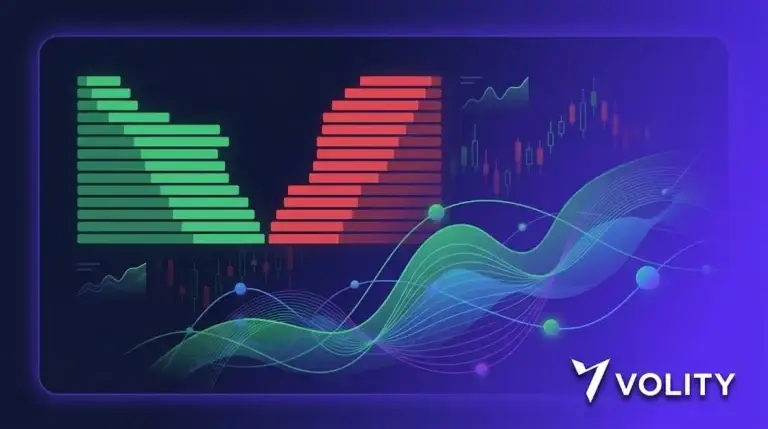
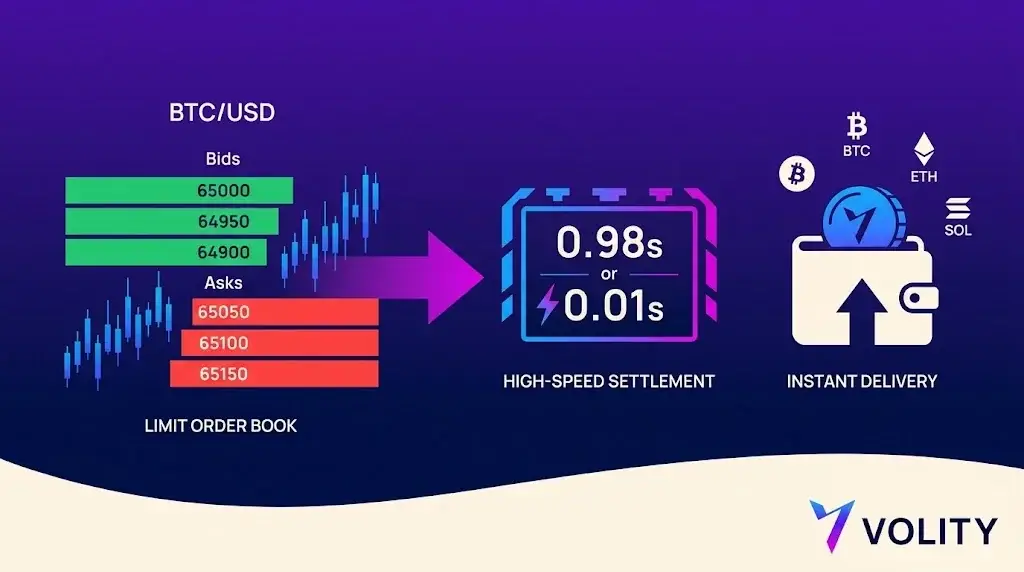
Every regulated venue and major centralised exchange runs a central limit order book (CLOB):
- Bids: buy orders, sorted highest price first.
- Asks: sell orders, sorted lowest price first.
- Top of book: highest bid and lowest ask. The gap between them is the spread.
A market buy order matches against the lowest ask; a market sell against the highest bid. A limit order rests on the book at your chosen price until it is matched or cancelled. The matching engine processes orders by price-time priority: better price first, then earliest-arrived order at the same price.
What “settlement” means in spot
On a centralised exchange, settlement is internal: the venue moves balances between accounts on its database, typically in under a second. On-chain settlement (DEX trades) takes one block confirmation: roughly 12 seconds on Ethereum L1, sub-second on most L2s. On a regulated CFD-reference platform like Volity, the spot-reference price is delivered through a contract for difference, which removes on-chain settlement entirely and consolidates exposure into a single account alongside forex, indices, and commodities.
Cost components
Three main costs on a typical retail spot trade:
- Spread. 1-3 basis points on BTC/USD on a deep venue. 5-30 bp on mid-cap altcoins. 50-300 bp on illiquid tokens.
- Commission or fee. 0.05-0.5% per side on most CEXs, often tiered by 30-day volume. CFD-reference platforms typically build the cost into a slightly wider spread instead of a separate commission line.
- Network fees. Only relevant if you withdraw the underlying token. Bitcoin: $1-15 depending on mempool. Ethereum L1: $5-50 historically. Volity charges no platform-side withdrawal fee on most rails.
Spot vs derivative: the four practical differences
| Dimension | Spot | Derivative (perp/future) |
|---|---|---|
| Settlement | Now | At expiry (future) or never (perp) |
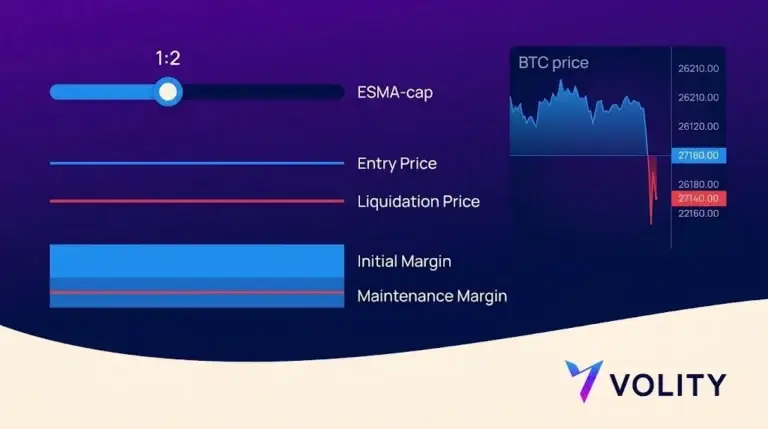
| Leverage | None | Up to 1:2 retail under ESMA |
| Funding rate | None | Every 8 hours (perpetual only) |
| Direction | Long only | Long or short |
Order types you should actually use
- Limit. You set the price. Fills only at your number or better. Use this 90% of the time.
- Market. Fills now at whatever the book shows. Use only for small size in liquid pairs.
- Stop-limit. Triggers a limit order when price crosses a threshold. Useful for entries and exits without staring at the screen.
- Iceberg (where supported). Splits a large order into visible chunks to avoid telegraphing size.
Tax and accounting
Spot trades are typically taxed as capital gains on disposal. Each sale (or crypto-to-crypto swap) is a taxable event. HMRC and most EU tax authorities treat crypto as property, not currency. Practical implications: keep cost basis per lot, track every disposal, reconcile annually. CFD-reference exposure (the Volity model) often produces a single annual statement instead of hundreds of disposal events, simplifying reporting in most jurisdictions. Rules vary; consult a local advisor.
When spot is the right tool
- Multi-month or multi-year view. Funding-rate bleed on a perpetual eats returns over long horizons. Spot is the cleanest expression of a directional thesis with no carry.
- Learning execution. Order types, slippage, and book mechanics are easier to internalise without leverage and funding noise.
- Treasury allocation. Companies and family offices typically hold spot, not derivatives, for accounting and audit reasons.
When spot is the wrong tool
- You want to short. Spot is long-only. Use a perpetual or future for bearish exposure.
- You want capital efficiency. Same exposure, less margin tied up. Derivatives win on this dimension, with the trade-off of leverage risk.
- You want hedging. Pairing a long spot with a short perp neutralises directional risk while keeping the underlying.
Crypto spot at Volity
Volity offers spot-reference exposure to 20+ cryptocurrencies including BTC, ETH, SOL, XRP, BNB, and major altcoins. Trading is executed by UBK Markets Ltd, a Cyprus Investment Firm authorised by CySEC under licence 186/12. Crypto leverage for retail clients in the EEA is capped at 1:2 under ESMA product-intervention measures. Negative balance protection applies on retail accounts. Eligible retail clients are covered by the Cyprus Investor Compensation Fund up to EUR 20,000 per client per firm in the event of broker insolvency.
Spot settles immediately, while derivatives and event contracts settle against written criteria on a stated date. For the latter, read our guide to how prediction markets resolve before you commit to a position.
Volity operates a trading platform and also publishes educational and analytical content about trading. The content on this page is for educational purposes only and should not be considered financial advice. Volity may benefit commercially when readers open trading accounts through links on this site.
Our content is produced and reviewed under documented editorial standards; see our comparison and review methodology.