Investing in financial products involves risk. Losses may exceed the value of your original investment.
The Crypto Trading Starter Kit
A plain-English PDF: what to check before you trade, how orders and risk really work, and the mistakes to skip. Get it free.
Quick answer
Spot trading in crypto is the buying and selling of actual cryptocurrency tokens for immediate on-chain settlement. The trader receives ownership and can self-custody, transfer on-chain, or use the coins in DeFi protocols. Spot differs from derivatives in that no leverage is involved, no expiry, and no overnight financing cost. Major venues: Coinbase, Kraken, Binance, plus DEXes like Uniswap.
Spot trading in crypto is the simplest form of buying or selling a digital asset: you pay the live market price, the asset hits your wallet within seconds, and you own it outright. There is no leverage, no expiry date, no funding rate. If you bought one ether at $3,200 last Tuesday and the price is $3,400 today, your account shows $200 of unrealised profit. That is the trade.
How spot trading actually works
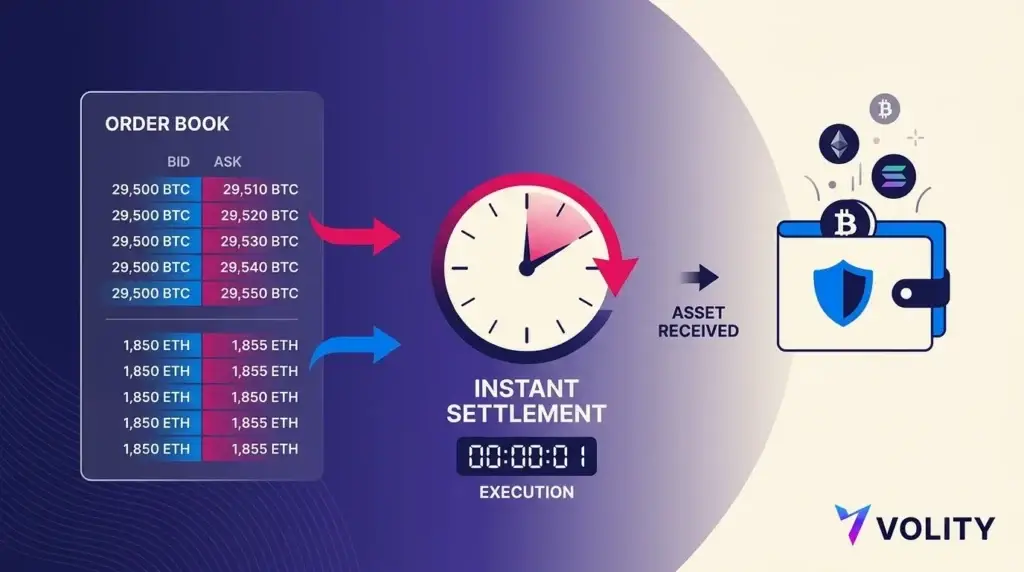
The order book matches your buy order against the cheapest available sell order, or your sell order against the highest available bid. Settlement is near-instant on most centralised platforms (under 1 second). On a regulated multi-asset platform like Volity, spot crypto exposure is offered as a CFD reference price rather than custody of the underlying token, which means one KYC, one tax statement, and one withdrawal rail across forex, indices, commodities, and crypto. Execution at Volity is by UBK Markets Ltd, a Cyprus Investment Firm authorised by CySEC under licence 186/12.
Spot vs derivative crypto trading: what is the difference?
A spot trade settles now at today’s price. A derivative trade (futures, perpetual, option) settles in the future or never settles in the underlying. The practical implications:
- No expiry. A spot position lives until you close it.
- No funding rate. Perpetual contracts charge or pay a funding rate every eight hours; spot does not.
- No leverage on spot. You can only put on a position equal to the cash you funded.
- Tax treatment. Spot trades are typically taxed as capital gains on disposal; derivatives are often treated separately. Rules vary by jurisdiction; consult a local advisor.
What does a spot crypto trade cost?
Three components, in order of size for most retail trades:
- Spread. The gap between the bid and the ask. On BTC/USD this is typically 1-3 basis points on a deep venue, wider on illiquid altcoins.
- Commission. Some platforms charge a fixed percentage (0.1-0.5%) per side. CFD-reference platforms often build the cost into the spread instead.
- Withdrawal fee. Network fees on the underlying chain. Bitcoin can run $1-15 depending on mempool congestion; Ethereum L1 has been $5-50 historically. Volity charges no platform-side withdrawal fee.
When does spot trading make sense?
Three honest answers:
- You want exposure, not a strategy. If your view is that bitcoin will be higher in two years, spot is the cleanest expression of that view. No funding bleed, no margin call, no expiry.
- You are size-constrained. Most retail accounts cannot meaningfully use leverage without crossing the risk-of-ruin threshold. Spot enforces that discipline by design.
- You are learning. Spot is the right place to understand order types, slippage, and execution mechanics before you ever touch a perpetual or option.
What are the risks?
Three that will catch a careless trader:
- Drawdown discipline. An unleveraged spot position can still go to zero. Bitcoin drew down 75% in 2018 and 65% in 2022. A position-sizing rule (e.g. no single asset above 5% of liquid net worth) is the floor.
- Custody risk. If you hold the underlying token in self-custody, you own the operational risk: lost seed phrases, phishing attacks, exchange hacks. CFD-reference exposure (the Volity model) removes this risk because the broker custodies the contract, not the token.
- Tax tracking. Every spot trade is potentially a taxable event. Tooling (Koinly, CoinTracker, your broker’s annual statement) is the difference between a 30-minute return and a 30-hour reconciliation.
Spot trading at Volity
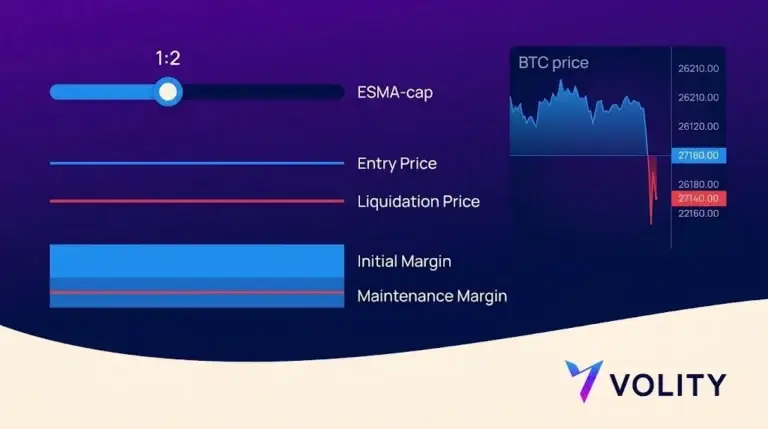
Volity offers spot-reference exposure to 20+ cryptocurrencies including BTC, ETH, SOL, XRP, BNB, and major altcoins. Trading is executed by UBK Markets Ltd. Crypto leverage for retail clients in the EEA is capped at 1:2 under the ESMA leverage limits. Negative balance protection applies. Eligible retail clients of UBK Markets are covered by the Cyprus Investor Compensation Fund up to EUR 20,000 per client per firm in the event of broker insolvency.
Volity operates a trading platform and also publishes educational and analytical content about trading. The content on this page is for educational purposes only and should not be considered financial advice. Volity may benefit commercially when readers open trading accounts through links on this site.
Our content is produced and reviewed under documented editorial standards; see our comparison and review methodology.