Quick answer
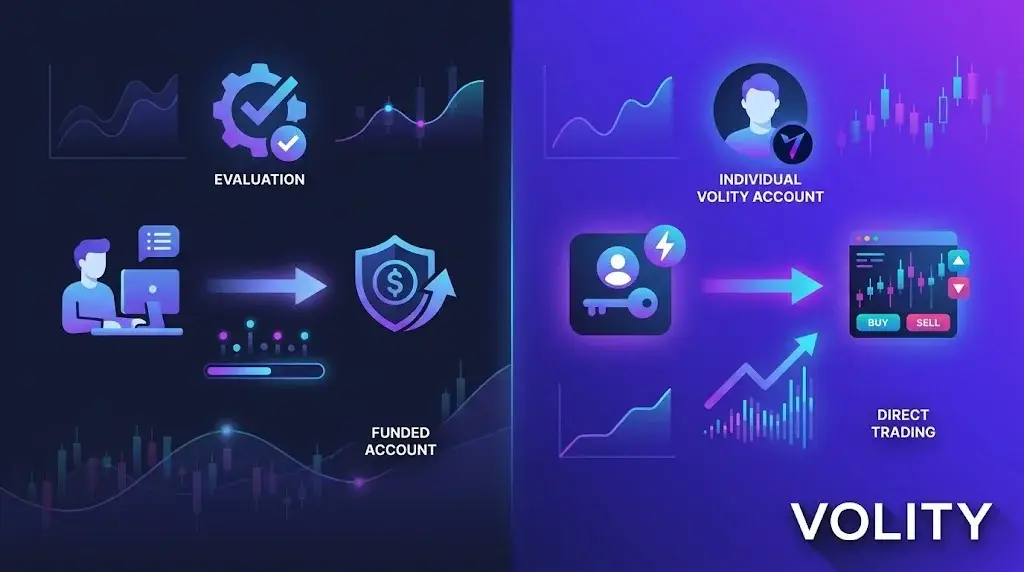
Crypto prop trading is trading a firm’s capital rather than your own: you pass an evaluation, get a funded account, and split the profits with the prop firm. It lets skilled traders access larger size without risking much of their own money, but firms charge fees and impose strict rules and drawdown limits. Choose established firms and read the rules before paying.
The Crypto Trading Starter Kit
A plain-English PDF: what to check before you trade, how orders and risk really work, and the mistakes to skip. Get it free.
Crypto prop (proprietary) trading firms let you trade firm capital instead of your own, with a profit-share split. Common model: pay an evaluation fee, prove your strategy on a demo with strict rules, get a funded account, take 70-90% of profits. This page explains how prop firms work, the trade-offs, and where Volity’s individual account model fits as an alternative.
The prop firm model:
- Evaluation phase. Pay a one-time fee ($100-$1,000+). Trade a demo account with specific rules: profit target, max daily drawdown, max overall drawdown, minimum trading days
- Verification phase. Reduced profit target, same drawdown rules. Confirms the evaluation was not luck
- Funded account. Pass verification, get a “funded” account (often still demo-like internally, but with profit-split paid as real money)
- Profit split. Typically 70-90% of profits to the trader, with monthly payouts above a threshold
Examples of crypto-focused prop firms:
- FTMO (commodities, forex, indices, some crypto)
- The5ers (forex + crypto)
- MyForexFunds (multiple asset classes including crypto)
- Crypto-specific firms (newer market; firms come and go)
The space has grown rapidly since 2020, with both legitimate firms and scam operations. Vet carefully.
Trade-offs of prop firm path:
Pros: – Trade larger size than personal capital allows – Defined rules force discipline – Profit potential without proportional capital risk
Cons: – Evaluation fee is sunk cost if you fail – Strict drawdown rules force conservative trading that may not match your edge – Some firms have unclear payout reliability – Most evaluations are designed to be passable by only 10-20% of applicants
How prop firm economics work:
Firms make money from evaluation fees, not from trader profits. If 1,000 traders pay $300 evaluation fees ($300K revenue), and 100 pass to funded accounts, the firm has $300K up front. The 100 funded traders’ profits (and the firm’s share) come on top.
This explains why evaluation rules can feel impossibly strict, the firm’s revenue model depends on most applicants failing.
Prop firms vs Volity (individual accounts):
| Feature | Crypto Prop Firm | Volity Individual Account |
|---|---|---|
| Trade size | Firm capital (e.g., $50K-$200K funded) | Your capital |
| Profit split | 70-90% to trader | 100% to trader |
| Loss risk | Limited to evaluation fee + any rule breaks | Your full deposit at risk |
| Trading rules | Strict (daily drawdown, max trades, etc.) | Your own rules |
| Onboarding cost | $100-$1,000+ fee | $0 |
| Payout reliability | Varies by firm | Direct to your bank account |
| Strategy freedom | Limited by firm rules | Full freedom |
| Trade execution | Firm’s chosen platform | Volity MT directly |
For traders with capital constraint and proven strategy, prop firms can be a path to larger size. For traders with capital but unsure of strategy, individual accounts (Volity) provide better learning environment without external rule pressure.
Who suits prop firm trading:
- Skilled trader with proven results but limited personal capital
- Trader who thrives with external rule pressure
- Trader willing to invest in evaluation fees with realistic expectations of pass rate
Who suits Volity individual account:
- Trader still developing edge (rule pressure premature)
- Trader with sufficient personal capital
- Trader wanting strategy freedom and 100% of profits
- Trader who values multi-asset account (forex + crypto + commodities) under one regulatory framework
Hybrid approach:
Some traders run both: a Volity individual account for primary trading with their own capital, and a prop firm evaluation in parallel as a “stretch” path to additional capital. The two are not mutually exclusive.
Vetting a crypto prop firm:
- Track record: how long operating, how many funded traders, payout reliability stories
- Rules transparency: are drawdown rules clearly defined, are platform requirements reasonable
- Asset coverage: does the firm support the crypto pairs you trade
- Spread comparison: prop firms sometimes have wider spreads than retail brokers, eating into the profit-split advantage
- Customer service responsiveness: pre-fund tests
- Reviews from confirmed funded traders, not generic “good experience” testimonials
Sources
Related Volity crypto guides
- Benefits of Crypto Trading: 7 Real Advantages
- Crypto Trading Meaning: What It Is, 5 Forms
- Crypto Trading Tips: 12 Habits That Separate Profit
- Live Crypto Trading: Real-Time Execution on Volity
- Crypto Trading Volume Explained
- Crypto Day Trading Platform on Volity MT
- Crypto Trading Charts Guide: How to Read Them
- Crypto Trading Books: 10 Recommendations
- Can You Make Money Trading Crypto?
- Contract for Difference Trading Crypto: How CFDs Work
- Crypto Insider Trading: Definition, Cases, Patterns
- Crypto Trading Careers: Roles, Paths, Realistic Income
Frequently Asked Questions
What is crypto prop trading?
Trading crypto with a firm’s capital instead of your own, in exchange for a profit-share. Common: pass an evaluation phase, get a funded account, take 70-90% of profits. The firm takes the rest and bears the loss risk.
Are crypto prop firms legitimate?
Some are; many are not. The space has grown rapidly with mixed quality. Established firms (FTMO, The5ers, MyForexFunds) have track records; newer firms vary. Vet carefully, check funded-trader payouts, read terms carefully.
Can I prop-trade through Volity?
Volity offers individual trading accounts, not prop-firm-style funded accounts. For trading firm capital, prop firms are the standard path. Volity is the direct trading layer; prop firms may execute through brokers like Volity (subject to firm’s platform choice).
What is the cost of crypto prop trading?
Evaluation fees typically $100-$1,000+. If you pass and start the funded phase, you keep 70-90% of profits but the evaluation fee is sunk cost. If you fail, you lose the fee.
How hard is it to pass a prop firm evaluation?
Pass rates typically 10-20% of applicants. Evaluation rules (strict daily drawdown, profit targets, minimum trading days) are designed so most applicants fail. The firm’s revenue model depends on this.
What is the difference between prop trading and copy trading?
Prop trading: you trade firm capital with rules. Copy trading: you trade your own capital by mirroring another trader’s positions. Different structures, different risk profiles.
Should I prop-trade or trade my own account?
Depends on your capital and strategy. Capital-constrained + proven strategy: prop firm scales your size. Sufficient capital + still-developing strategy: own account (Volity) provides freedom. Many traders run both.