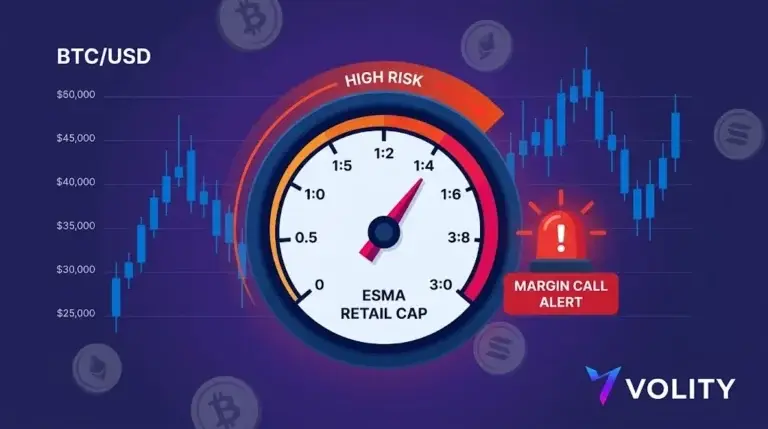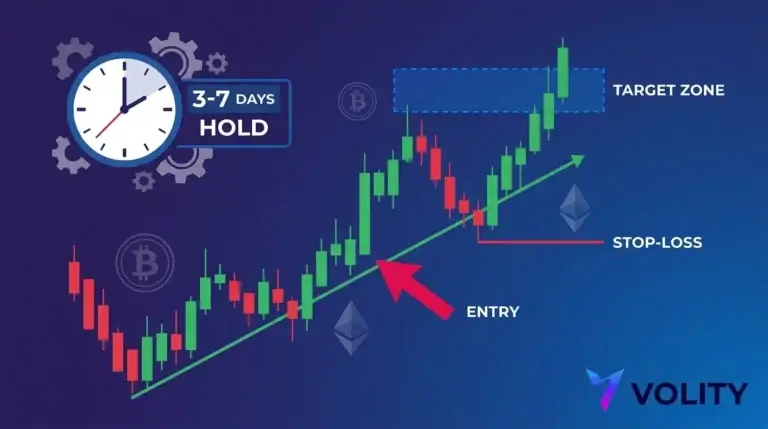
A crypto trading bot is software that places and manages trades for you based on rules you set in advance. Bots watch the market around the clock, react in milliseconds, and remove the emotion that trips up most traders. They are not a shortcut to guaranteed profit. A bot follows its instructions exactly, so a flawed strategy loses money just as automatically as a good one makes it. This guide explains how crypto trading bots work, the main types, and how to use them without handing over more risk than you intend.
The Crypto Trading Starter Kit
A plain-English PDF: what to check before you trade, how orders and risk really work, and the mistakes to skip. Get it free.
Automation has moved from a niche tool for coders to something most active traders run into within their first year. The appeal is simple. Markets never close, but you do, and a bot covers the hours you cannot watch. The catch is just as simple. A bot does what you tell it, not what you meant, so the work shifts from clicking buttons to designing and testing rules that hold up in a live market.
What is a crypto trading bot?
A crypto trading bot is an automated program that connects to an exchange or trading platform and executes orders on your behalf. You define the logic, for example “buy when the price drops three percent and sell when it recovers two percent,” and the bot carries it out every time the condition is met. It does not get tired, it does not panic, and it does not change its mind halfway through a trade.
The trade-off is control versus judgement. A bot is faster and more consistent than any human, but it has no judgement. It cannot tell the difference between a normal dip and a market breaking down on bad news. That is why the strategy behind the bot matters far more than the bot itself, and why testing comes before real money.
The main types of crypto trading bots
Most bots fall into a handful of families, from grid and DCA bots to trend-following and signal bots that act on crypto trading signals. Knowing which one fits your goal saves you from forcing the wrong tool onto the wrong market.
| Bot type | What it does | Best suited to |
| Grid bot | Places buy and sell orders at set intervals above and below a price | Sideways, range-bound markets |
| DCA bot | Buys a fixed amount on a schedule to average the entry price | Long-term accumulation |
| Trend-following bot | Enters in the direction of momentum and exits when it fades | Markets with a clear trend |
| Arbitrage bot | Exploits small price gaps between venues | Fast, low-latency setups |
| Signal bot | Acts on alerts from an external strategy or service | Traders who follow a defined system |
None of these is inherently better than the others. A grid bot that prints steady gains in a quiet market can bleed money the moment a strong trend starts, while a trend-following bot does the opposite. Match the bot to the conditions, and be ready to switch it off when those conditions change.
How to use a crypto trading bot without losing control
The traders who get value from automation treat the bot as one part of a wider plan, not as the plan itself. A few habits separate them from the people who blow up an account on autopilot.
- Backtest before you fund it. Run the strategy against historical data and, ideally, a demo account before a single real coin is at stake.
- Size positions for survival. A bot can place hundreds of trades, so a small per-trade risk still adds up. Decide your maximum exposure first.
- Set hard stops. Build a stop-loss and a daily loss limit into the rules so a bad run cannot run away from you.
- Watch it anyway. Automation reduces work, it does not remove responsibility. Check in regularly and intervene when the market clearly shifts.
- Keep your funds somewhere regulated. The safety of the account behind the bot matters as much as the bot’s logic.
On Volity you trade through a single regulated account on the Volity MT platform, with TradingView charts for building and testing the logic behind any rules-based approach. If you would rather follow an experienced trader than write your own rules, copy-trading/">crypto copy trading lets you mirror vetted traders while keeping oversight of your own account. For the markets you can trade and the conditions that apply to you, see the crypto hub and account types.
Are crypto trading bots worth it?
A bot is worth it when you have a strategy you trust, the discipline to test it, and the patience to monitor it. It is not worth it as a way to skip learning how markets work. The bot amplifies whatever you give it, so a disciplined trader gets a force multiplier and an impulsive one gets a faster way to lose. Start small, prove the logic, and scale only once the results hold up.
Frequently asked questions
Crypto trading bots reward preparation and punish shortcuts. Build a strategy you understand, test it, give it strict risk limits, and keep your capital somewhere regulated. Done that way, automation becomes a tool that works while you sleep instead of a risk you cannot see.
Investing in financial products involves risk. Losses may exceed the value of your original investment.
Sources
This guide draws on the following public sources.
- Bitcoin whitepaper – Nakamoto, Bitcoin: A Peer-to-Peer Electronic Cash System
- Ethereum Foundation – Ethereum protocol developer documentation
- Bank of England – Bank of England Financial Stability in Focus: cryptoassets
- BIS – BIS central bank digital currency principles and features
- European Commission – EU crypto-asset policy and the MiCA framework
- BIS – BIS working paper on crypto trading behaviour and losses
- Financial Stability Board – FSB monitoring of crypto-asset market structure
- Bank for International Settlements – BIS Annual Economic Report chapter on the crypto system
- ESMA – Markets in Crypto-Assets Regulation (MiCA) overview