Investing in financial products involves risk. Losses may exceed the value of your original investment.
The Crypto Trading Starter Kit
A plain-English PDF: what to check before you trade, how orders and risk really work, and the mistakes to skip. Get it free.
Quick answer
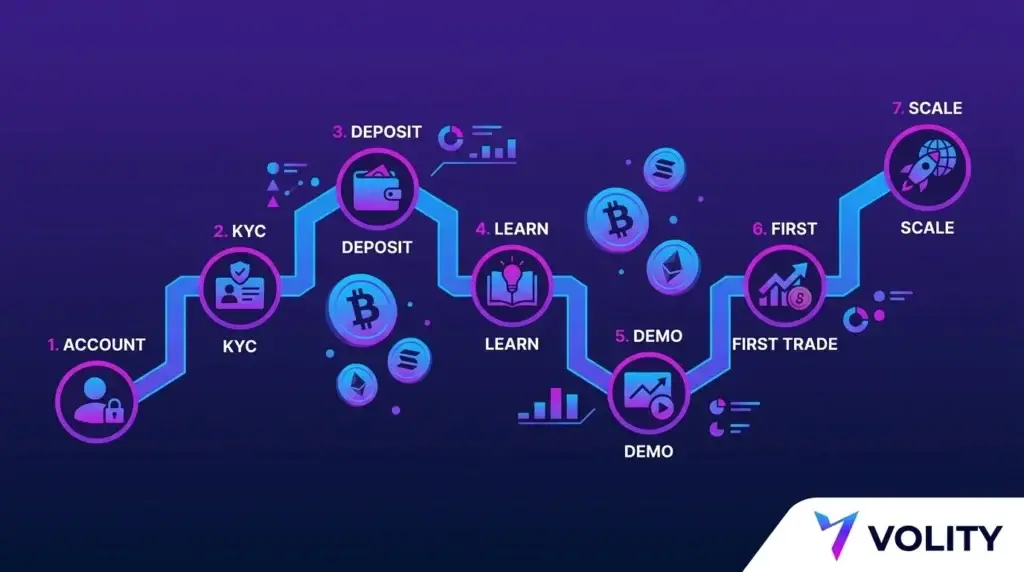
To start crypto trading: pick a regulated venue (CySEC-licensed broker for CFDs, or major regulated exchange for spot), fund with an amount you can afford to lose, learn one or two coins (BTC and ETH first), define risk per trade at 1% of capital, run 30 demo trades to validate edge, then deploy small live capital with strict stop-losses. The 7 steps: educate, register, verify KYC, fund, demo, plan, execute.
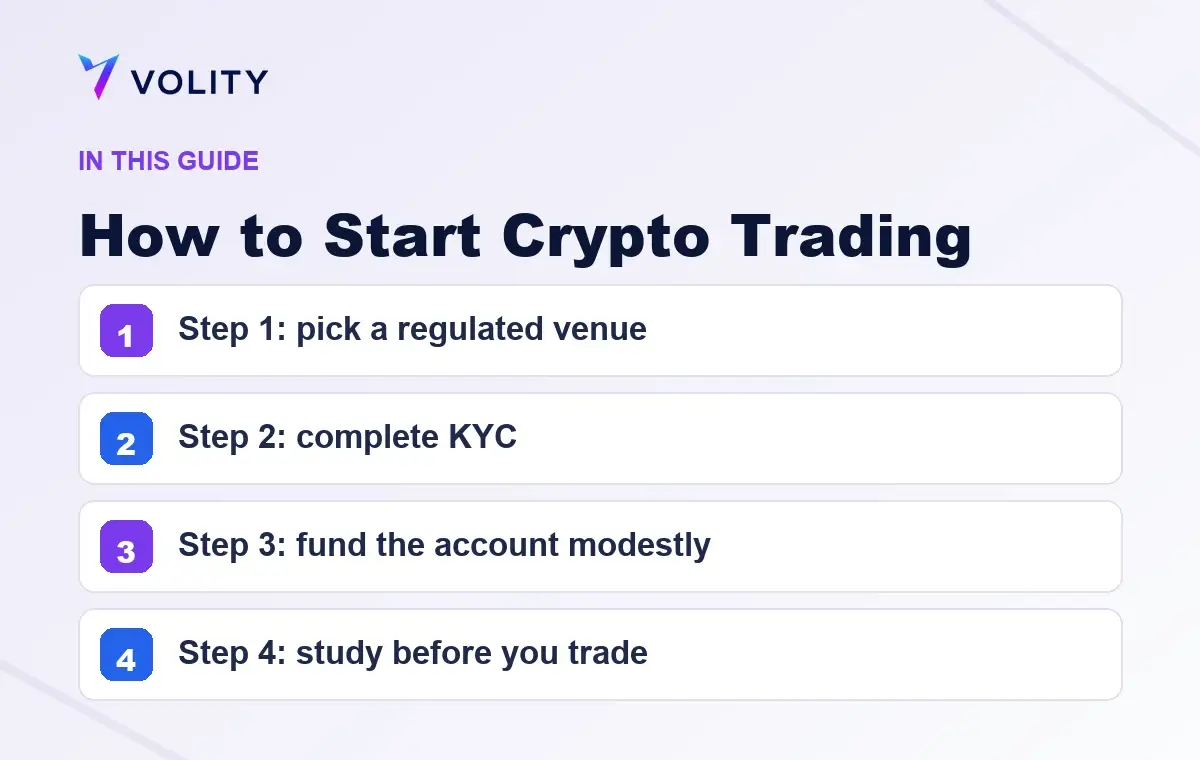
Starting crypto trading in 2026 is straightforward if you reject two temptations: the urge to size up early, and the urge to trade everything at once. The 7-step roadmap below is what we walk new clients through. It assumes nothing except that you have funds you can afford to lose and 10 hours of focused study. Skip steps at your own cost.
Step 1: pick a regulated venue
Three non-negotiables for the venue:
- A real licence on a public register. CySEC, FCA, ASIC, BaFin, MAS. Volity’s trading is by UBK Markets Ltd, CySEC 186/12, verifiable on the CySEC register.
- Negative balance protection. Retail clients of EU-regulated brokers cannot lose more than they deposit; the protection is built into the EU retail client regime.
- Investor compensation. Cyprus ICF covers eligible retail clients up to EUR 20,000 per client per firm in the event of broker insolvency.
An offshore exchange with no licence may have lower fees. It also has no recourse mechanism if your funds disappear. The 0.05% fee saving is not worth the asymmetric risk.
Step 2: complete KYC
Identity verification takes 15 minutes if your documents are ready. You will need a government photo ID, proof of address dated within three months, and (for higher tiers) proof of source of funds. Approval typically lands within 24 hours.
Step 3: fund the account modestly
The right starting capital is the amount you can lose without changing your sleep, your relationships, or your savings plan. For most beginners that number is between $500 and $5,000. Not your emergency fund. Not next month’s rent. Fund via SEPA (free, 0-1 day), card (instant, 1-2% fee), or stablecoin transfer (10-60 minutes).
Step 4: study before you trade
Two weeks of focused reading and observation. Three reading priorities:
- How crypto pricing actually works. Order books, market makers, slippage, funding rates on perpetuals. Bitcoin’s price is set across 200+ venues; understanding the plumbing prevents the most common beginner errors.
- The macro context. Federal Reserve rate decisions, ECB policy, US Treasury yields, dollar index. Crypto correlates more with risk-on/risk-off macro than most beginners realise. The Fed’s H.15 release and ECB monetary policy decisions move crypto.
- The taxonomy. Layer 1s (BTC, ETH, SOL), stablecoins (USDT, USDC), DeFi tokens, infrastructure plays. Trading without knowing what you are trading is a fast path to learning expensive lessons.
Step 5: paper-trade your strategy
Open a demo account on the same platform you will trade live. Run 30 paper trades over two to three weeks. Track each trade in a journal with: setup, entry, stop, target, position size, R-multiple at exit, lesson. Use realistic position sizes; if your live account is $2,000, paper-trade $20 of risk per trade, not $2,000.
By trade 30, you will know which setups work for you and which do not. Cut everything that is not paying.
Step 6: place a small first live trade
The first live trade is 25% of your intended position size, with risk-per-trade set to 0.5% of account equity (half your eventual rule). The point is not the P&L. The point is to feel the difference between paper and live: slippage on entry, the urge to move the stop, the temptation to take profit too early.
Three rules for the first 20 live trades:
- Predefined stop, predefined target. No exceptions.
- One position at a time. Multi-position management is a later skill.
- One asset. Pick BTC or ETH. Altcoins can wait until you have a working process on majors.
Step 7: scale based on track record
After 50 live trades at half size, review the journal. Three scenarios:
- Positive expectancy across at least 30 trades: scale to full position size and 1% risk per trade. Continue journaling.
- Break-even or slightly negative: stay at half size for another 50 trades while you isolate the failure mode. The journal will tell you whether the issue is setup selection, entry timing, or exit discipline.
- Materially negative: drop back to paper. Keep the live account funded but inactive while you debug. There is no shame in this. The shame is doubling down on a process that is not working.
What beginners do that costs them
- Leverage too early. ESMA caps retail crypto leverage at 1:2. Use the cap as a ceiling, not a target. Most beginners should trade unleveraged for the first 100 trades.
- Position-size by feel. Risk-per-trade must be a fixed percentage. Doubling size after a winner is the fastest path to giving back gains.
- Trade altcoins before majors. Bitcoin and Ethereum have the deepest liquidity and the cleanest data. Master them first.
- Skip the journal. The journal is the only mechanism that turns trades into learning. Without it, you are guessing.
Crypto trading at Volity
Volity offers CFD exposure to 20+ cryptocurrencies on MT4 and MT5. Retail leverage is capped at 1:2 under ESMA. Negative balance protection applies. Cyprus ICF covers eligible retail clients up to EUR 20,000 per client per firm. Trading is executed by UBK Markets Ltd (CySEC 186/12). Account opening typically completes within 24 hours.
Common questions
Is crypto trading legal in the European Union?
Yes. CFDs on cryptocurrencies are legal in the EU and UK under MiFID II / FCA rules. Volity routes execution through UBK Markets Ltd under CySEC licence 186/12, with negative balance protection for retail clients. Spot crypto trading is also legal but subject to MiCA registration for the venue and KYC for users.
How much do I need to start trading Bitcoin?
$1 opens a Volity Markets account, enough to size micro-positions on BTC and ETH without material risk. A working live account that can express full crypto strategies wants $500 to $2,000. The on-ramp is genuinely small; the discipline gap is what separates accounts that grow from those that liquidate within ninety days.
Should I use a CFD broker or a crypto exchange?
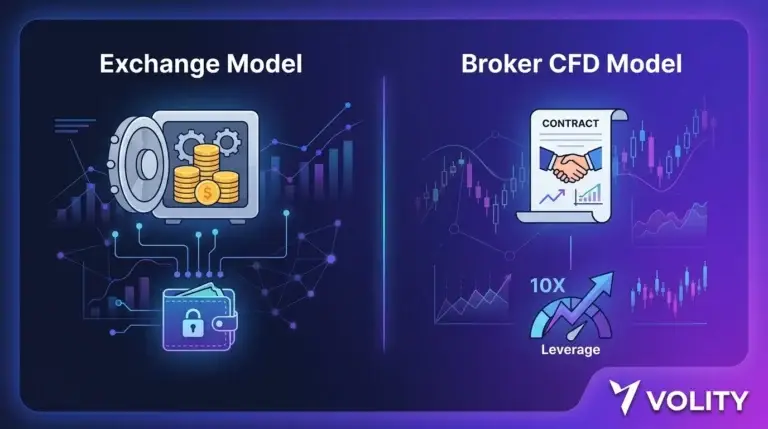
Use a CFD broker if your goal is to trade direction, short with one click, and run controlled-leverage strategies under a regulated framework. Use a spot exchange if your goal is to hold crypto for years, self-custody, or interact directly with the chain. Many traders use both: a Volity account for active trading, a spot exchange for long-term holds.
Volity operates a trading platform and also publishes educational and analytical content about trading. The content on this page is for educational purposes only and should not be considered financial advice. Volity may benefit commercially when readers open trading accounts through links on this site.
Our content is produced and reviewed under documented editorial standards; see our comparison and review methodology.