Investing in financial products involves risk. Losses may exceed the value of your original investment.
The Crypto Trading Starter Kit
A plain-English PDF: what to check before you trade, how orders and risk really work, and the mistakes to skip. Get it free.
Quick answer
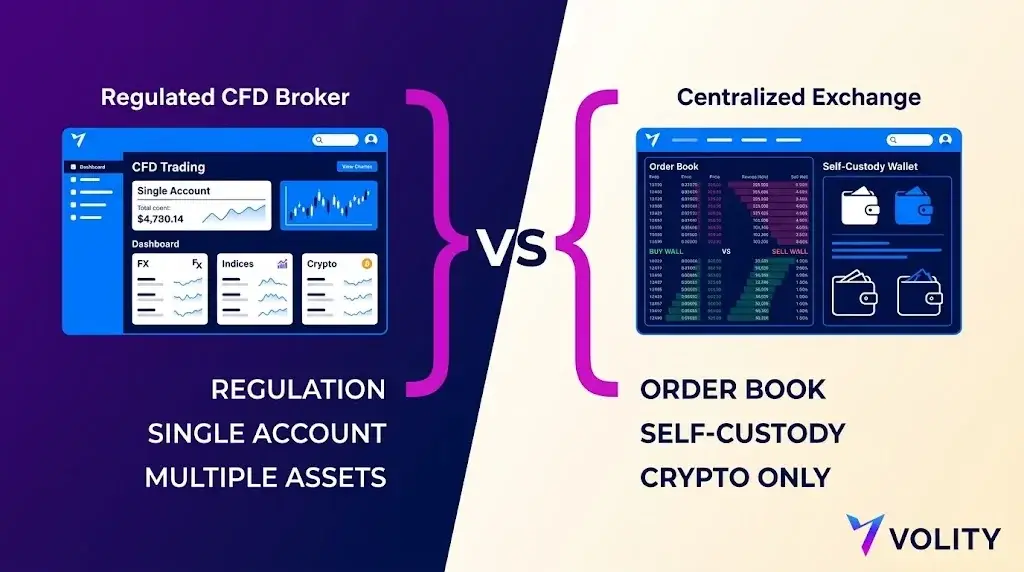
Crypto broker vs exchange is a choice between CFD-style speculation (broker) and spot-token ownership with self-custody (exchange). Brokers offer leverage, regulated venues (CySEC/FCA), and traditional account flow. Exchanges offer self-custody, on-chain transfers, and DeFi access. Brokers fit short-term speculation; exchanges fit long-term holding and on-chain use.
The choice between a regulated broker and a crypto exchange is not about which is better in the abstract. It is about which fits your use case. A broker like Volity offers CFD-reference exposure to crypto alongside forex, indices, commodities, and equities on one regulated account, with retail leverage capped at 1:2 under ESMA. A centralised exchange (CEX) offers direct ownership of the underlying token with self-custody options. Each has different cost, custody, leverage, and tax implications. Most active traders end up using both, for different jobs.
For derivatives specifically, the same choice comes down to custody and transparency, covered in perp DEX versus centralised exchange.
The structural difference
| Dimension | Regulated broker (CFD) | Centralised exchange |
|---|---|---|
| Underlying held | No (price-reference contract) | Yes (or in custody) |
| Other asset classes on same account | Yes (FX, indices, commodities, equities) | Crypto only (mostly) |
| Regulator | Securities regulator (e.g., CySEC) | Crypto-asset regulator (MiCA in EU; varies) |
| Leverage available to retail | 1:2 on crypto under ESMA | 0-1:5 EEA, higher offshore |
| Negative balance protection | Mandatory on retail accounts | Not standard |
| Investor compensation scheme | Yes (e.g., ICF EUR 20,000) | Sometimes; varies by jurisdiction |
| Custody | Broker-side; client money segregated | Exchange wallet or self-custody |
| Withdrawal of underlying | Cash settlement only | On-chain to your wallet |
| Tax reporting | Single annual statement typical | Per-trade disposal events |
When a broker fits
Five clear use cases:
- Multi-asset trader. You want crypto exposure alongside FX, gold, the S&P 500, and individual equities on one platform with one P&L. CFD brokers consolidate this. Exchanges do not.
- Tax simplicity. CFD trades are typically reported on a single annual statement; spot crypto trades on an exchange create per-disposal taxable events that must be reconciled with cost basis.
- Regulated venue preference. You want a securities regulator overseeing the firm, segregated client money, and an investor compensation scheme. Broker-dealer regulation is more mature than crypto-specific regulation in most jurisdictions, though MiCA is closing the gap.
- No custody operations. You do not want to manage seed phrases, hardware wallets, or smart-contract approvals. Broker-side custody removes this entirely.
- Short exposure. CFD perpetuals on a regulated broker make shorting straightforward without crypto-specific lending markets.
When an exchange fits
Three clear use cases:
- You want the underlying. Self-custody, on-chain transfer to your wallet, ability to bridge to L2s, lend on DeFi, or use as collateral. A broker cannot do this; the asset never leaves the contract wrapper.
- You want altcoin breadth. Major exchanges list 200-500+ tokens. Brokers typically cover 20-50 majors and large mid-caps. If your strategy depends on small-cap discovery, an exchange is the only path.
- You want native staking or yield. ETH staking, stablecoin yield, exchange-managed earn products. These are exchange-side products that brokers do not replicate.
The cost comparison
Headline rates favour exchanges (0.05-0.5% per side) versus brokers (typically built into the spread). The all-in math depends on what you actually pay:
- Exchange: commission per trade + bid-ask spread + on-chain withdrawal fee + funding rate (if perpetual).
- Broker: bid-ask spread + overnight financing on leveraged positions + (typically) no platform-side withdrawal fee.
For a $5,000 BTC round-trip held for one day at zero leverage, both venues land within roughly 10-20 basis points of each other after fees. The cost gap widens only at high frequency or in altcoins where exchange spreads tighten faster.
The custody and counterparty risk reality
The 2022 collapse of FTX cost retail account holders an estimated $8bn at the time. Exchange counterparty risk is real and historical. Mitigations:
- On-exchange: keep only active trading capital; move long-term holdings to self-custody.
- Self-custody: hardware wallet, properly backed-up seed phrase, multi-sig for larger holdings.
- Regulated broker: client money segregation under MiFID II; investor compensation scheme coverage in the event of broker insolvency.
Volity client money is held in segregated accounts under CySEC rules. Eligible retail clients are covered by the Cyprus Investor Compensation Fund up to EUR 20,000 per client per firm.
The leverage and protection comparison
- EEA broker: 1:2 retail crypto leverage, mandatory negative balance protection, MiFID II suitability assessment for higher tiers.
- EEA-licensed exchange (under MiCA): limited or no leverage on most retail products; spot only is the default.
- Offshore exchange: 1:50, 1:100, sometimes higher. No negative balance protection, so a gap through your margin level can leave a debit balance you owe.
Tax and reporting
Most jurisdictions treat crypto held on an exchange as property, with each disposal a taxable event. CFD trades on a regulated broker often produce a single consolidated annual statement, simplifying reconciliation materially. HMRC and most EU tax authorities accept broker statements for CFD reporting; for exchange spot activity, full per-trade reconciliation is typically required. Rules vary by jurisdiction; consult a local advisor.
The honest answer for most retail traders
If you want diversified market exposure on a regulated venue, with one account, one P&L, and predictable reporting: a broker fits. If you want the underlying token, altcoin breadth, or DeFi composability: an exchange fits. Many serious traders run both: broker for liquid majors and cross-asset, exchange for the underlying and altcoin discovery.
Crypto trading at Volity
Volity offers CFD exposure to 20+ cryptocurrencies plus forex, indices, commodities, and equities on MT4 and MT5. Trading is executed by UBK Markets Ltd, a Cyprus Investment Firm authorised by CySEC under licence 186/12. Retail leverage is capped at 1:2 on cryptoassets under ESMA. Negative balance protection applies on retail accounts. Eligible retail clients are covered by the Cyprus Investor Compensation Fund up to EUR 20,000 per client per firm.
Volity operates a trading platform and also publishes educational and analytical content about trading. The content on this page is for educational purposes only and should not be considered financial advice. Volity may benefit commercially when readers open trading accounts through links on this site.
Our content is produced and reviewed under documented editorial standards; see our comparison and review methodology.
Frequently asked questions
What is the practical difference between a crypto broker and an exchange?
An exchange matches your order against other users on a public order book. A broker quotes you a price and takes the other side or routes it onward. The exchange shows you the market; the broker gives you a price.
Which is cheaper?
Exchanges usually publish lower headline fees, but the all-in cost depends on the spread you actually receive and any funding or withdrawal charges. For small sizes, a broker's wider spread can still cost less than an exchange's fees plus slippage.
Which should a beginner choose?
The one whose risk you can assess. A regulated broker gives you a clearer counterparty and a complaints route; an exchange gives you transparency of pricing and self-custody options. Both are defensible, provided you check the entity before funding it.