Crypto derivatives now run on two different venue models. One keeps the order book inside a company’s matching engine and holds your margin on the operator’s own systems. The other runs the book on a blockchain, where every order, cancel, trade and liquidation happens transparently with one-block finality. This perp DEX vs centralised exchange comparison sticks to the places the two models genuinely diverge: where your margin sits, what you can check yourself, when the market is open, how the funding rate is set, and how a liquidation reaches you. Neither model wins on every line.
The Crypto Trading Starter Kit
A plain-English PDF: what to check before you trade, how orders and risk really work, and the mistakes to skip. Get it free.
TL;DR / Quick insight: On a centralised venue your margin is a balance the operator records for you, and you verify it through the operator’s own reporting. On an on-chain perpetuals venue the margin sits against your address in consensus state, and the order book, the funding rate and the liquidations are public data anyone can query. That openness is real, and it is paid for with real trade-offs: no compensation scheme, no central counterparty standing behind the trade, bridge and smart contract exposure, and full responsibility for your own keys.
Nothing here is personal advice. Leveraged perpetual futures can lose more than the margin you posted against a position, and a liquidation closes a position whether or not you are watching.
Where your margin sits in each model
On a centralised exchange you transfer funds to an address the venue controls, and what you hold afterwards is a balance the venue records for you. That arrangement works well and clears enormous volume every day, but the balance is an entry in the operator’s ledger, and its safety depends on how client assets are held and separated from the firm’s own. The Financial Stability Board’s High-level Recommendations for the Regulation, Supervision and Oversight of Crypto-Asset Activities and Markets devotes a recommendation to exactly this, because a firm that runs trading, custody and lending under one roof can face conflicts between its own book and its clients’ assets.
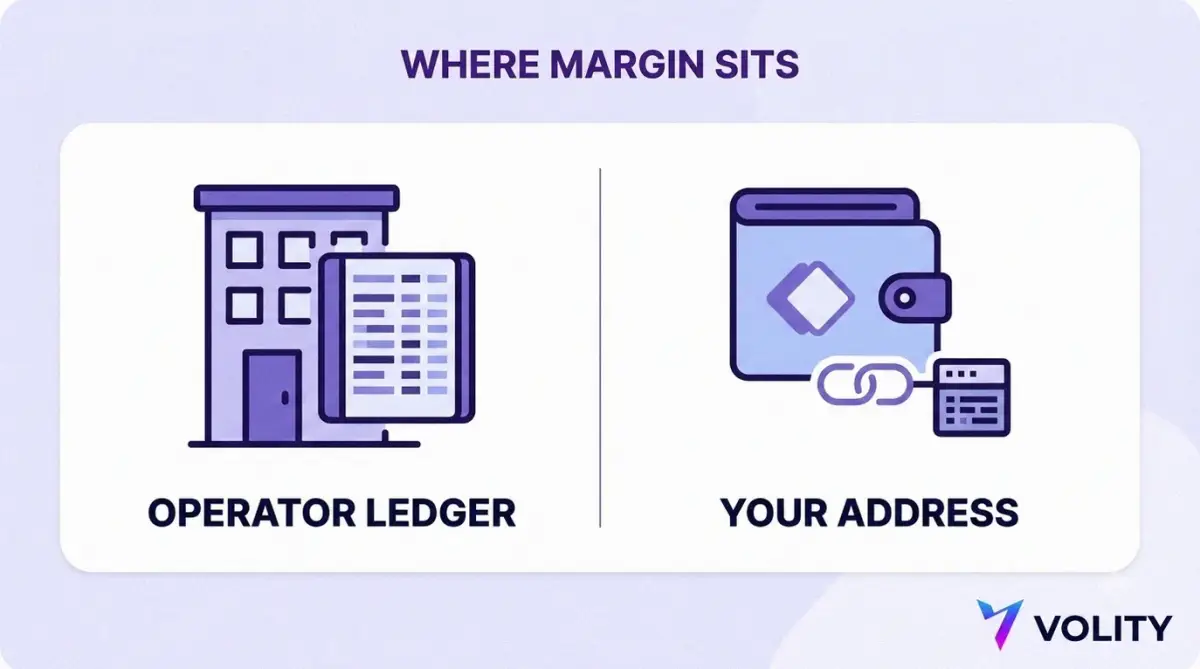
An on-chain venue records the same information somewhere else. On Hyperliquid the perps clearinghouse is a component of the execution state that manages the margin state for each address, including balance and positions. Your margin is attached to a wallet you control rather than to an account the venue opens for you, and cross margin and isolated margin are both handled at that level. If you want the underlying concepts first, our explainer on what a decentralised exchange is covers the general model.
Self-custody does not mean you have removed every counterparty. Collateral reaches the venue through a bridge contract on Arbitrum, where deposits are credited when more than two thirds of the staking power has signed the deposit, with withdrawals signed the same way and held through a dispute period before finalisation. One distinction is worth drawing here, because the two get conflated constantly. Moving value between HyperCore and the HyperEVM is not a bridge at all, since the HyperEVM is not a separate chain, but rather secured by the same HyperBFT consensus as HyperCore. Cross-chain risk attaches to the Arbitrum deposit route, not to that internal transfer. Either way you have swapped a company for a validator set and a contract, which is a different risk rather than an absent one.
What you can verify yourself, and what you take on trust
This is the sharpest difference between the models. HyperCore does not rely on the crutch of off-chain order books, and every transaction is ordered by HyperBFT consensus, so the book state is public rather than reported. Anyone can query it. Reading the venue’s public info endpoint on 2 August 2026 returned 297 live perpetual markets, about $10.2 billion of open interest and roughly $2.1 billion of notional volume over the previous 24 hours, computed from the raw perpetuals data the API publishes rather than copied off a dashboard. At the same moment CoinGecko’s derivatives API reported open interest of 162,122 BTC, which converts to the same $10.2 billion and agrees with the venue’s own figure to within roughly a tenth of a percent. Those numbers move continuously and are quoted as of that date. Being able to reconcile a venue against an independent aggregator in real time is the practical shape of what on-chain publication buys you.
A centralised venue answers the same question with periodic attestation instead of live data. Proof-of-reserves programmes are a genuine improvement on nothing: an independent accountant takes an anonymised snapshot of balances, aggregates them into a Merkle tree, and collects signatures proving control of on-chain addresses. The venues that publish these are also candid about the limits. Kraken’s own description says the procedure cannot prove exclusive possession of private keys, cannot identify hidden encumbrances or prove that funds had not been borrowed for purposes of passing the review, and that keys may have been lost or funds stolen since the latest review. A snapshot is a photograph, and the market moves between photographs.
Openness has a ceiling on the other side too. The Bank for International Settlements argued in its 2022 Annual Economic Report chapter on the future monetary system that full decentralisation is largely illusory, because governance needs decision-makers and decision-making concentrates. The clearest example is on the venue itself. Hyperliquid’s mark price comes from an oracle, and validators publish spot oracle prices every 3 seconds as the weighted median of Binance, OKX, Bybit, Kraken, Kucoin, Gate IO, MEXC and Hyperliquid spot mid prices, weighted 3, 2, 2, 1, 1, 1, 1 and 1. The on-chain venue prices its markets partly from centralised ones.
Continuous markets versus a session calendar
Crypto venues of both kinds quote around the clock, so the interesting comparison is not one against the other but both against the traditional session calendar. ICE Brent Crude futures, one of the most globally traded contracts in existence, runs 01:00 to 23:00 London time on ICE business days, with a Sunday pre-open at 22:00 and a Sunday open at 23:00. There is a daily gap and a weekend gap, and news that arrives inside those gaps expresses itself as a jump when the market reopens.
Permissionless listing has made that contrast sharper. Since HIP-3, any deployer meeting a 500,000 HYPE staking requirement can deploy a perp dex and is responsible for the market definition, the oracle definition and the contract specification. The same rules let the deployer choose the collateral, because any quote asset can be used as the collateral asset for a dex, so margining in USDC is a property of the main HyperCore book rather than a blanket protocol guarantee. That is also how real-world-asset perpetuals arrived. On 2 August 2026 the largest builder-deployed dex on the venue held about $3.5 billion of that $10.2 billion of open interest and listed equity, index and commodity contracts alongside crypto, which means you can carry exposure to something whose primary cash market is shut. Read that carefully before you trade it. When the underlying market is closed, the price you see is derived from the deployer’s oracle rather than from live cash trading, and the reopen can move against a position that looked calm all weekend.
Continuous also does not mean uninterrupted. Software upgrades, node incidents and consensus problems can stop trading on an on-chain venue, just as maintenance windows and outages can on a centralised one. A market that never closes is a market where a stop can be hit at four in the morning, which is a workflow question as much as a technical one.
A published funding formula versus a rate the operator sets
Perpetual futures have no expiry, so a periodic payment between longs and shorts keeps the contract tethered to spot. What differs is who computes it and how visible the computation is. Hyperliquid publishes the arithmetic: Funding Rate (F) = Average Premium Index (P) + clamp(interest rate – Premium Index (P), -0.0005, 0.0005), with the interest component fixed at 0.01% every 8 hours, funding paid every hour at one eighth of the computed rate, and the whole thing capped at 4% per hour. When the contract trades above spot the long pays the short, and when it trades below the short pays the long.
You can check that the published formula is what actually happens. Reading the same public endpoint on 2 August 2026, the hourly BTC funding rate was 0.00125%, which is precisely the fixed interest component with the premium at zero, and which the documentation describes as 11.6% APR paid to shorts. Here is what those rates cost on a $10,000 notional position held for a week, using the base tier taker fee of 0.045% and maker fee of 0.015%.
| Cost line | Rate | On $10,000 notional |
|---|---|---|
| Taker fee to open | 0.045% | $4.50 |
| Taker fee to close | 0.045% | $4.50 |
| Funding, per hour | 0.00125% | $0.125 |
| Funding, 7 days held | 0.21% | $21.00 |
| Total round trip plus a week of funding | $30.00 |
A centralised venue publishes a funding methodology too, and most of them document it properly. The distinction is narrower than the marketing on either side suggests: the operator computes the inputs, the operator can revise the methodology, and you see the output. An on-chain formula can also be changed, through governance rather than a product decision, so the real question is who is able to change the rule and whether you would see it happen. Our breakdown of Hyperliquid fees and volume tiers works through what an active trader actually pays, and how perpetual contracts work covers the instrument itself.
Liquidations in the open versus liquidations you are told about
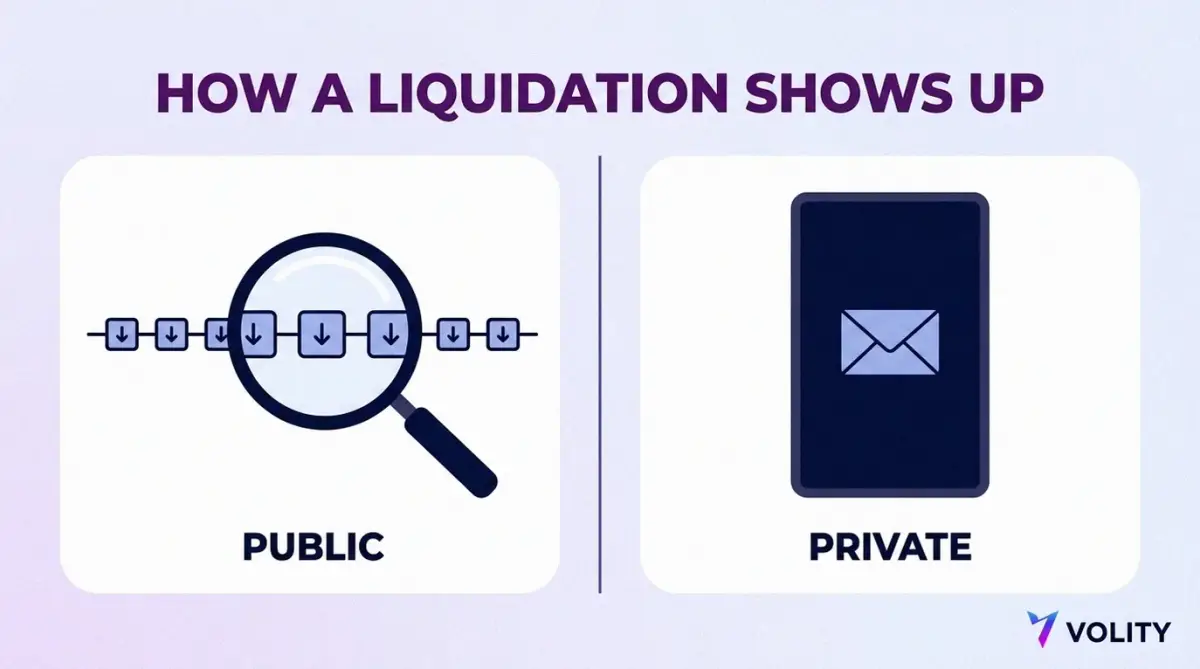
On an on-chain venue a liquidation is a consensus transaction, which means it is public the moment it happens. Hyperliquid’s documentation sets maintenance margin at half of the initial margin at maximum leverage, which varies from 3x to 40x, so the threshold sits somewhere between 1.25% and 16.7% depending on the asset. Most liquidations are routed straight to the order book so anyone can compete for the flow, and only when account equity falls below two thirds of the maintenance requirement does the liquidator vault step in as a backstop. That vault is a component strategy of HLP, and the profit and loss stream from liquidations goes to the community rather than to an operator.
Visibility cuts both ways, and pretending otherwise would be dishonest. A public liquidation level is also a public target, and a large position with a known threshold can be pushed toward it. The JELLY episode on 26 March 2025 showed both sides of the same coin: a trader engineered a squeeze that left the protocol vault holding a losing position, and the validator set voted to delist the JELLY perpetual and settle open positions at a set price. Everyone could watch it, and a small group could still intervene.
The centralised model handles the same event privately. You learn your position was closed because the venue tells you, and the insurance fund and any auto-deleveraging mechanism work according to rules published in the venue’s own documentation. Plenty of traders prefer that. A liquidation nobody else can see is a liquidation nobody else can hunt.
What an on-chain venue asks you to give up
Every advantage above has a price attached, and these risks sit with you rather than with any intermediary.
- No compensation scheme. You should be prepared to lose the money you put in. This applies to crypto venues of both kinds, so it is not a point that separates them, but it does separate both from a protected savings product.
- No central counterparty. Nothing guarantees performance of the other side of your trade the way a clearing house does in listed markets. Shortfalls are absorbed by protocol backstops, and those backstops have finite capacity.
- Smart contract and bridge exposure. Bridges are the historic weak point of the whole sector. Chainalysis counted $2 billion stolen across 13 separate cross-chain bridge hacks, amounting to 69% of all funds stolen in 2022. Hyperliquid’s bridge has been audited by Zellic and its code published, which reduces the risk without deleting it.
- Validator and governance risk. A stake-weighted validator set signs bridge withdrawals and can vote on the market set. The Bank of England’s Financial Stability in Focus on cryptoassets and decentralised finance flags leverage and operational fragility in these markets as the risks to watch.
- Your keys are your problem. Lose the key and there is no password reset, no identity check and no support desk that can reverse a signed transaction.
- Oracle dependence. Margining, liquidation and funding all rest on a price feed. If that feed is wrong or stale, the consequences reach your position before anyone can correct it.
Which model suits which kind of trader
Match the model to what you actually need from a venue rather than to which one sounds more modern.
| What you care about | On-chain perpetuals venue | Centralised exchange |
|---|---|---|
| Where margin is recorded | Against your own address in consensus state | As a balance on the operator’s systems |
| Checking the book and the flow | Query it live yourself | Operator reporting and periodic attestation |
| Funding rate | Published formula, paid hourly, capped | Published methodology, operator computed |
| Liquidations | Public transactions anyone can see | Private to you and the venue |
| Account recovery | None, key loss is final | Identity-based recovery normally available |
| Extra technical exposure | Bridge, smart contract, validator set, oracle | Operator solvency and internal controls |
| Getting started | Wallet and a bridge deposit | Account opening and onboarding checks |
Before you commit margin to either model, work through the following.
- Read where the venue says client balances are held, and whether you can confirm it independently.
- Find the funding methodology in the venue’s own documentation and check the payment interval and any cap.
- Look up the maintenance margin for the specific market you want, not the venue average.
- Establish what happens to your position if the venue halts, upgrades or delists a contract.
- Decide how you will recover access if you lose a device, and test it before you need it.
- Size the position so that a gap through your level is survivable, because a stop is not a guarantee.
If the underlying mechanics are still new to you, start with how an on-chain order book works, then why these contracts are margined in USDC and how to read margin health and a liquidation price. The rest of our crypto guides fill in the wider context.
Where Volity fits
The Markets screen in your Volity dashboard lets you connect a Hyperliquid account, fund it from your Volity USD wallet and see available balance, account value, margin used, open positions and unrealised P&L from the same place you manage everything else. The flow runs the same way each time: connect or create your account at the venue, deposit from your Volity USD wallet, then trade on the venue and track the balance from your dashboard.
Volity is the funding and tracking layer here, not the venue. Balances and positions are held on the external platform, and trading, availability and withdrawals are subject to that platform’s own terms. Volity does not place or manage orders on your behalf and does not take the other side of anything you trade. The step-by-step version is in our guide to funding a Hyperliquid account.
Is a perp DEX safer than a centralised exchange?
Neither is safer in general, because they fail in different ways. An on-chain venue removes the risk that an operator misuses balances it holds for you, and adds smart contract, bridge, validator and oracle exposure in its place. A centralised venue removes the technical burden and gives you account recovery, and asks you to rely on its controls and its reporting. Cryptoasset trading generally falls outside consumer compensation schemes either way, so check what applies to any venue before you fund it.
Can I see other traders’ liquidations?
On an on-chain venue, yes. Liquidations are consensus transactions, so a cascade is observable in real time by anyone reading the chain or the public API. Most liquidations are routed to the order book, so market participants can compete to take the other side. On a centralised venue you generally see aggregate liquidation data if the venue chooses to publish a feed, and individual events stay private.
Who holds my margin on a perp DEX?
The margin is recorded in the venue’s clearinghouse state against your own wallet address rather than in an account the venue opens for you. That said, funds usually arrive through a bridge secured by a validator set, so the money passes through infrastructure you do not control. Self-custody at the venue and a trust-free path into it are two different things.
What happens if the venue goes down?
Positions stay open and keep their exposure to price while you may be unable to add margin or close. Both models are subject to this. On a chain the cause is usually a consensus or node problem and the state is preserved once blocks resume; on a centralised venue it is an internal outage or a maintenance window. Size positions on the assumption that you will not always be able to act instantly.
Is there deposit insurance?
No. There is no deposit protection on crypto derivatives trading in either model, and the FCA warns that cryptoasset buyers are unlikely to have access to the Financial Ombudsman Service or the Financial Services Compensation Scheme. Some venues run an insurance fund to absorb shortfalls from liquidations, which is a protocol backstop with a finite balance and not a compensation scheme. Treat any amount you post as margin as fully at risk.