Investing in financial products involves risk. Losses may exceed the value of your original investment.
The Crypto Trading Starter Kit
A plain-English PDF: what to check before you trade, how orders and risk really work, and the mistakes to skip. Get it free.
Quick answer
To pick crypto for day trading, use five filters: 24-hour volume above $200M (liquidity), realised daily ATR above 2% of price (movement), bid-ask spread under 5 bps (cost), regular news/catalyst flow (price drivers), and order-book depth that holds at $100k+ trade size on the venue you trade. Coins meeting all five at any moment is a small set: BTC, ETH, SOL, BNB, plus rotating mid-caps.
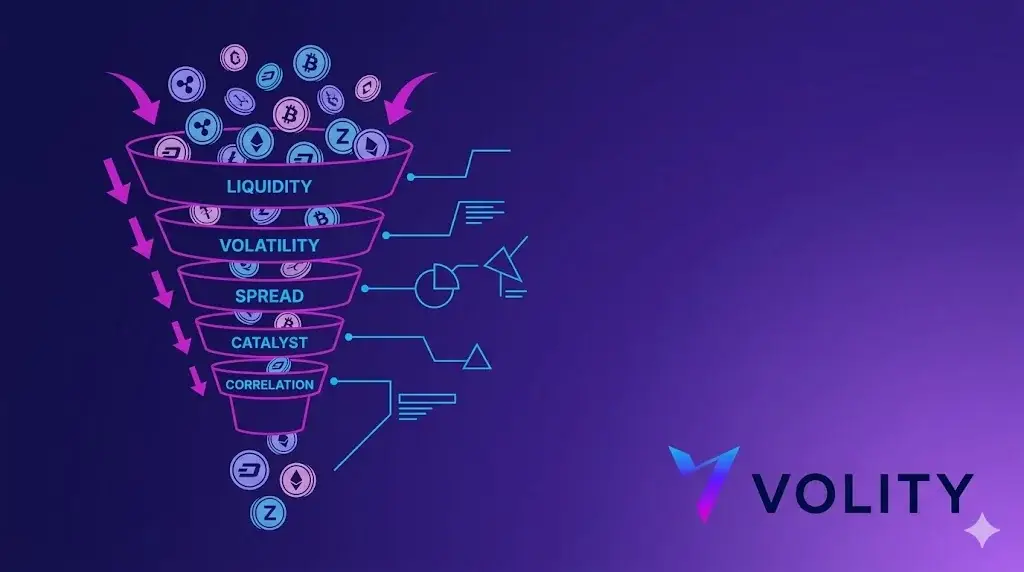
Day trading crypto is not about picking the coin that will move the most today. It is about picking the coin where your edge survives execution. The wrong coin can be a perfect setup and still lose money to a 30-basis-point spread, a mid-session liquidity cliff, or an unrelated correlated move. Here is the 5-filter framework we run before any intraday setup.
Filter 1: liquidity
Daily volume is the floor. Below $200m of 24-hour volume across major venues, your stop will not fill at the advertised price during a fast move. Above $1bn, slippage on a 0.5 BTC ticket is invisible. The honest rule:
- Tier 1 ($1bn+ daily): BTC, ETH, SOL, XRP, BNB. Trade with confidence at any retail size.
- Tier 2 ($200m-1bn): large-cap altcoins, top-30 by market cap. Trade with caution; size down 30-50%.
- Tier 3 (under $200m): do not day-trade. Slippage will eat the edge.
CoinMarketCap and Kaiko publish reliable venue-level volume data, and regulated crypto-futures volume published daily by the listing exchange is a useful proxy for institutional engagement. Cross-check at least two, because self-reported exchange volume is not uniformly audited.
Filter 2: realised volatility
Day trading needs movement. A coin that does 0.8% per day is not a day trade; it is a savings account. The metric we use is 14-day Average True Range as a percentage of price. Three bands:
- Under 2% daily ATR: too tight. Move on.
- 2-5% daily ATR: workable. The standard band for BTC and ETH most months.
- Over 5% daily ATR: hot. High return potential, high stop-out frequency. Size down.
Volatility is not edge by itself. A coin that moves 8% per day with no setup is just noise. Volatility is permission to deploy edge.
Filter 3: spread and depth
The bid-ask spread plus the slippage on a typical ticket is the cost of doing business. On a CFD-reference platform like Volity, the spread is built into the quoted price; on a centralised exchange, you pay maker/taker fees in addition.
Two checks:
- Average spread during your trading window. BTC/USD is typically 1-3 bp on tier-1 venues. A coin that quotes 15 bp is bleeding 15 bp every round trip. At 5 trades a day, that is 75 bp of cost; you need a 1%+ daily edge just to break even.
- Depth at your size. Look at the top 5 levels of the order book. If your typical ticket size is 5% of the visible depth, you will move the market on entry and exit. Cut the size or cut the coin.
Filter 4: news catalyst on the day
Edge concentrates around catalysts. Five recurring categories:
- Macro releases: FOMC decisions, US CPI, ECB policy decisions. Schedule from the Federal Reserve and ECB calendars.
- Project-specific: hard forks, mainnet launches, token unlocks (vesting schedules), exchange listings.
- Regulatory: SEC enforcement actions, CFTC clarifications, EU MiCA implementation milestones.
- ETF flows: spot bitcoin ETF daily flow data published by issuers and aggregated by Bloomberg and Coinglass.
- On-chain: large whale moves, exchange inflows/outflows. Glassnode and Nansen publish timely on-chain data.
A coin with no catalyst on the day is a coin trading on noise. Skip it.
Filter 5: correlation
Day trading three altcoins that are 90% correlated to ETH is one trade with three tickets. The risk concentrates; the diversification is illusory.
The check: rolling 30-day correlation to BTC and ETH. Above 0.85, it is a beta play on the major. Below 0.6, it has a real independent driver. The screen we run keeps no more than two highly correlated names in the daily watchlist.
Putting the filters together
A coin that passes all five filters: $200m+ daily volume, 2%+ daily ATR, sub-5 bp spread, a catalyst on the day, and correlation under 0.8 to BTC. That coin gets the setup work. Coins that fail any single filter come off the watchlist for the day. This is not exclusion permanently; conditions change daily. The filters re-run every morning.
Day trading crypto at Volity
Volity offers CFD exposure to 20+ cryptocurrencies including BTC, ETH, SOL, XRP, BNB and major altcoins, on MT4 and MT5. Retail leverage is capped at 1:2 under ESMA. Negative balance protection applies. Trading is executed by UBK Markets Ltd (CySEC 186/12). For a deeper view of intraday setup selection see our crypto day trading guide.
Common questions
What makes a crypto pair tradeable for day trading?
Five filters: liquidity (24h volume above $200M), spread (under 5 basis points on the venue), volatility (daily ATR above 2% of price), session-aligned news flow, and predictable patterns from prior price action. BTC and ETH pass all five reliably. Mid-cap alts pass intermittently. Memecoins fail the spread and reliability checks more often than not.
How much liquidity do I need for crypto day trading?
At Volity the rule of thumb is venue depth at least 100x your typical position size. For a $1,000 position that means $100,000 of bid/ask depth within 0.5% of mid. BTC and ETH always meet this on the primary tape. Below the top-20 by market cap, depth drops fast outside US and Asia open windows.
Should I day trade memecoins?
Most retail accounts that try this lose money. Memecoins fail the liquidity and spread filters most of the time, gap on social-media flow that no chart pattern predicts, and have order-book depth that disappears at the first sign of volume. The adrenaline pattern is genuine; the risk-adjusted return rarely is. Stick to majors until the journal proves otherwise.
Volity operates a trading platform and also publishes educational and analytical content about trading. The content on this page is for educational purposes only and should not be considered financial advice. Volity may benefit commercially when readers open trading accounts through links on this site.
Our content is produced and reviewed under documented editorial standards; see our comparison and review methodology.