The Crypto Trading Starter Kit
A plain-English PDF: what to check before you trade, how orders and risk really work, and the mistakes to skip. Get it free.
Bitcoin trading involves high market volatility. The Bitcoin halving is a protocol-level supply reduction that has historically influenced price cycles, but future performance is never guaranteed. Always use appropriate risk management and only invest capital you can afford to lose. Past performance is not indicative of future results. Capital at risk.
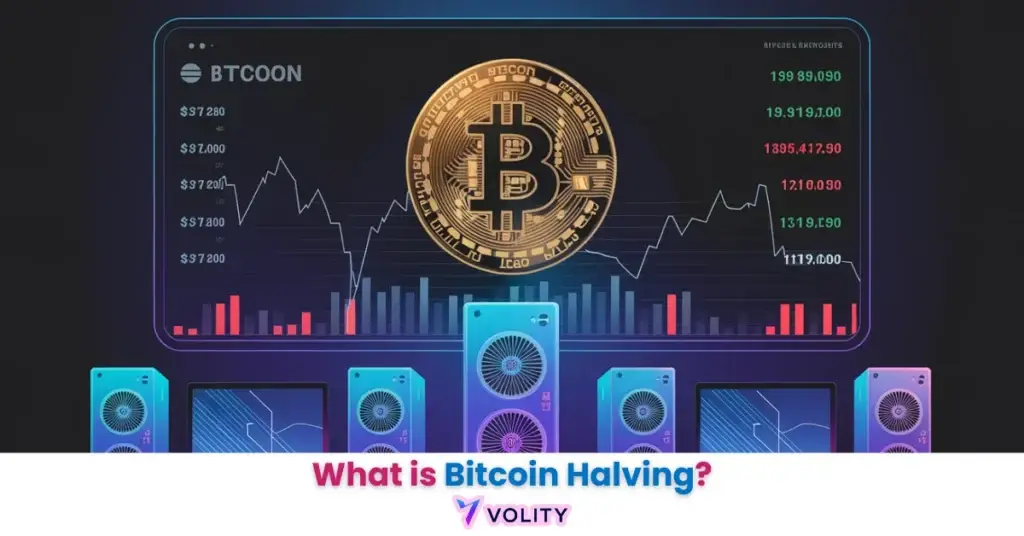
Bitcoin halving is a pre-programmed event that reduces the reward for mining new blocks by 50% every 210,000 blocks. The 2024 halving reduced rewards to 3.125 BTC, while the 2028 event will further cut them to 1.5625 BTC, reinforcing Bitcoin’s digital scarcity. Understanding these supply shocks reveals the core of Bitcoin’s deflationary economic model and its impact on long-term value.
Bitcoin halving represents the protocol’s primary mechanism for enforcing digital scarcity by cutting the issuance of new coins by half every four years. This event identifies the transition into a new ‘epoch’ of the network, reducing the daily supply of BTC available for sale by miners. In April 2024, the fourth halving successfully lowered the block subsidy to 3.125 BTC, pushing Bitcoin’s annual inflation rate below 1%.
The interaction between shrinking supply and growing institutional demand, particularly following the 2024 SEC approval of Spot ETFs, has fundamentally altered the asset’s market cycles. While historical data shows a lag between the halving and peak price appreciation, the 2028 countdown is already influencing long-term accumulation strategies. This guide examines the mechanics of the halving and its verified historical impacts on the global financial landscape.
While understanding Bitcoin Halving is important, applying that knowledge is where the real growth happens. Create Your Free Crypto Trading Account to practice with a free demo account and put your strategy to the test.
What is the Bitcoin halving and why does it happen?
Bitcoin halving is a hardcoded protocol event that reduces the block subsidy by 50% to ensure that the total supply of Bitcoin never exceeds 21 million coins. The 210,000 block rule establishes this rhythm approximately every four years, creating a predictable monetary policy encoded into Bitcoin’s genesis block. Satoshi Nakamoto designed this mechanism to enforce deflationary economics, contrasting sharply with fiat currency systems where central banks expand money supplies without limit.
The scarcity mechanics cascade through Bitcoin’s reward schedule: 50 BTC (2009-2012), 25 BTC (2012-2016), 12.5 BTC (2016-2020), 6.25 BTC (2020-2024), and 3.125 BTC (2024-2028). This exponential reduction ensures that approximately 99% of all Bitcoin reaches circulation by 2040, with the final 1% taking over a century to mine. The declining issuance schedule reveals why Bitcoin functions as a hard asset: inflation becomes mathematically impossible to reverse, unlike gold or silver where geological discovery introduces supply shocks.
Bitcoin’s annual inflation rate dropped to approximately 0.83% following the April 2024 halving (Bitbo, 2024), making it significantly scarcer than gold on a percentage basis. This deflationary trajectory reinforces the network’s economic security model, which will eventually transition from block rewards to transaction fees as miner compensation. The What is Bitcoin (BTC) Crypto? foundational architecture establishes this supply constraint as immutable, distinguishing Bitcoin from all other assets that carry inflationary risk.
Ready to Elevate Your Trading?
You have the information. Now, get the platform. Join thousands of successful traders who use Volity for its powerful tools, fast execution, and dedicated support.
Create Your Account in Under 3 Minutes💡 KEY INSIGHT: The halving ensures Bitcoin’s annual inflation rate continues to decline. Following the 2024 event, Bitcoin’s inflation dropped to 0.83%, making it significantly scarcer than gold.
What happened after the 2024 Bitcoin halving?
The 2024 Bitcoin halving reduced the block reward from 6.25 BTC to 3.125 BTC on April 20, 2024, at block height 840,000. This supply reduction was historic in one critical way: Bitcoin reached an all-time high of approximately $73,700 before the halving occurred, breaking the traditional four-year cycle pattern where price peaks lag the event by 6-12 months. This reversal signals that institutional demand via Spot Bitcoin ETFs may be front-running traditional supply-side market dynamics.
The ETF factor fundamentally altered the 2024 cycle’s mechanics. Following SEC approval in January 2024, US Spot Bitcoin ETFs accumulated over $18 billion in assets within three months, absorbing newly minted supply at an accelerated rate. This institutional absorption happened months before the halving, creating a demand floor that suppressed the typical post-halving consolidation phase. Bitcoin transaction fees surged to over 1,200 BTC on the 2024 halving day, setting a new daily record for miner revenue (GDA, 2024).
Miner resilience proved remarkable despite the 50% subsidy cut. The surge in protocol-level fees, driven by Ordinals and Runes transactions, provided a revenue buffer that prevented widespread miner capitulation. This fee-driven revenue shift marks a fundamental evolution in Bitcoin’s economic model, with miners increasingly dependent on Layer 1 transaction throughput rather than programmed issuance. The Crypto Bull Run: How to Spot It Early, Maximize Gains & Exit Before the Crash framework applies to the 2024 cycle, though institutional participation compressed traditional volatility metrics.
ESMA investor protection solidified the institutional participation that redefined the 2024 cycle. This regulatory clarity enabled pension funds and major allocators to hold BTC directly through regulated vehicles, removing custody and compliance friction that previously constrained adoption.
When is the next Bitcoin halving? (2028 Countdown)
The next Bitcoin halving is projected to occur in April 2028 when the network reaches block height 1,050,000, reducing the reward to 1.5625 BTC. The estimated date window spans April 11–17, 2028, based on the current average of 10-minute block confirmation times. However, Bitcoin’s difficulty adjustment algorithm ensures precision: if hashrate increases, block times accelerate and the halving occurs earlier; if hashrate declines, block times extend and the date shifts later by several days.
The inflation projection following the 2028 halving reveals Bitcoin’s path toward absolute scarcity. Annual inflation is expected to drop to approximately 0.4%, further enhancing its status as a hard asset rival to precious metals. At this rate, Bitcoin’s supply growth becomes negligible compared to gold’s annual mine production, solidifying its position as the only financial asset with a mathematically guaranteed supply cap. The fifth epoch begins in 2028, where the block subsidy becomes less than 1.6 BTC, a threshold where transaction fees increasingly dominate miner compensation.
Future proof-of-work hardware evolution accelerates ahead of the 2028 cut. Mining equipment manufacturers (Bitmain, MicroBT) are already developing next-generation ASICs optimized for marginal cost efficiency, anticipating margin compression from the halving. This hardware arms race reflects the economic reality: in a fee-driven economy, only the most efficient miners survive. The DCA in Crypto: The Smart Way to Ride Market Waves strategy applies well to the pre-halving accumulation period, as the 2024 example demonstrates.
A real trading example from the 2024 cycle illustrates this dynamic: An investor initiating a dollar-cost-averaging plan 12 months before the April 2024 halving (approximately April 2023) would have benefited from the pre-halving rally, capturing approximately a 100% gain from the 2023 lows to the March 2024 all-time high before the supply reduction occurred. Past performance is not indicative of future results.
Track the halving countdown via block height (1,050,000) rather than a fixed calendar date. Block times vary based on network hashrate, which can shift the estimated date by several days.
Bitcoin Halving History and Performance Metrics
Bitcoin halving history demonstrates a consistent pattern of diminishing percentage returns as the asset matures and its market capitalization increases.
| Halving Event | Metric | Value |
| 2012 Halving | Price at Event | $12.35 (Bitbo, 2024) |
| 2016 Halving | Price at Event | $650.63 (Bitbo, 2024) |
| 2020 Halving | Price at Event | $8,821.42 (Bitbo, 2024) |
| 2024 Halving | Price at Event | $63,971.00 (The Block, 2024) |
| 2028 Halving | Reward After | 1.5625 BTC (CoinGecko, 2024) |
Sources: Historical price data sourced from Bitbo and The Block (2024).
The BIS Working Paper on Bitcoin Economics provides academic rigor to long-term deflationary mechanics, confirming that Bitcoin’s supply reduction follows Satoshi’s original design without deviation. Each halving represents approximately 5.25 million fewer bitcoins issued annually, compounding the scarcity effect as the asset ages. The 2012 halving priced Bitcoin at $12.35 per coin; the 2024 halving priced it at $63,971, a 5,200x appreciation across three halving epochs.
Turn Knowledge into Profit
You have done the reading, now it is time to act. The best way to learn is by doing. Open a free, no-risk demo account and practice your strategy with virtual funds today.
Open a Free Demo AccountHow many Bitcoin halvings are left?
There are 29 Bitcoin halvings remaining until approximately the year 2140, at which point the block reward will reach zero. The issuance timeline means the final 1% of Bitcoin (approximately 210,000 BTC) will take over 100 years to mine, creating a centuries-long tail of decreasing supply. This extreme back-loading of supply creates a powerful long-term scarcity gradient, with Bitcoin becoming increasingly difficult to acquire as time progresses.
The fee-only economy represents Bitcoin’s ultimate security model. Once block rewards decline to zero, miners must be incentivized solely by transaction fees paid by users to process and secure network transactions. This transition requires sufficient fee revenue to maintain adequate hashrate, a dynamic that depends on Layer 1 throughput and user willingness to pay for confirmation space. Network difficulty adjusts every 2,016 blocks to ensure blocks are found every 10 minutes regardless of hashrate or reward size, maintaining this rhythm even as incentives evolve.
Long-term scarcity distinguishes Bitcoin as the only asset with a truly fixed supply schedule. Gold faces potential supply increases from new mining discoveries; fiat currencies face inflationary pressure from central bank policy. Bitcoin’s 21 million cap is mathematically immutable, hardcoded into consensus rules that require 95% of miners to approve any change. The Crypto Market Cap? How to Calculate & Why It Matters framework becomes increasingly relevant as Bitcoin’s total supply approaches finality.
WARNING: While halvings are historically bullish, the 2024 cycle saw an all-time high *before* the event for the first time. This suggests that institutional demand via Spot ETFs may be front-running traditional supply-side impacts.
FCA Cryptoasset Marketing and Risk Guidance emphasizes that halving-driven scarcity does not guarantee future price increases. Regulatory frameworks consistently remind market participants that past price appreciation during halving cycles carries no predictive weight for future events. Market conditions, macroeconomic sentiment, and regulatory developments all influence actual price outcomes, independent of supply mechanics.
How does halving affect Bitcoin miners and network security?
The halving directly impacts miner profitability by reducing revenue, forcing less efficient operations to upgrade or exit the network. The period immediately following a halving is the most stressful for mining firms, as operational costs (electricity, hardware depreciation, labor) remain fixed while BTC-denominated revenue drops 50% overnight. Smaller operations with thin margins often capitulate during this window, leading to a concentration of hashrate among well-capitalized industrial miners.
The difficulty adjustment algorithm balances hashrate to maintain 10-minute block times regardless of reward size or miner count. When revenue declines and miners exit, difficulty decreases proportionally, making block discovery easier for remaining participants and preserving the network’s security model. This self-correcting mechanism ensures Bitcoin’s security doesn’t degrade despite changing miner economics. The energy efficiency imperative becomes acute post-halving, as operations with high electricity costs can no longer afford to mine profitably.
Transaction fee growth directly supports miner survival post-halving. Layers of the Bitcoin ecosystem, Ordinals, Runes, Lightning channel opens, and high-priority user transactions, generate competitive fee markets that incentivize mining activity even as block subsidies decline. The 2024 halving demonstrated this principle in practice: transaction fees surged to record levels, enabling miners to maintain revenues despite subsidy reduction. The Crypto Mining: Real Profitability, PoW Mechanics & the Green Future guide examines these mechanics in depth, showing how renewables and low-cost energy dominate post-halving mining economics.
Key Takeaways
- Bitcoin halving occurs every 210,000 blocks to systematically reduce new supply and enforce a 21 million coin cap.
- The 2024 halving reduced miner rewards to 3.125 BTC, pushing Bitcoin’s annual inflation rate down to approximately 0.83%.
- The 2028 halving is estimated for mid-April at block height 1,050,000, with a new reward of 1.5625 BTC.
- Bitcoin price reached a new all-time high of ~$73,700 before the 2024 halving, breaking historical cyclical patterns.
- Miner revenue is increasingly supported by transaction fees, which reached record levels during the 2024 halving event.
- FCA regulations in 2025/2026 continue to emphasize that halving-driven scarcity does not guarantee future price increases.
Frequently Asked Questions
This article contains references to Bitcoin Halving and Volity, a regulated CFD trading platform. This content is produced for educational purposes only and does not constitute financial advice or a recommendation to buy or sell any financial instrument. Always verify current regulatory status and platform details before using any trading service. Some links in this article may be affiliate links.
By Volity Editorial, Volity research desk.
What our analysts watch: Three datasets reveal whether the post-halving thesis is actually playing out. Realised hashrate after the subsidy cut shows whether miner economics are stable, often a leading indicator of equipment shutdowns or upgrades. Miner reserve drawdown tracks distribution pressure or holding behaviour from the producer side. And spot ETF net flow tells us whether new demand is meeting the constrained supply. The 2024 cycle gave a clean read on all three; 2028 will be measured the same way.
Volity operates a trading platform and also publishes educational and analytical content about trading. The content on this page is for educational purposes only and should not be considered financial advice. Volity may benefit commercially when readers open trading accounts through links on this site.
Our content is produced and reviewed under documented editorial standards; see our comparison and review methodology.