Quick answer
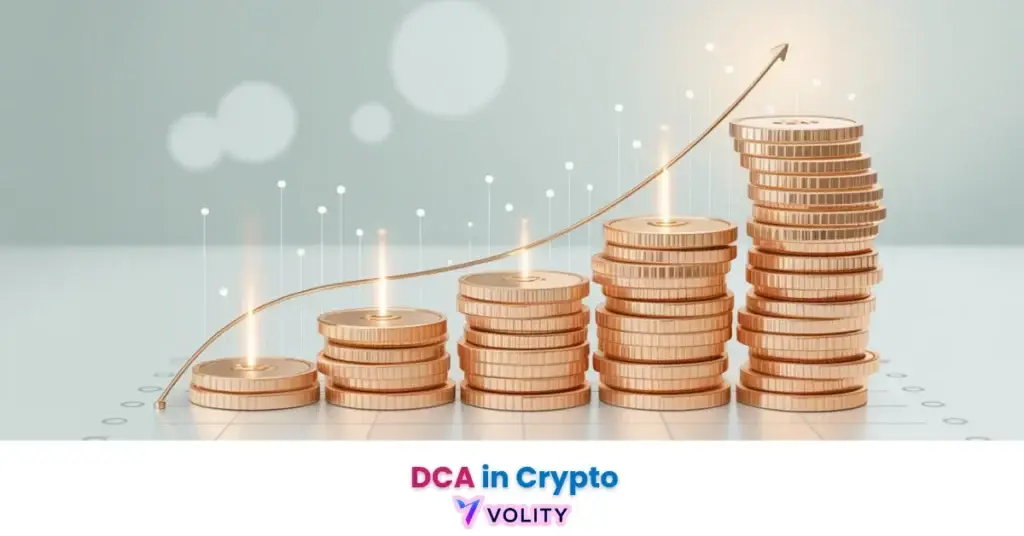
Dollar-cost averaging (DCA) in crypto means investing a fixed amount at regular intervals, regardless of price, instead of trying to time the market. It smooths out volatility by buying more when prices are low and less when high, lowering your average cost over time. DCA suits long-term investors who want to reduce timing risk and emotion.
The Crypto Trading Starter Kit
A plain-English PDF: what to check before you trade, how orders and risk really work, and the mistakes to skip. Get it free.
Dollar-cost averaging (DCA) reduces market timing risk but does not eliminate the possibility of capital loss if the underlying asset declines permanently. Always ensure your portfolio is diversified across multiple asset classes. Past performance is not indicative of future results. Capital at risk.
While understanding Dollar-Cost Averaging (DCA) is important, applying that knowledge is where the real growth happens. Create Your Free Forex Trading Account to practice with a free demo account and put your strategy to the test.
Dollar-cost averaging (DCA) reveals a disciplined pathway to wealth building where consistency replaces the high-risk guesswork of market timing. Current research indicates that 59.13% of cryptocurrency participants identify DCA as their primary entry strategy, favoring steady accumulation over emotional “all-in” decisions.
Success with this method depends on a multi-year horizon and the selection of low-fee automation tools. This guide identifies the mathematical advantages of averaging, the 2026 platform fee landscape, and the statistical success rates of DCA versus lump-sum investing. Advanced practitioners combine DCA with day trading for beginners guide to refine their long-term entry timing.
What is Dollar-Cost Averaging (DCA) and how does it function?
Dollar-cost averaging (DCA) is an investment technique where a participant allocates a specific dollar amount to a financial asset on a recurring schedule to lower the average purchase price over time. The mechanism of “averaging down” means buying more units when prices are low and fewer units when prices are high, a mathematical advantage that emerges without requiring market timing skill. The most common trap retail investors face is waiting for the “perfect bottom,” which often leads to missing the recovery entirely and holding idle cash that never deploys.
DCA removes the emotional burden of choosing entry points by automating consistent, predetermined intervals. investing vs trading wealth building explains why this discipline separates wealth builders from speculators. Unlike lump-sum investing where capital sits idle until the “right moment,” DCA participants deploy capital systematically regardless of price action, creating a natural dollar-cost averaging effect through periodic purchases.
This approach is the gold standard for volatile crypto portfolios and long-term retirement accounts. Research confirms that even investors with decades of experience fail to time market cycles, making DCA the mathematically superior strategy for most participants when measured over 10+ year horizons.
Ready to Elevate Your Trading?
You have the information. Now, get the platform. Join thousands of successful traders who use Volity for its powerful tools, fast execution, and dedicated support.
Create Your Account in Under 3 MinutesHow do I automate my DCA plan for Bitcoin and Ethereum?
Automated DCA involves using brokerage or exchange “Recurring Buy” features that execute trades via API or direct bank transfer without manual intervention. The automation removes the psychological barrier that derails most retail investors, the temptation to pause contributions during bear markets when buying is most valuable. Schedule selection determines tax complexity; weekly buys create 52 transactions annually, while monthly buys reduce accounting burden by 75%.
Strike and River represent the 2026 fee landscape shift, both offering 0% fees for automated Bitcoin recurring purchases (Source: Strike, 2026). These platforms recognize that removing fees accelerates long-term adoption and capital accumulation. Fees on automated DCA plans erode annual returns by up to 1.5% if high-fee retail platforms are used, making fee structure the single most important platform selection criterion.
algorithmic trading and automation reveals how institutional traders build decision-rule systems similar to DCA, removing emotion by ceding control to pre-programmed execution. Setting a “trade-only” API key on your automation platform prevents unauthorized withdrawals while maintaining investment consistency.
Is DCA better than lump-sum investing in 2026?
The choice between DCA and lump-sum investing involves a trade-off between the mathematical probability of higher returns and the psychological comfort of risk mitigation. Vanguard research consistently demonstrates that lump-sum investing outperforms DCA in 68% of rolling 10-year periods, reflecting the mathematical reality that being in the market longer beats timing (Source: Vanguard Research: Dollar-cost averaging vs Lump-sum 2026). The “Cost of Waiting” emerges when investors stay in cash during bull markets, this prolonged idle period creates a higher average entry price despite using DCA discipline.
Yet DCA delivers its greatest value during extended downtrends like the 2022-2023 “Crypto Winter.” Investors who maintained weekly $100 Bitcoin purchases during the $15,000-$20,000 price range accumulated massive positions at generational lows, while lump-sum investors either never deployed capital or watched their $100,000 entries face 80%+ drawdowns. The psychological shield DCA provides prevents panic selling at the worst possible moments, a benefit that Vanguard’s statistical models cannot quantify.
The verdict depends on market cycle timing, bear markets reward DCA discipline, while bull markets favor lump-sum deployment. Professional allocators hedge this uncertainty by deploying 50% of capital lump-sum and 50% via DCA over 12-24 months, capturing both time-in-market and accumulation benefits.
How do you calculate your DCA price and portfolio performance?
DCA price calculation is the result of dividing the total capital invested by the cumulative number of asset units acquired during all purchase intervals. The formula (Total Invested) / (Total Units) = Net Average Cost reveals why consistent buying at multiple price levels mathematically lowers your entry versus a single-point purchase. Accounting for fees is mandatory; gross investment must be adjusted for all transaction costs to determine true break-even pricing, ignoring fees creates a false sense of profit.
Real-world example (2021-2025 Recovery):
A participant executed $100/week recurring Bitcoin purchases starting November 2021 (peak ~$69,000). Throughout 2022-2023, declining prices (dipping to $15,000) meant each $100 purchased more satoshis. Average cost dropped to ~$28,000 by 2023; when Bitcoin reached $100,000 in early 2025, the initial $10,400 investment returned over $350,000, representing 3,300% cumulative gain. Past performance is not indicative of future results.
finding a consistent trading edge covers how traders develop systematic edge through rules-based approaches, exactly mirroring DCA’s discipline. Advanced practitioners use “Value-Triggered DCA,” which doubles the investment amount only when on-chain indicators like the MVRV Z-Score signal that Bitcoin is historically oversold, combining technical analysis with averaging discipline.
What are the risks and limitations of the DCA strategy?
Risks of dollar-cost averaging include the opportunity cost of holding idle cash during bull markets and the danger of “averaging into a zero” on low-quality assets. The Sunk Cost Fallacy traps DCA participants into continuing purchases of failing tokens or bankrupt companies, averaging down indefinitely until capital is completely depleted. Tax Complexity emerges when daily DCA creates 365+ individual purchase transactions, complicating cost basis and capital gains reporting to your national tax authority (e.g. HMRC in the UK) in 2026.
risk management strategies for traders emphasizes why position sizing rules must override averaging discipline, continuing DCA into a fundamentally broken project guarantees total loss. Investors must define exit criteria before entering DCA, ensuring that new data triggers suspension rather than continued averaging.
Averaging into coins facing regulatory bans or fundamental protocol failure destroys capital regardless of purchase discipline.
2026 DCA Platform and Success Benchmarks (EAV Table)
DCA benchmarks reveal the statistical reality of retail success rates and the cost efficiencies of leading 2026 investment platforms. The fee structure dominates the platform selection decision, a 1% annual fee on a 20-year $200,000 DCA commitment erodes $40,000+ in returns through compounding. Strike and River have eliminated automation fees entirely, recognizing that fee removal accelerates adoption.
| Entity | DCA Success Rate (Bear) | 2026 Automation Fee | Best For |
| Strike | High | 0% (Source: Strike official fee schedule for recurring buys) | Bitcoin Only |
| River | High | 0% (Source: River) | Bitcoin Only |
| Binance | Moderate | 0.10% (Source: Binance) | Multi-Asset DCA |
| Coinbase | Moderate | 0.50% – 1.50% (Source: SSGA) | Beginners |
| Vanguard (LSI) | 32% (Low) | N/A | Bull Markets |
Sources: Strike, River, Binance, Coinbase, SSGA, 2026
Turn Knowledge into Profit
You have done the reading, now it is time to act. The best way to learn is by doing. Open a free, no-risk demo account and practice your strategy with virtual funds today.
Open a Free Demo AccountKey Takeaways
- Dollar-cost averaging (DCA) smooths volatility by investing a fixed amount at regular intervals regardless of market price.
- Statistics from 2026 show that 59.13% of crypto investors use DCA to remove emotional timing from their strategy.
- Vanguard research indicates that lump-sum investing outperforms DCA in 68% of 10-year rolling periods during bull markets.
- Strike and River currently offer 0% fees for automated recurring Bitcoin purchases, maximizing long-term accumulation.
- DCA significantly reduces “market timing regret” by ensuring capital is deployed during major bear market dips.
- Advanced “Value-Triggered DCA” uses on-chain data to increase buy amounts when assets are statistically undervalued.
Frequently Asked Questions
This article contains references to Dollar-Cost Averaging (DCA) and Volity, a regulated CFD trading platform. This content is produced for educational purposes only and does not constitute financial advice or a recommendation to buy or sell any financial instrument. Always verify current regulatory status and platform details before using any trading service. Some links in this article may be affiliate links.
What our analysts watch: We track three signals when reading the crypto tape. Spot ETF net flows reveal institutional demand. Stablecoin issuance shows sidelined buying power. Miner reserves indicate supply pressure.
Volity operates a trading platform and also publishes educational and analytical content about trading. The content on this page is for educational purposes only and should not be considered financial advice. Volity may benefit commercially when readers open trading accounts through links on this site.
Our content is produced and reviewed under documented editorial standards; see our comparison and review methodology.