The Crypto Trading Starter Kit
A plain-English PDF: what to check before you trade, how orders and risk really work, and the mistakes to skip. Get it free.
Smart contract development and blockchain interactions carry significant technical and financial risk. EVM code execution cannot be reversed. Past performance is not indicative of future results. Capital at risk.
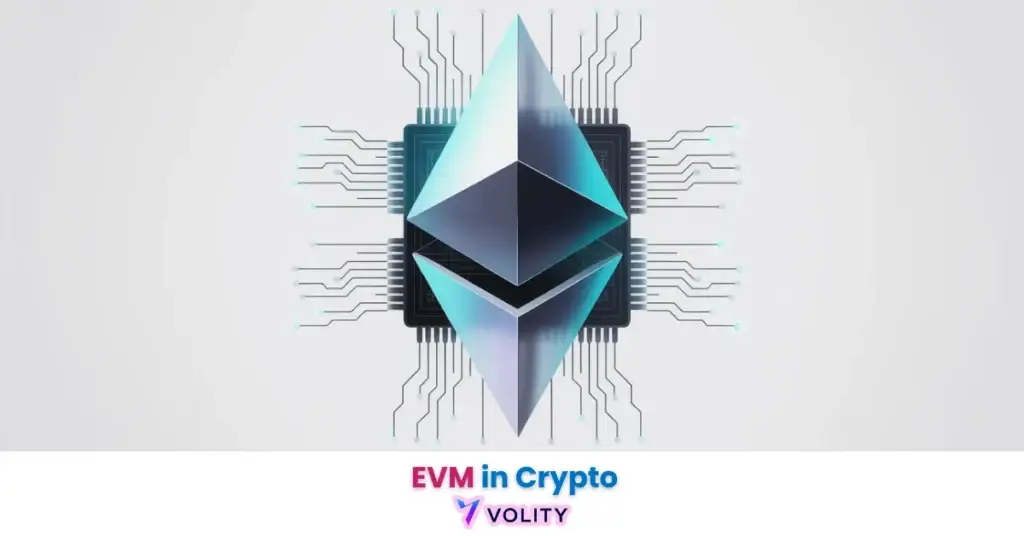
The Ethereum Virtual Machine identifies the computational layer that powers all smart contract execution on Ethereum and compatible blockchains. This decentralized processor reveals how complex financial logic can operate autonomously without centralized intermediaries or single points of failure.
In 2026, EVM adoption has expanded far beyond Ethereum itself, chains like Polygon, Arbitrum, Avalanche, and dozens of others utilize EVM compatibility to tap existing developer ecosystems. Understanding how the EVM works proves essential for traders, DeFi participants, and developers navigating the broader blockchain landscape.
While understanding Ethereum Virtual Machine (EVM) is important, applying that knowledge is where the real growth happens. Create Your Free Crypto Trading Account to practice with a free demo account and put your strategy to the test.
What is the Ethereum Virtual Machine and how does it work?
The Ethereum Virtual Machine is a decentralized, Turing-complete computing environment that executes smart contracts by processing bytecode across thousands of independent nodes.
The EVM functions as a “world computer”, rather than running on a single server, it distributes computation across Ethereum’s validator network. When you deploy a smart contract (written in Solidity), it compiles into bytecode that the EVM understands.
This bytecode specifies exact operations: reading from storage, performing calculations, calling other contracts, sending transactions. Gas serves as the EVM’s metering mechanism, each operation consumes a specific amount of gas (computational cost), preventing infinite loops and protecting against denial-of-service attacks.
A simple addition operation costs 3 gas, while storage writes cost 20,000 gas. This granular cost structure forces developers to write efficient code while preventing malicious actors from abusing network resources.
The blockchain technology explained guide documents how the EVM fits within Ethereum’s broader blockchain architecture and consensus mechanism.
Ready to Elevate Your Trading?
You have the information. Now, get the platform. Join thousands of successful traders who use Volity for its powerful tools, fast execution, and dedicated support.
Create Your Account in Under 3 MinutesEVM-Compatible Chains: Polygon, Arbitrum, and the 50+ Network Ecosystem
For querying these chains efficiently, see The Graph (GRT) indexing protocol.
The EVM compatibility standard identifies a network of 50+ blockchains utilizing the same virtual machine architecture for interchangeable smart contracts.
Polygon maintains the largest EVM-compatible ecosystem by transaction volume, processing billions of daily transactions at near-zero costs. Arbitrum, an Ethereum Layer 2 using EVM, has captured significant enterprise and DeFi adoption through its robust infrastructure.
Avalanche C-Chain implements EVM compatibility while maintaining independent security and consensus. This proliferation of EVM chains creates a monoculture where developers can deploy identical contracts across multiple networks, but also introduces systemic concentration risk, a critical EVM bug could theoretically impact all 50+ compatible chains simultaneously.
The trade-off between ecosystem composability and security concentration remains unresolved as of 2026.
The decentralized finance (DeFi) applications guide explains how EVM smart contracts power the entire DeFi ecosystem across multiple compatible chains.
Gas Costs and Transaction Economics in the 2026 EVM Landscape
Gas pricing in 2026 reveals significant divergence between mainnet Ethereum (averaging $5-50 per transaction) and Layer 2/sidechain alternatives (averaging $0.01-$0.10 per transaction).
The EVM’s gas metering system creates economic incentives that shape developer and user behavior fundamentally. High Ethereum L1 gas costs have driven migration to cheaper alternatives, users increasingly batch transactions, use liquidity pools instead of direct swaps, and interact with contracts during low-congestion periods.
Layer 2 solutions utilizing the EVM have introduced “blobs” (EIP-4844) that reduce effective gas costs by 100x through data compression and temporary storage. This economic reality has fractured the EVM ecosystem: simple transactions remain economically viable on Layer 2s while complex interactions still occur primarily on L1 or alternative chains.
The implication for 2026 DeFi is clear: transaction complexity and chain selection have become inseparable decisions.
The crypto market capitalization guide shows how layer selection (L1 vs L2 vs sidechain) impacts institutional adoption and capital flow routing through different EVM implementations.
Turn Knowledge into Profit
You have done the reading, now it is time to act. The best way to learn is by doing. Open a free, no-risk demo account and practice your strategy with virtual funds today.
Open a Free Demo AccountSmart Contract Security: Common EVM Vulnerabilities and 2026 Exploits
EVM smart contract vulnerabilities represent the primary source of institutional capital loss in 2026, exceeding $400M+ annually despite increased auditing standards.
Reentrancy attacks exploit the EVM’s callback mechanism where external contract calls execute before state updates complete. Flash loan attacks leverage uncollateralized borrowing within a single block to manipulate prices and exploit liquidation logic.
Integer overflow/underflow in contracts predating Solidity 0.8.0 caused catastrophic fund losses before the compiler added automatic overflow protection. The 2026 landscape has evolved, most critical vulnerabilities have been identified and remedied, but sophisticated attacks targeting business logic rather than low-level exploits continue damaging even audited contracts.
The implication is clear: auditing reduces but does not eliminate EVM smart contract risk.
The security protocols in DeFi guide details security best practices for evaluating smart contract risk before depositing capital.
How to interact with EVM smart contracts safely
Interacting with EVM contracts requires understanding wallet security, contract verification, and transaction mechanics to protect capital from phishing and exploitation.
Contract Verification represents the first defense, always verify that contract addresses match official documentation before authorizing transactions. Phishing scams targeting EVM users have exploded in 2026, using lookalike addresses and fraudulent approval transactions to steal user funds.
Understand what permissions you grant, an “approval” transaction allows a contract to spend unlimited tokens on your behalf if that contract is subsequently compromised. Use hardware wallets for significant amounts to prevent key theft.
Understand gas mechanics before executing transactions, the EVM will execute your transaction even if you massively overpay for gas, permanently losing excess amounts.
The crypto wallets guide documents wallet security best practices and hardware wallet setup procedures essential for safe EVM interaction.
Key Takeaways
- The Ethereum Virtual Machine executes smart contracts across distributed validator networks, eliminating centralized intermediaries.
- EVM compatibility has become the industry standard, with 50+ blockchain networks utilizing identical smart contract architecture.
- Gas costs determine economic feasibility of transactions, Layer 2 EVM implementations offer 100x cost reduction compared to L1 Ethereum.
- Smart contract vulnerabilities cause $400M+ annual losses despite increased auditing standards and security improvements.
- Reentrancy, flash loan, and overflow attacks represent the primary exploitation vectors in 2026 EVM ecosystem.
- Contract verification and hardware wallet usage remain essential defenses against phishing attacks targeting EVM users.
Frequently Asked Questions
This article contains references to the Ethereum Virtual Machine, smart contracts, blockchain technology, and Volity, a regulated CFD trading platform. This content is produced for educational purposes only and does not constitute financial advice. Always verify contract addresses and security before deploying capital. Some links may be affiliate links.
What our analysts watch: EVM compatibility is now a competitive surface, and three quantitative reads tell you which chains are actually winning. Gas consumed per day in EVM opcodes (the cleanest measure of real execution demand, more honest than transaction count).
Verified contract count and unique deployer addresses over rolling 30-day windows (deployment breadth matters more than aggregate TVL for ecosystem durability). Cross-chain message volume into and out of the EVM venue (a chain that imports liquidity but exports no traffic is a temporary parking lot, not a destination).
Track those three together and the noise around branding fades quickly into a usable picture of where developer effort is actually concentrated.
Volity operates a trading platform and also publishes educational and analytical content about trading. The content on this page is for educational purposes only and should not be considered financial advice. Volity may benefit commercially when readers open trading accounts through links on this site.
Our content is produced and reviewed under documented editorial standards; see our comparison and review methodology.