The Crypto Trading Starter Kit
A plain-English PDF: what to check before you trade, how orders and risk really work, and the mistakes to skip. Get it free.
Decentralized Finance (DeFi) involves high technical and financial risks, including smart contract exploits and impermanent loss. Assets are not protected by traditional insurance like FDIC. Past performance is not indicative of future results. Capital at risk.
On-chain derivatives venues put this idea to work in practice, with the trade-offs laid out in perp DEX versus centralised exchange.
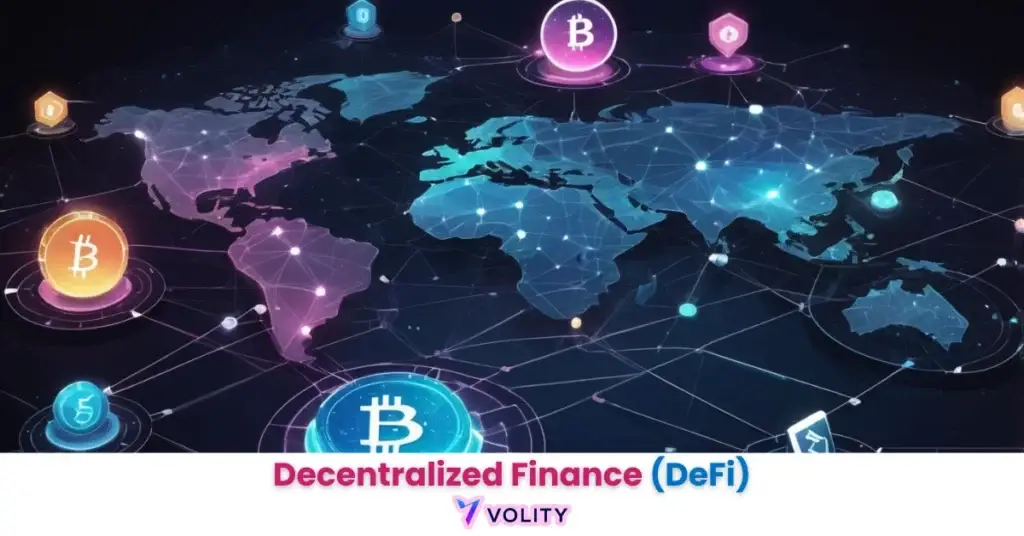
Decentralized Finance (DeFi) is a blockchain-based ecosystem that automates financial services through smart contracts. Statistics from April 2026 show a risk-off environment with Ethereum holding $46.17B in TVL, while the impending July 1 MiCA deadline is forcing protocols to seek full licensing or face exclusion from EU markets.
Decentralized Finance (DeFi) reveals a paradigm shift where code replaces traditional banking intermediaries. Current data indicates that Ethereum hosts $46.17 billion in total value locked (TVL), maintaining a dominant 53.9% share of the global decentralized ecosystem. This growth identifies a mature market where retail and institutional participants access lending, borrowing, and trading services 24/7 without geographic restrictions.
Success in this environment requires understanding the technical barriers and regulatory shifts governing permissionless protocols. This guide identifies the core mechanics, yield strategies, and compliance benchmarks necessary for navigating the 2026 financial landscape.
While understanding Decentralized Finance DeFi is important, applying that knowledge is where the real growth happens. Create Your Free Crypto Trading Account to practice with a free demo account and put your strategy to the test.
What is DeFi and how does it solve traditional banking problems?
Decentralized Finance (DeFi) is an ecosystem of financial applications built on public blockchains that removes the need for centralized intermediaries like banks. DeFi’s 24/7 availability identifies a fundamental advantage over traditional banking, which restricts services to business hours and operates only in specific time zones. Transparency through public ledgers prevents the opacity that led to systemic risks like the 2008 financial crisis, where hidden derivatives and counterparty exposures created cascading failures.
Permissionless access identifies another core advantage: DeFi allows the unbanked to participate in global credit markets without credit scores, geographic restrictions, or regulatory gatekeeping. Over $606 million was lost to DeFi hacks in the first 18 days of April 2026 alone, revealing that smart contract security remains a critical challenge (CryptoTimes, April 2026). Despite these risks, the DeFi ecosystem continues to mature through improved auditing standards and insurance mechanisms.
Ready to Elevate Your Trading?
You have the information. Now, get the platform. Join thousands of successful traders who use Volity for its powerful tools, fast execution, and dedicated support.
Create Your Account in Under 3 MinutesHow does decentralized finance work through Smart Contracts?
The smart-contract foundation runs on Ethereum and similar L1s, see our Ethereum primer for the protocol layer beneath every DeFi app.
Decentralized finance works by deploying self-executing smart contracts that automate the terms of financial agreements on a blockchain. dApps (decentralized applications) serve as user interfaces for complex contract interactions, allowing non-technical users to access lending and borrowing with simple button clicks. Liquidity pools enable peer-to-peer trading through Automated Market Makers (AMMs), where price discovery happens algorithmically rather than through human market makers.
Immutability reveals why once a contract is deployed, it cannot be altered by a single entity, this transparency builds trust but also means that bugs and exploits cannot be patched without user consensus. Smart Contracts as self-executing code identifies the foundation of DeFi, where code reliability determines protocol safety. Automated Market Maker AMM mechanics show how liquidity pools replace traditional order books.
Use Efficiency Mode (eMode) on Aave V3 when borrowing correlated stablecoins to access Loan-to-Value (LTV) ratios as high as 97%.
What are the best DeFi platforms for lending and borrowing in 2026?
Two of the largest are Aave and Compound.
The best DeFi platforms for lending and borrowing deliver automated interest rates based on real-time asset utilization and collateralization levels. Aave V3 identifies the benchmark for institutional-grade liquidity and eMode efficiency, allowing borrowers to achieve 97% LTV ratios on correlated stablecoins. Compound (COMP) reveals a decentralized interest rate protocol for autonomous yield generation, where governance token holders vote on parameter changes.
Uniswap identifies the primary platform for trustless token swaps and liquidity provision, maintaining over $4.2B in TVL across thousands of trading pairs. These platforms reveal a spectrum of use cases: Aave for yield generation, Compound for risk management, and Uniswap for active trading.
DeFi Yield Strategies: Lending, Borrowing, and Leverage
Yield farming runs through crypto liquidity pools on DEXs, both topics worth understanding before depositing real capital.
DeFi yield strategies identify multiple paths to generate returns on idle capital. Lending strategies show how depositing USDC into Aave earns 4-6% APY automatically. Leverage strategies reveal how borrowers can deposit ETH, borrow USDC at 5% interest, and reinvest those USDC into higher-yield opportunities like liquidity pools earning 8-12% APY. This 3-7% yield spread identifies the core of DeFi’s profitability model.
Loop strategies identify advanced techniques where borrowers continuously borrow and re-deposit collateral to maximize leverage. These strategies reveal significant liquidation risk if prices move against the position, but skilled operators can generate 20-30% annualized returns during favorable market conditions.
DeFi Regulation: MiCA Deadlines and Compliance
DeFi regulation identifies a critical 2026 inflection point where the EU’s Markets in Crypto-Assets (MiCA) regulation takes full effect on July 1. By this date, any DeFi service targeting EU users must comply with MiCA licensing, verifiably excluding non-compliant protocols from European markets. This regulatory shift reveals why major protocols like Lido and Aave are rapidly seeking compliance or implementing geographic restrictions.
Non-compliance identifies significant risks: users could face withdrawal freezes, regulatory investigations, and legal liability. Protocols implementing front-end geofencing identify a pragmatic approach, blocking EU IP addresses while continuing to operate globally elsewhere.
Security and Risk Management in DeFi Lending
Security audits identify the primary defense against smart contract exploits. Protocols like Aave undergo quarterly third-party audits and maintain $1B+ insurance funds. Risk management parameters like loan-to-value (LTV) ratios identify how much borrowers can take relative to collateral value, higher LTV reveals higher liquidation risk.
Liquidation mechanics reveal how DeFi protocols protect lenders: when borrowers’ collateral falls below a safety threshold, liquidators automatically sell the collateral to repay loans, preventing bad debt from accumulating.
Key Takeaways
- Decentralized Finance (DeFi) is a blockchain-based ecosystem automating financial services through self-executing smart contracts.
- Ethereum hosts $46.17 billion in TVL, identifying DeFi as a mature market with 24/7 access to lending, borrowing, and trading.
- Aave V3 identifies the benchmark platform for lending, enabling up to 97% loan-to-value ratios on correlated assets.
- Yield strategies reveal 3-7% spreads between borrowing costs and lending yields, driving professional liquidity provision.
- MiCA compliance becomes mandatory on July 1, 2026, for any protocol serving EU users, identifying a regulatory inflection point.
- Smart contract audits and insurance funds identify core safety mechanisms protecting DeFi users from exploits and insolvency.
Frequently Asked Questions
What our analysts watch: Volity analysts track Ethereum TVL share versus L2 migration, Aave V3 utilisation curves and stablecoin borrow rates as the leading risk-on signal, oracle-feed deviations on Chainlink and Pyth, MEV-bot extraction on top DEX pairs, and the MiCA-licensing roadmaps published by Lido, Aave and Uniswap. Geographic-restriction toggles on protocol front-ends are an early tell that compliance pressure is biting.
Volity operates a trading platform and also publishes educational and analytical content about trading. The content on this page is for educational purposes only and should not be considered financial advice. Volity may benefit commercially when readers open trading accounts through links on this site.
Our content is produced and reviewed under documented editorial standards; see our comparison and review methodology.