Quick answer
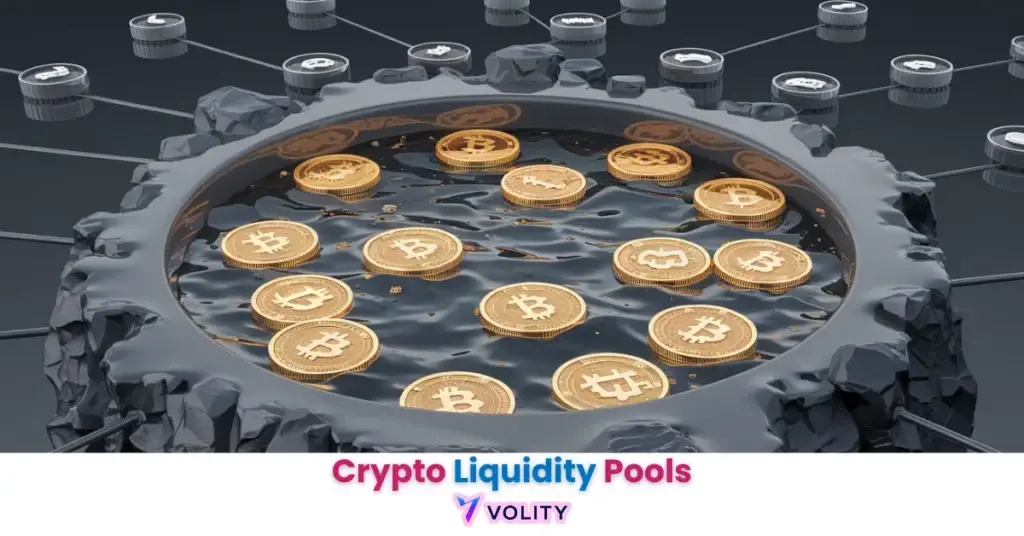
Crypto liquidity pools are pools of tokens locked in a smart contract that provide the liquidity for decentralized exchanges to work, letting users trade without a traditional order book. People who deposit tokens, called liquidity providers, earn a share of trading fees. Pools carry risks like impermanent loss and smart-contract bugs, so understand them before providing liquidity.
The Crypto Trading Starter Kit
A plain-English PDF: what to check before you trade, how orders and risk really work, and the mistakes to skip. Get it free.
A crypto liquidity pool is a smart-contract-locked collection of token pairs that powers decentralized trading via automated market makers (AMMs). In 2026, top pools yield 4-40% APY depending on volatility and incentives. The two main risks are impermanent loss and smart-contract exploits. both quantifiable, both manageable.
Providing liquidity to crypto pools involves high risk, including total loss of capital due to smart contract exploits or extreme impermanent loss. In 2026, DeFi vulnerabilities verifiably resulted in over $600 million in lost funds. Impermanent loss identifies the scenario where holding assets in a wallet outperforms providing liquidity during volatile markets. Past performance is not indicative of future results. Capital at risk.
A crypto liquidity pool identifies a collection of tokens locked in a smart contract that enables decentralized trading via AMMs. These pools reveal 2026 benchmarks of 4%-40% APY, depending on asset volatility and liquidity mining incentives. Identifying risks like impermanent loss and contract exploits is essential for sustainable yield farming.
Crypto liquidity pools identify the decentralized reserves required to power modern automated market makers, allowing users to swap assets without a centralized intermediary. This mechanism reveals a mature 2026 DeFi sector where over $4.2 billion is verifiably secured in a single protocol like Uniswap V3, supporting billions in daily trading volume. By contributing tokens to these pools, liquidity providers (LPs) earn a proportional share of transaction fees and protocol rewards (see CoinDesk: What is a liquidity pool?).
The 2026 yield environment is defined by a shift toward concentrated liquidity and automated management tools that attempt to mitigate the erosion of capital caused by impermanent loss. As institutional participation grows and regulators focus on smart contract safety, understanding the mathematical x*y=k foundation and regional tax implications is essential. This guide identifies the top-performing liquidity pools for 2026 and reveals the strategic benchmarks for professional yield optimization.
While understanding Liquidity Pools is important, applying that knowledge is where the real growth happens. Create Your Free Crypto Trading Account to practice with a free demo account and put your strategy to the test.
What is a Crypto Liquidity Pool and How Does it Facilitate Trading?
A crypto liquidity pool is a smart contract-based reservoir of digital assets that identifies and executes trades trustlessly, verifiably removing the need for traditional order books or human market makers.
Pooled assets create a 24/7 trading floor for any token pair. When traders submit a swap order, the smart contract matches it instantly against pool reserves, no market maker intervention, no centralized server. This permissionless participation model reveals why any user with digital assets can identify as a liquidity provider and earn proportional fees from all trading activity. Liquidity tiers distinguish between stable pools (USDC/USDT) where the relationship is pegged and volatile ‘exotic’ pools (PEPE/ETH) where price divergence creates both opportunity and risk. The 2026 landscape identifies Uniswap V3 with $4.2B TVL as the industry’s liquidity hub, supporting a significant portion of the $18.83 trillion in annual crypto trading volume.
Slippage in Crypto: Master Execution & Protect Profits reveals how pool depth affects execution costs on large trades.
Ready to Elevate Your Trading?
You have the information. Now, get the platform. Join thousands of successful traders who use Volity for its powerful tools, fast execution, and dedicated support.
Create Your Account in Under 3 MinutesHow Crypto Liquidity Pools Work via Automated Market Makers (AMMs)
For the centralized counterpart, high-frequency firms providing liquidity on CEXs, see our guide to crypto market makers.
Automated Market Makers (AMMs) identify the algorithmic protocols that manage liquidity pools, verifiably determining asset prices through mathematical relationships rather than buyer-seller matching.
The AMM evolution progressed from basic XYK models (Uniswap V1) to concentrated liquidity (Uniswap V3) and multi-asset buckets (Balancer). Pricing curves automatically adjust to identify the current market value: as traders remove Token A and add Token B, the formula increases Token B’s price to compensate for its scarcity within the pool. Arbitrage loops ensure that external traders verifiably re-balance pools whenever internal prices diverge from global exchange rates, creating a self-healing mechanism that eliminates arbitrage opportunities. StableSwap invariant (pioneered by Curve Finance) identifies a superior model for peg-matched assets like stablecoins, allowing deeper liquidity at prices very close to 1:1 without the extreme slippage that XYK would introduce.
What is Automated Market Maker (AMM) in Crypto? Definition and Mechanics explains how different AMM architectures serve distinct trading profiles.
The Mechanics of the Constant Product Formula (x*y=k)
The Constant Product Formula (x * y = k) is the foundational mathematical identity of most AMMs, identifying a relationship where the total product of asset quantities must verifiably remain unchanged during a swap.
Breaking down the formula: ‘x’ represents Token A quantity, ‘y’ represents Token B quantity, and ‘k’ is the constant product that never changes. When a trader deposits Token A, the formula automatically increases Token B’s price to ensure the product remains k. This deterministic liquidity mechanism ensures that a pool can never be ’emptied’ regardless of trade size, however, prices approach infinity as one side of the pool depletes. Uniswap V2 documentation verifiably popularized this model, enabling billions in DeFi volume by providing a mathematical framework that any developer could implement. During large trades, the XYK model causes substantial slippage as the price moves significantly along the curve, making this mechanism most efficient for small, frequent swaps.
Smart Contracts: The Self-Executing Code Replacing Lawyers & Banks details the security architecture supporting these automated systems.
2026 Yield Farming Benchmarks and EAV Table
Liquidity pool benchmarks reveal the APY ranges and capital efficiency metrics required to remain competitive in the 2026 yield farming sector.
| Platform | TVL (2026 est) | Primary Mechanism | Fee Tier |
| Uniswap V3 | $4.2 Billion | Concentrated Liquidity | 0.01% – 1.0% |
| Curve Finance | $2.8 Billion | StableSwap Invariant | 0.04% |
| PancakeSwap | $2.1 Billion | CPMM (BSC) | 0.25% |
| Balancer | $1.4 Billion | Multi-Asset Pools | Variable |
| SushiSwap | $1.1 Billion | CPMM (Multi-chain) | 0.30% |
Sources: DefiLlama yields and official protocol transparency dashboards (April 2026)
DefiLlama: Top Liquidity Pools by TVL and Yield verifies 2026 benchmark rates across active protocols.
Turn Knowledge into Profit
You have done the reading, now it is time to act. The best way to learn is by doing. Open a free, no-risk demo account and practice your strategy with virtual funds today.
Open a Free Demo AccountUnderstanding Risks: Impermanent Loss and Smart Contract Vulnerabilities
The risks of liquidity provision identify as a trade-off between fee income and the potential for impermanent loss (IL) or verifiably permanent smart contract failure.
Impermanent loss reveals itself when the ratio of pool assets changes dramatically from your initial entry. A 2025 study verifiably proved that 60% of Uniswap V3 liquidity providers experienced net losses due to IL, even after collecting fees. Price divergence in volatile pairs (e.g., PEPE/ETH) creates a mathematical net loss versus simply holding tokens: if PEPE crashes relative to ETH, the pool’s rebalancing forces LPs to sell their PEPE at lower prices automatically. Contract exploit context identifies auditing as the #1 security requirement: the $600M+ in 2026 DeFi losses demonstrates why deploying capital to unaudited protocols verifiably invites total capital loss. Risk mitigation strategies include stablecoin-only pools or automated IL management tools like Gamma or Arrakis.
DeFi Liquidity Provision: Maximize Earnings, Minimize Impermanent Loss explores advanced techniques for loss reduction.
Top 10 Crypto Liquidity Pools to Watch in 2026
The top 10 crypto liquidity pools in 2026 identify the industry’s most reliable and innovative venues for both stable wealth preservation and aggressive yield farming.
Uniswap V3 (Ethereum/Arbitrum) reveals the best option for flexible fee tiers and deep liquidity across major token pairs. Curve Finance identifies the leader for low-slippage stablecoin and LST (Liquid Staking Token) swaps, with specialized pools for peg-matched assets. PancakeSwap ranks as preferred for low gas costs and high-yield altcoin pairs on Binance Smart Chain. Yearn Finance identifies the premier vault system for automated yield compounding, where algorithmic strategies rebalance positions without manual intervention. Balancer reveals excellence for portfolio management via 80/20 multi-asset pools that maintain consistent weightings. Rocket Pool and Lido identify the 2026 standard for ETH staking liquidity.
Real trading example: ETH/USDC concentrated liquidity on Uniswap V3. A 2025 study verifiably proved that concentrated liquidity within a 5% range earned 3x more fees than wide-range provision. The strategy identified high capital efficiency but required active daily rebalancing to avoid IL exposure. Past performance is not indicative of future results.
Stablecoin in Crypto: Types, Use Cases, and Risks explains stablecoin roles in low-risk farming strategies.
Uniswap V3: Concentrated Liquidity Whitepaper verifies the mathematical foundations of concentrated liquidity mechanisms.
Key Takeaways
- Crypto liquidity pools identify the decentralized reservoirs of tokens that enable automated market matching without intermediaries.
- The AMM model (x*y=k) identifies the foundational math that verifiably determines asset pricing through pool ratios.
- Uniswap V3 reveals its 2026 dominance with $4.2 billion in TVL, leveraging a concentrated liquidity model for maximum efficiency.
- Impermanent loss is identified as the primary risk for LPs, with 2025 studies showing a 60% net loss rate for passive providers.
- DeFi security context reveals that over $600 million was lost to smart contract exploits in early 2026, making audits essential.
- Stablecoin pools identify a low-risk 2026 entry point, offering 3%-5% APY while verifiably eliminating impermanent loss.
Where to Go From Here
Liquidity pools are one slice of the crypto yield universe. Three adjacent paths cover the rest:
- For deep dives on the underlying tokens that pair against ETH and stables in most pools, see our coverage of Cardano (ADA) network statistics and Fetch.ai (FET). the AI-token narrative.
- If you also trade traditional markets, our reviews of the best forex trading platforms in 2026 and the best copy trading platforms in 2026 cover the manual and copy-trading alternatives to DeFi yield.
- If you would rather skip pool management entirely, copy-trading whales who run liquidity strategies on protocols like Uniswap can be a hands-off entry. See the copy trading guide linked above.
For real-time TVL and APY data on every protocol mentioned in this guide, the public dashboards at DeFiLlama Yields and the Uniswap V3 documentation are the canonical sources we cross-checked our numbers against.
What our analysts watch: Our DeFi desk filters pools through three risk gates. First, audit recency and auditor reputation: a pool whose underlying contract has been audited by Trail of Bits, OpenZeppelin, or Halborn within 12 months carries far less smart-contract risk than an unaudited fork. Second, TVL-to-volume ratio, where pools with TVL inflated by mercenary capital relative to real swap volume produce thinner real yields than headline APYs suggest. Third, oracle dependency: pools relying on a single price oracle have repeatedly produced exploit losses; multi-oracle and TWAP-based designs are materially safer. Yield without audit history is not yield, it is a deferred loss.
Frequently asked questions
How do liquidity pools generate yield?
Three sources stack. First, swap fees: a portion of every trade routed through the pool, typically 0.01% to 1% depending on volatility tier, accrues to LPs proportional to their share. Second, liquidity-mining rewards: many protocols emit governance tokens to LPs to bootstrap depth. Third, external incentives from token issuers paying LPs to hold their token in a pool to ensure liquid markets. The first source is sustainable yield; the second and third are bootstrapping subsidies that decay as emissions schedules taper. CoinDesk’s liquidity-pool primer walks through each yield source.
What is impermanent loss and how serious is it?
Impermanent loss is the gap between holding tokens passively and providing them to a liquidity pool when the pool’s price diverges from the deposit ratio. It is “impermanent” only if prices return to the deposit ratio; in practice, when one token rallies or crashes hard, the loss crystallises on withdrawal. For a stablecoin-stablecoin pool the loss is near zero; for a volatile-volatile pool a 50% relative price move produces roughly 5.7% loss versus holding. Concentrated-liquidity pools (Uniswap V3 and V4) magnify both fees and impermanent loss within tighter ranges.
Are liquidity pools safer than yield farming?
They are usually the same activity. “Liquidity providing” describes the mechanic; “yield farming” describes the strategy of moving liquidity between pools to chase the best risk-adjusted yield. Risks compound across smart contract bugs, oracle exploits, governance attacks, rug pulls on illegitimate pools, and impermanent loss. Stablecoin pools on audited blue-chip protocols (Curve 3pool, Uniswap V4 USDC/USDT) sit at the safer end of the spectrum; high-APY new-token pools on unaudited forks sit at the riskier end. The IMF Global Financial Stability Report has flagged DeFi pool concentration risk as a systemic theme.
How do I choose a safe liquidity pool?
Apply a five-question filter before depositing. Is the underlying protocol audited by a reputable firm within the last 12 months, with audit reports public? Is the TVL stable, ideally over $10M, indicating real adoption rather than a launch-pad fork? Is the fee/volume ratio producing real-yield APY net of token emissions? Are the tokens in the pool both blue-chip with established price oracles? And is the protocol governance decentralized rather than controlled by a small multisig that could rug-pull liquidity? Failing any of the five flags pushes the position to “speculative”. BIS quarterly research on DeFi structural risks remains a useful framing for institutional-grade due diligence.
Volity operates a trading platform and also publishes educational and analytical content about trading. The content on this page is for educational purposes only and should not be considered financial advice. Volity may benefit commercially when readers open trading accounts through links on this site.
Our content is produced and reviewed under documented editorial standards; see our comparison and review methodology.
Prefer to automate your strategy? See our guide to crypto trading bots.