Investing in financial products involves risk. Losses may exceed the value of your original investment.
The Crypto Trading Starter Kit
A plain-English PDF: what to check before you trade, how orders and risk really work, and the mistakes to skip. Get it free.
Quick answer
Swing trading crypto holds positions for 2 to 14 days to capture multi-day trend moves and reversals. The framework: identify trends on 4-hour and daily charts, enter on retracement to support or breakout, size positions to risk 1% of capital per trade, set stops at structural levels (not arbitrary ATR multiples), and target risk-reward of 2:1 minimum. Suits traders with full-time jobs who can’t watch markets continuously.
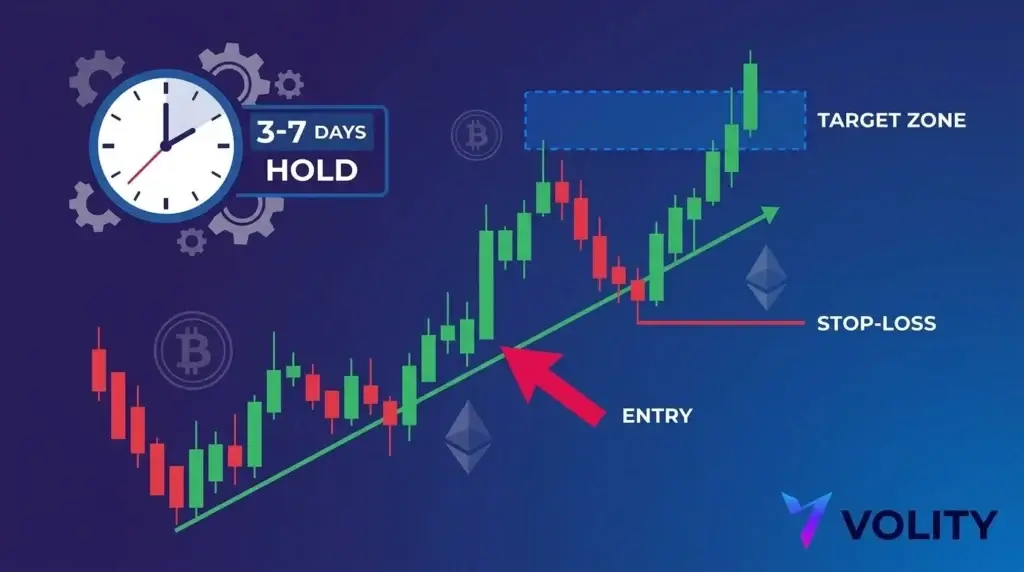
Swing trading crypto means holding a position for several days to a few weeks, looking to capture the middle 60-80% of a directional move. Not minutes, not months. Three to seven trading days is the sweet spot. The framework is identical across forex, equities, and crypto: setup, entry, stop, target, risk-per-trade. Crypto’s twist is that markets trade 24/7, so the discipline has to be portfolio-level rather than session-level.
Step 1: define the setup
Three setup families dominate swing trading flow on our desk:
- Pullback to moving average. Coin trends up, retraces to the 20-day or 50-day exponential moving average, holds, and rebuilds. Entry on the bounce.
- Breakout from consolidation. A 2-4 week range, then a clean break of the upper band on volume. Entry on the close above resistance.
- Mean reversion in oversold. RSI below 30 on the daily, a higher low forming, and a positive divergence on the next push. Entry on the higher low confirmation.
Step 2: define the entry
Entry rules are the contract you sign with your future self. Two non-negotiables:
- Wait for the candle to close. Intraday wicks lie. Daily closes confirm.
- Predefine the price band. If your trigger is a close above $3,400 on ETH, do not chase $3,420 if you missed it. The R:R deteriorates fast.
Step 3: define the stop
The stop comes before the entry, not after. Three stop logics, in order of preference:
- Structure stop: just beyond the recent swing low (long) or swing high (short). The market has to invalidate your thesis to take you out.
- ATR stop: 1.5-2x the daily ATR below entry. Volatility-adjusted. Works when there is no clean structure.
- Time stop: if the position has not moved in 5 trading days, close it. You are renting capital; charge it for non-performance.
Step 4: size the position
Risk-per-trade is the single biggest determinant of long-term outcome. The rule we run:
Risk no more than 1% of account equity per swing trade. If your account is $10,000, you risk $100 per trade. The position size is then $100 divided by the dollar distance from entry to stop.
Example: BTC entry $60,000, stop $58,500. Distance is $1,500. At 1% risk on a $10,000 account, position size is $100/$1,500 = 0.067 BTC. Notional $4,000. At 1:2 leverage that is $2,000 of margin. Plenty of headroom for the next trade.
Step 5: manage the trade
Three management rules:
- Never move a stop the wrong way. You can trail it tighter as the trade works. You cannot widen it.
- Take partial profit at 1R. If you risked $100, take half off when the trade is up $100. Now the worst case is breakeven, the best case is a runner.
- Trail the runner. Move the stop to the most recent swing low (long) every two days. Let the trade tell you when it is done.
Crypto-specific watchpoints
- Funding rates on perpetuals. A 0.05% per 8 hours funding rate is 0.45% over a 5-day swing. That is half your gross R. Track it.
- Weekend liquidity. Saturday and Sunday volume is 30-50% of weekday volume. Wider spreads, sharper wicks. Size accordingly.
- News asymmetry. Macro and regulatory news (ETF approval, exchange exploit, exchange-rate freeze) move BTC 10-20% in hours. Have a plan for the gap.
What to track
A simple journal beats every analytics dashboard for the first six months. For each trade, record: setup family, entry, stop, target, position size, R-multiple at exit, lesson. After 50 trades you will know which setup family pays you. Cut everything else.
Swing trading at Volity
Volity offers CFD exposure to 20+ cryptocurrencies on a regulated platform with retail leverage capped at 1:2 (ESMA), negative balance protection, and a 4-hour withdrawal target on most rails. Execution is by UBK Markets Ltd (CySEC 186/12). For shorter-horizon entries see our day trading guide; for the underlying mechanics see our spot trading definition.
Volity operates a trading platform and also publishes educational and analytical content about trading. The content on this page is for educational purposes only and should not be considered financial advice. Volity may benefit commercially when readers open trading accounts through links on this site.
Our content is produced and reviewed under documented editorial standards; see our comparison and review methodology.
Frequently asked questions
How long is a typical swing trade in crypto?
Usually a few days to a few weeks, long enough to capture a directional move but short enough to avoid the drift of a long-term hold. The holding period should follow the timeframe your setup was found on, not the calendar.
Does swing trading crypto require leverage?
No, and leverage often works against a multi-day position because funding accrues nightly and a normal retracement can reach a liquidation level long before the thesis is wrong. Many swing traders use little or no leverage for exactly that reason.
Where should a swing trade stop go?
Beyond the level that would invalidate the setup, not at a round percentage. If the trade is based on a breakout holding, the stop belongs below the breakout level. Size the position so that distance still equals an acceptable loss.