Investing in financial products involves risk. Losses may exceed the value of your original investment.
The Crypto Trading Starter Kit
A plain-English PDF: what to check before you trade, how orders and risk really work, and the mistakes to skip. Get it free.
Quick answer
Leverage trading crypto in 2026 splits along regulatory lines: EU retail capped at 1:2 with negative balance protection, US restricted by CFTC oversight, offshore venues offer up to 125x with liquidation risk. The working framework: keep leverage at 2x to 3x maximum for retail, never trade leveraged altcoins, and treat the funding rate as a continuous cost on perpetual positions.
Leverage trading crypto is the practice of borrowing exposure from a broker so a small amount of cash controls a larger position, with profit and loss calculated on the full notional. At 1:2 leverage, a $5,000 deposit controls $10,000 of bitcoin: a 10% move is $1,000, not $500. The math is symmetric. The same lever that doubles a winner doubles a loser, and that asymmetry of feeling, not of mathematics, is where most retail accounts blow up.
How leverage on crypto actually works
You post margin. The broker tracks the price. Your equity moves tick-for-tick on the full notional. Three numbers run the trade:
- Initial margin: the cash required to open. At 1:2 retail crypto leverage, initial margin is 50% of notional.
- Maintenance margin: the minimum equity to keep the position open. Drop below it and the broker issues a margin call.
- Liquidation price: the level where the broker auto-closes the position. With negative balance protection, retail accounts cannot lose more than the cash posted.
Worked example. BTC at $60,000, you go long $10,000 of notional at 1:2. Margin posted: $5,000. Maintenance threshold (typical): 25% of notional, or $2,500 of equity. Drop in BTC of about 25% (to $45,000) puts you near liquidation. The path from “comfortable trade” to “position closed” is shorter than most beginners price in.
What are the leverage caps in 2026?
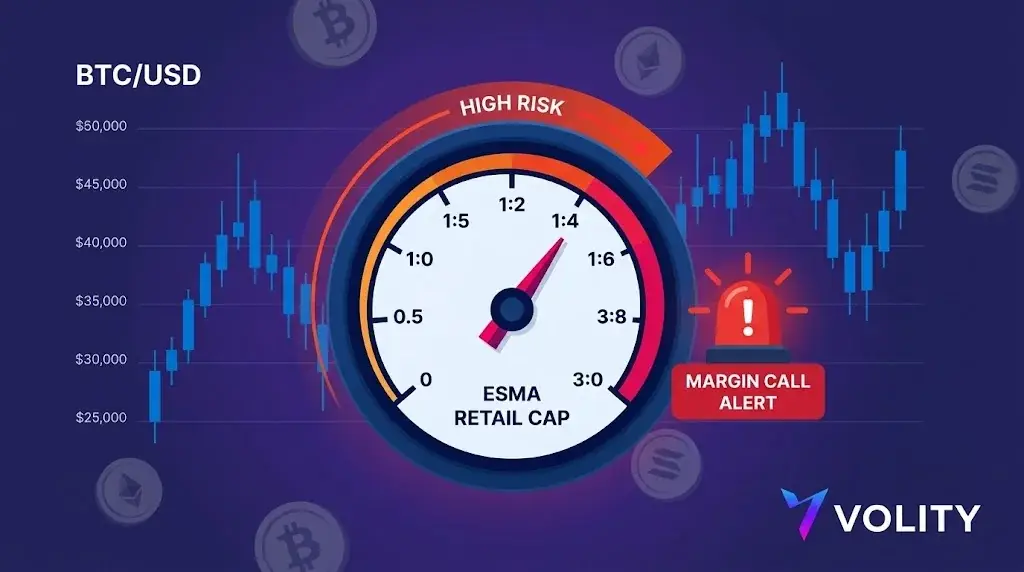
Under ESMA product intervention measures, retail leverage in the EEA is capped by asset class. The crypto cap is the tightest in the rulebook:
- Cryptoassets: 1:2
- Major currency pairs: 1:30
- Non-major currencies, major indices, gold: 1:20
- Other commodities and non-major equity indices: 1:10
- Individual equities: 1:5
These limits apply to retail clients. Professional clients on request, who pass a MiFID II suitability assessment based on portfolio size, transaction frequency, and relevant work experience, can access higher leverage. Negative balance protection applies to retail accounts. If you see a broker advertising 1:50, 1:100, 1:500 or 1:1000 on crypto to EEA retail clients, you are looking at offshore. Read the small print on entity, jurisdiction, and recourse before you fund.
Why the crypto cap is the lowest of any asset class
ESMA’s product intervention measures point to three drivers: extreme historical volatility (BTC has had multiple 50%+ drawdowns in single quarters), 24/7 trading with thinner weekend liquidity, and the tail risk of exchange or chain-level events that gap the price hundreds of basis points in seconds. The 1:2 cap is not punitive; it is the math that keeps a typical retail account from being wiped out by a single normal-size weekend candle.
What does leverage cost?
Three line items, in order of impact:
- Spread. The bid-ask cost on entry and exit. On BTC/USD this is typically 1-3 basis points on a deep venue, wider on smaller-cap coins.
- Overnight financing (swap). The interest you pay to hold a leveraged position past the daily rollover. Crypto financing rates float with the funding curve and are visible per-symbol on the platform.
- Slippage. The difference between expected and filled price during fast moves. Crypto news (ETF flows, exchange exploits, macro prints) routinely moves BTC 2-5% in minutes.
When does leverage make sense?
Three honest use cases on our desk:
- Short-duration directional trades. A 24-72 hour view where carry is small and conviction is high.
- Hedging a spot stack. A long-term BTC holder shorting a perp to neutralise short-term downside without selling the underlying and triggering a tax event.
- Capital efficiency in a multi-asset book. Leverage on one position frees cash to take exposure elsewhere on the same account.
What goes wrong
Four classic failure modes:
- Sizing by margin, not by risk. “I have $5,000, so I can open $10,000” is the wrong question. The right question is “how many dollars do I lose if my stop is hit, and is that under 1% of equity?”
- Stop placement too tight. Leverage shrinks the price band that takes you out. A 2% stop on 1:2 BTC eats 4% of equity. Volatility-aware stops (ATR-based) prevent this.
- Holding through news. A 1:2 long through a Fed print or an ETF rumour is a coin flip with leverage attached. Flatten or reduce.
- Adding to losers. Averaging down on a leveraged position is a guaranteed way to find your liquidation price faster. It is not a strategy; it is denial.
Leverage trading crypto at Volity
Volity offers crypto CFD exposure on 20+ coins. Retail leverage is capped at 1:2 under ESMA. Professional clients on request may access higher leverage subject to a MiFID II suitability assessment. Negative balance protection applies on retail accounts. Eligible retail clients of UBK Markets are covered by the Cyprus Investor Compensation Fund up to EUR 20,000 per client per firm. Execution is by UBK Markets Ltd (CySEC 186/12).
Volity operates a trading platform and also publishes educational and analytical content about trading. The content on this page is for educational purposes only and should not be considered financial advice. Volity may benefit commercially when readers open trading accounts through links on this site.
Our content is produced and reviewed under documented editorial standards; see our comparison and review methodology.