Investing in financial products involves risk. Losses may exceed the value of your original investment.
The Crypto Trading Starter Kit
A plain-English PDF: what to check before you trade, how orders and risk really work, and the mistakes to skip. Get it free.
Quick answer
Crypto margin trading uses borrowed capital secured by deposited collateral to amplify position size. Initial margin opens the position; maintenance margin keeps it open. Falling below maintenance triggers liquidation, where the exchange auto-closes positions to protect the lender. Liquidation cascades are the killer: large positions close, push price further, trigger more liquidations. Traders on the wrong side of one often end up getting rekt. EU retail crypto leverage capped at 1:2.
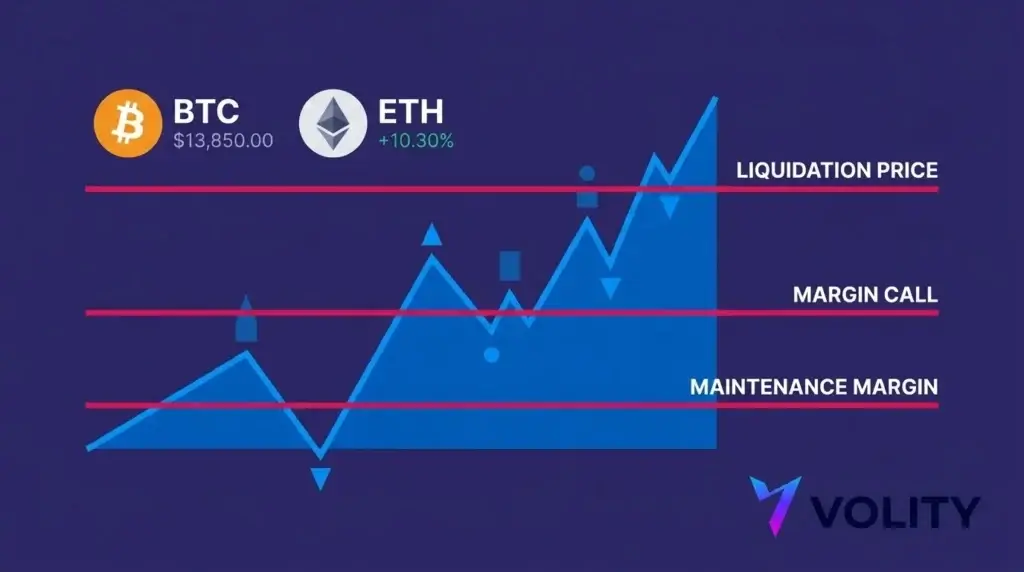
Crypto margin trading runs on three numbers. Initial margin is the cash you post to open. Maintenance margin is the equity floor that keeps the trade alive. Liquidation price is the level at which the broker closes the position to prevent further loss. Get those three right on entry and the trade manages itself; get them wrong and the trade manages you.
How does initial margin work?
Initial margin is set by the leverage cap on the asset. For crypto retail in the EEA, ESMA fixes the cap at 1:2, so initial margin is 50% of notional. A $10,000 BTC position requires $5,000 of cash. The platform reserves that $5,000 from your free balance the moment the order fills.
How does maintenance margin work?
Maintenance margin is the percentage of notional your equity must stay above to keep the position open. For retail crypto on a typical platform, this is around 25% of notional, although the exact number is set per symbol and per regulator. The point of maintenance margin is to give the broker enough buffer to close out the position before it goes to negative equity, especially in fast moves where the next price tick can be 1-2% away from the last.
Concrete example. BTC long at $60,000, notional $10,000, initial margin $5,000, maintenance margin 25% (= $2,500 equity floor). If BTC drops 25% to $45,000, the unrealised loss is $2,500 and equity sits at $2,500. You are at the margin-call line.
What is a margin call?
A margin call is the broker’s notice that your equity has touched the maintenance threshold and the position is now at risk of being closed. On a regulated platform you typically see:
- Soft warning. An on-platform alert that maintenance margin is approaching.
- Margin call. Equity at or below maintenance. You are asked to top up funds or reduce exposure.
- Stop-out / liquidation. Equity below the liquidation threshold. The platform begins closing positions automatically, largest loss first.
On retail accounts with negative balance protection, you cannot lose more than the cash posted, even if the next tick gaps through the stop-out level.
How is liquidation price calculated?
The simple formula for a long, ignoring fees and financing:
Liquidation price = Entry price × (1 − (Initial margin − Maintenance margin) ÷ Notional)
For BTC long at $60,000, notional $10,000, initial margin $5,000, maintenance margin $2,500: liquidation price = $60,000 × (1 − ($5,000 − $2,500) ÷ $10,000) = $60,000 × 0.75 = $45,000. A 25% drop and the position is gone. Tight, by design, because the cap on retail leverage is 1:2.
What changes the liquidation price after entry?
- Adding margin. Topping up cash widens the buffer and pushes liquidation further away.
- Reducing position size. Closing a portion of the contract reduces notional and frees margin.
- Overnight financing. Each day, financing is debited from equity. A long-held position drifts closer to liquidation even if the price is flat.
- Realised P&L on other positions. On a cross-margin account, profits elsewhere lift the buffer; losses elsewhere shrink it.
Once the theory is clear, the work moves to the screen. Our guide to reading margin health and liquidation price walks through the five fields a connected venue actually shows you and how adding margin or cutting size moves the level.
Cross margin vs isolated margin
Two account models:
- Isolated. Each position has its own dedicated margin. A blow-up on one trade does not touch others. Best while you are learning.
- Cross. All positions share the account margin pool. Capital efficient and the only way to run a portfolio hedge cleanly. Also the path by which a single mismanaged position can drain capital that was funding a winning one.
What goes wrong
- Maintenance ignorance. Traders watch initial margin on entry and never look at maintenance until they get the alert. By then the choice is bad or worse.
- Funding drift. A position held for two weeks accumulates financing that quietly moves the liquidation price closer to current. Re-check daily.
- Cross-margin assumption. “I have $20,000 in the account, the position can drop a lot.” Yes, but other positions also share that pool. Run the math on the worst-case combination, not the best.
- Top-up reflex. Adding margin to a losing position to push liquidation further. This is averaging down with extra steps. Cut, do not feed.
Crypto margin trading at Volity
Volity offers crypto CFD exposure on 20+ coins. Retail leverage is capped at 1:2 (ESMA). Professional clients on request may access higher leverage subject to MiFID II suitability assessment. Negative balance protection applies on retail accounts. Eligible retail clients of UBK Markets are covered by the Cyprus Investor Compensation Fund up to EUR 20,000 per client per firm. Execution is by UBK Markets Ltd (CySEC 186/12).
Maintenance margin behaves the same way on an on-chain venue, except the thresholds are published rather than inferred. Our step-by-step guide to funding a Hyperliquid account sets out the panel fields that decide when a position is closed for you.
Volity operates a trading platform and also publishes educational and analytical content about trading. The content on this page is for educational purposes only and should not be considered financial advice. Volity may benefit commercially when readers open trading accounts through links on this site.
Our content is produced and reviewed under documented editorial standards; see our comparison and review methodology.