Blockchain oracles and decentralized oracle networks (DONs) introduce middleware risk, data manipulation vectors, and single-point-of-failure vulnerabilities in smart contracts. Flash loan attacks, sequencer manipulation, and economic incentive misalignment can compromise oracle data integrity.
The Crypto Trading Starter Kit
A plain-English PDF: what to check before you trade, how orders and risk really work, and the mistakes to skip. Get it free.
Hardware oracles face supply chain attacks, sensor spoofing, and physical tampering risks. Zero-Knowledge oracle implementations remain novel and unaudited in production environments.
Reliance on external price feeds for liquidation thresholds, collateral ratios, or settlement amounts creates cascading failure vectors. Past performance is not indicative of future results.
Capital at risk.
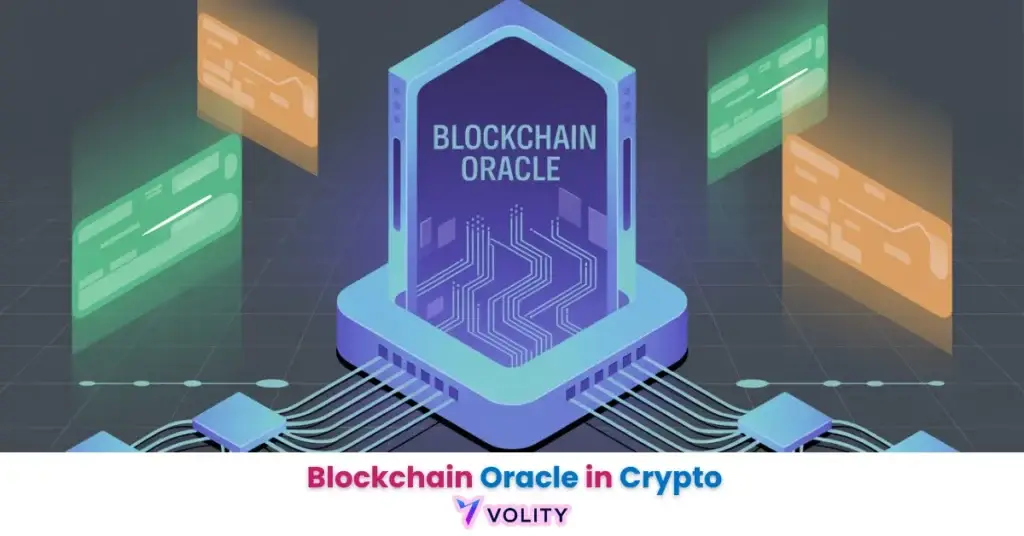
The blockchain oracle executes the vital task of feeding real-world information into the isolated environment of a blockchain. Smart contracts rely on these tamper-proof inputs to trigger automated actions based on price movements or weather events. The process identifies the “Oracle Problem” by providing a secure bridge that maintains the integrity of decentralized consensus.
Modern decentralized finance (DeFi) applications utilize oracles to synchronize asset prices across blockchain layers. As institutional adoption grows, the integration of oracles with ISO 20022 standards ensures that real-world assets (RWAs) can be priced accurately on-chain. Developers must carefully manage decentralization with nodes to prevent manipulation in high-stakes environments.
While understanding Blockchain Oracle is important, applying that knowledge is where the real growth happens. Create Your Free Crypto Trading Account to practice with a free demo account and put your strategy to the test.
What is the primary role of a blockchain oracle?
A blockchain oracle is a third-party middleware service that enables smart contracts to interact with data and systems outside their native blockchain environment. The oracle’s core function bridges an architectural gap created by blockchain design, the isolation that provides security also prevents blockchains from accessing the outside world. Without oracles, smart contracts would be restricted to using only information encoded directly on-chain, limiting their utility for complex financial applications.
Solving the “Oracle Problem” requires understanding why blockchains are natively deterministic and isolated. Determinism means that every validator must arrive at identical transaction results to reach consensus. This property is incompatible with external API calls, different validators at different times would retrieve different data from an external server, breaking consensus. The distinction between on-chain data (transaction history stored in blocks) and off-chain data (market prices, weather, world news) defines the oracle’s purpose.
How oracles act as the data agents for initial coin offerings (ICOs) and DeFi protocols illustrates their economic importance. Early ICOs required oracles to convert fiat investments into token allocations. Modern DeFi protocols require continuous price feeds to calculate collateral ratios, liquidation thresholds, and settlement amounts. Any dApp whose logic depends on a price, a rate or a real-world event needs at least one external data feed to function at all.
Determinism vs. Real-World Volatility
Determinism is the blockchain property where nodes must arrive at identical results for every transaction to maintain security. Why blockchains cannot “call” an API directly stems from this requirement, multiple nodes executing the same API call would retrieve different values depending on network latency and server timing. The need for signed data inputs resolved this problem by requiring cryptographic signatures that prove the data’s authenticity and timestamp.
Ready to Elevate Your Trading?
You have the information. Now, get the platform. Join thousands of successful traders who use Volity for its powerful tools, fast execution, and dedicated support.
Create Your Account in Under 3 MinutesHow do decentralized oracle networks (DONs) work?
Decentralized oracle networks (DONs) function by aggregating data from multiple independent nodes to ensure that no single point of failure can compromise the smart contract. The architecture distributes the oracle role across tens or hundreds of independent operators, each running secure node infrastructure. If one node submits false data, the consensus mechanism (typically a median aggregation) filters that outlier and uses the correct value from the majority of nodes.
The request-and-response cycle demonstrates how a dApp queries an oracle node. A smart contract calls an oracle contract with a data request (e.g., “What is ETH/USD price?”).
The oracle protocol broadcasts this request to its network of nodes. Each node fetches the data from its own sources, signs the result with a private key, and submits it back to the oracle contract.
The contract aggregates these responses and returns the finalized value to the original dApp.
Consensus mechanisms for data medianize price feeds to filter outliers and eliminate manipulation attempts. If a node is compromised and submits $10,000 per ETH while all others submit $2,500, the median algorithm ignores the outlier and uses the consensus value. The leading networks are integrated across a large number of chains, which provides redundancy against a regional outage or a single-chain failure.
Impact on Maximal Extractable Value (MEV) protection through fair sequencing prevents oracle operators from front-running smart contract executions based on price data they control. Fair ordering protocols ensure that users’ transactions execute at the price conditions they agreed to, even if oracle operators attempted to manipulate the data to extract value.
What are the different types of blockchain oracles?
Blockchain oracles are categorized by their source and direction into software, hardware, inbound, outbound, and compute-enabled varieties. Software Oracles consume digital data feeds for Automated Market Makers (AMM), derivative exchanges, and lending protocols. These oracles pull price information from CEX APIs and aggregate multiple sources to prevent single-point reliance. Hardware Oracles utilize IoT sensors for supply chain tracking and insurance payouts, when a package’s temperature sensor confirms delivery within specification, the smart contract automatically releases payment to the carrier.
Inbound vs. Outbound describes the direction of data flow.
Inbound oracles receive data from external sources and bring it into the blockchain. Outbound oracles execute instructions initiated by smart contracts, such as triggering a bank wire transfer when a derivative expires.
ZK Oracles employ Zero-Knowledge Proofs to provide verifiable attestations while maintaining privacy, a smart contract can verify that a user’s credit score exceeds a threshold without the oracle revealing the actual score.
Leading Blockchain Oracle Projects and 2026 Rankings
Chainlink and Pyth Network dominate the 2026 oracle market, securing the vast majority of Total Value Enabled (TVE) across all blockchain ecosystems. Chainlink’s self-reported Total Value Secured and its long track record make it the default choice for risk-averse developers. The network is integrated across more than a hundred blockchain networks, which is the widest ecosystem coverage in the category. Its “Push” oracle model continuously updates price feeds at fixed intervals, ensuring that all users access identical data regardless of update timing.
Pyth Network’s focus on high-frequency financial data caters to the institutional trading segment that needs sub-second pricing. Pyth’s “Pull” model allows dApps to request the most recent price at the exact moment of transaction execution, minimizing staleness. Band Protocol’s specialized cross-chain data feeds serve niche applications requiring custom data types, weather data for parametric insurance, sports scores for prediction markets, or commodity prices for futures contracts.
Trading Example:
Compare the two models on the same large DEX swap. A push oracle updates on a fixed schedule or a deviation threshold, so between updates the contract prices against the last published value even if the market has moved.
A pull oracle is fetched at the moment of execution, so the contract prices against the freshest available value. In a fast market the gap between those two behaviours is the cost, and it grows with volatility and with trade size.
This is an illustration of the mechanism, not a record of a trade. Past performance is not indicative of future results.
The Challenges of Blockchain Oracles: Manipulation and Security
Managing oracle security requires mitigating the risks of data manipulation, flash loan attacks, and economic incentive misalignment. Flash loan attacks exploit oracles by borrowing massive capital, using it to move prices on a DEX, updating the oracle price to the manipulated level, and executing a profitable smart contract before repaying the loan within the same transaction. Decentralized oracle networks mitigate this risk by requiring multiple independent price sources and consensus, making flash loan manipulation vastly more expensive.
Economic incentive misalignment occurs when oracle operators face financial pressures that reward malicious behavior. If an oracle operator receives a payment of $1M to manipulate a price feed worth $100B in collateral, the incentive structure breaks down. Cryptographic proofs and reputation systems discourage this behavior, but perfect deterrence remains impossible in a permissionless system.
| Oracle/Component | Metric | Value |
| Chainlink | Total Value Secured (self-reported) | $70B |
| Pyth Network | Price-update model | Pull, fetched on demand |
| Total DON TVE | Cumulative, self-reported | Reported by Chainlink |
| Manipulation defence | Primary mechanism | Multi-source median aggregation |
| Chain Support | Networks integrated | Over 100, self-reported |
Figures marked self-reported come from the networks themselves and are not independently audited. Feed parameters and update mechanics: Chainlink developer documentation and Pyth price feeds documentation.
Future Trends: ZK Oracles and ISO 20022 RWA Standards
The future of blockchain oracles involves the integration of privacy-preserving technologies and standardized institutional data formats for global finance. ZKP Oracles employ Zero-Knowledge Proofs to verify identity without exposing private data, a user can prove they hold a valid government ID without revealing their actual identity to the oracle or smart contract. ISO 20022 compliance for real-world asset (RWA) bridging ensures that institutional finance data formats translate seamlessly into on-chain pricing models.
The shift toward oracle-agnostic dApp architectures in 2027 will allow smart contracts to query multiple oracle networks simultaneously and choose the best price or most secure attestation. This design pattern increases redundancy and prevents any single oracle from becoming a systemic chokepoint. Infrastructure providers are already building aggregators that abstract away the complexity of managing multiple oracle relationships.
Turn Knowledge into Profit
You have done the reading, now it is time to act. The best way to learn is by doing. Open a free, no-risk demo account and practice your strategy with virtual funds today.
Open a Free Demo AccountKey Takeaways
- Blockchain oracles identify the middleware services that connect smart contracts to external real-world data feeds.
- Chainlink is the market leader by reported Total Value Secured, a figure the network publishes itself rather than one that is independently audited.
- Pyth Network serves institutional DeFi with a pull model, fetching the price at the moment of execution rather than on a fixed schedule.
- Decentralized Oracle Networks (DONs) prevent single points of failure by aggregating data from multiple independent nodes.
- Zero-Knowledge (ZK) Oracles allow smart contracts to verify sensitive data while maintaining user privacy.
- ISO 20022 standards are increasingly used by oracles in 2026 to price real-world assets on decentralized blockchains.
Oracles decide real money outcomes on prediction markets. Polymarket resolves its markets through UMA’s optimistic oracle, with a two-hour challenge window and a bonded dispute path rather than a company decision. Our guide to how Polymarket works covers that resolution route end to end.
Frequently Asked Questions
This article contains references to blockchain oracles, Chainlink, Pyth Network, and Volity, a regulated CFD trading platform. This content is produced for educational purposes only and does not constitute financial advice or a recommendation to buy or sell any financial instrument. Always verify oracle security practices, TVS coverage, and smart contract audit reports before deploying capital on protocols that depend on oracle feeds. Some links in this article may be affiliate links.
What our analysts watch: Three oracle-integrity signals that distinguish institutional-grade infrastructure from a single-point-of-failure that has not yet failed. Node-operator decentralisation and identity (an oracle network with named, regulated, and operationally diverse node operators has a credibility differential against one whose nodes are anonymous wallets, and the difference matters most during stress events when accountability shapes response). Update-frequency and deviation-threshold parameters (a feed that updates every 60 seconds with a 0.5 percent deviation trigger behaves very differently from one that updates every 30 minutes; the parameter set is the actual product, not the marketing claim). Total Value Enabled (TVE) versus Total Value Secured (TVS) reading (TVE captures protocols that depend on the oracle for safety; TVS captures dollar value at risk; the ratio tells the user whether the oracle network is concentrated in a few high-value protocols or distributed across many smaller ones, with very different correlation profiles).
Volity operates a trading platform and also publishes educational and analytical content about trading. The content on this page is for educational purposes only and should not be considered financial advice. Volity may benefit commercially when readers open trading accounts through links on this site.
Our content is produced and reviewed under documented editorial standards; see our comparison and review methodology.