Investing in financial products involves risk. Losses may exceed the value of your original investment.
The Crypto Trading Starter Kit
A plain-English PDF: what to check before you trade, how orders and risk really work, and the mistakes to skip. Get it free.
Quick answer
Crypto algo trading is the deployment of rule-based code to execute trades on cryptocurrency markets without manual intervention. The retail framework: define a hypothesis, backtest on at least 3 years of data, walk-forward validate on out-of-sample period, paper-trade live for 30 days, then deploy with capped position size and a daily kill-switch. Most strategies fail walk-forward; that’s the point of the test.
Crypto algo trading is the practice of running a rule-based strategy through code rather than discretion. The strategy can be as simple as a moving-average crossover or as complex as a multi-asset stat-arb book. The market for this is no longer niche. The BIS puts algorithmic execution at close to three quarters of spot foreign exchange turnover, and the crypto venues that copied that market structure inherited the same pattern. The retail question is not whether algos work. It is which algos a retail trader can realistically run, and what edge survives the institutional layer above them.
What is the actual edge in crypto algo trading?
Five edge sources we see across the field, ranked by how reachable they are for retail:
- Trend following: the most retail-accessible edge. Crypto trends harder than equities, and momentum signals on the daily and 4H timeframe have held up across 2017-2025 cycles.
- Funding-rate harvesting: spot long, perp short. Mechanical, market-neutral, low latency requirement.
- Mean reversion at structural levels: works in ranges, fails in trends, requires a regime filter.
- Statistical arbitrage between correlated coins: BTC vs ETH ratio trades, ETH vs SOL pairs. Capital-intensive and crowded, but accessible.
- High-frequency market making and latency arb: institutional only. Retail cannot compete with co-located firms running sub-millisecond round trips.
Why do most retail algos die?
Four failure modes, in roughly the order they kill accounts:
- Overfitting: parameters tuned to the past, fragile in the present.
- Cost blindness: backtests run with zero slippage. Live, costs eat the edge.
- Regime shift: a strategy that worked 2021-2023 stops working in 2024 because correlations changed. The trader does not notice for two months.
- Operational risk: server crash, internet outage, broker disconnect. The algo needs a watchdog and a kill switch.
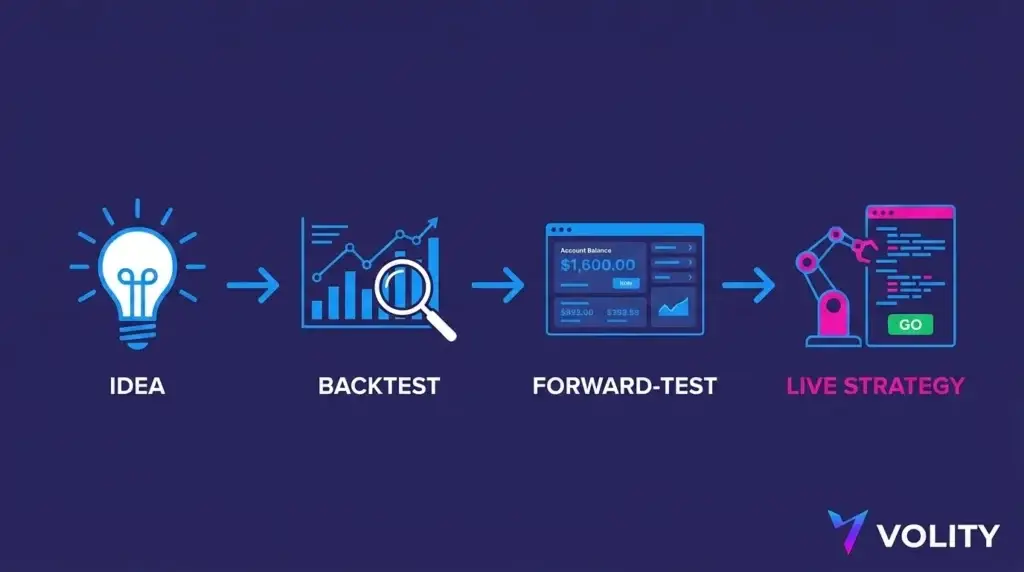
How do you go from idea to live?
The path our desk respects:
- Define the hypothesis in one sentence. If you cannot, the strategy is not real yet.
- Backtest on 3+ years of data, including a deep drawdown regime. Track Sharpe, max drawdown, profit factor, trade count.
- Add realistic costs and slippage. A 0.1% round-trip is the floor for retail CFD execution.
- Walk-forward test. Train on 70% of the data, test on the unseen 30%. If the unseen sample tanks, the strategy is overfit.
- Paper trade for 30 days minimum. Forward-walk on live data with no money at risk.
- Live deploy at 25% of intended size. Run for 50 trades, compare to backtest. Scale up only when live and backtest agree.
- Set a kill switch. 15% drawdown on the strategy, automatic stop. Re-evaluate before redeploying.
What infrastructure do you actually need?
The minimum-viable retail stack:
- Platform: MT5 (Expert Advisors), TradingView (alerts to broker webhook), or a Python bot via broker API.
- VPS: a $20-40/month VPS keeps the algo running 24/7 without depending on your home internet.
- Monitoring: Telegram or email alerts on every fill, and a daily P&L summary.
- Journal: every trade tagged with strategy version. When something breaks, you need to know which version.
What returns are realistic?
The ranges a realistic retail crypto trend-following plan should be built around, rather than the ones sold in a demo:
- Annualised return: 15-35%.
- Sharpe: 0.8-1.4.
- Max drawdown: 18-30%.
- Win rate: 40-50%.
- Profit factor: 1.4-1.8.
Anyone selling you a 200% annual return retail algo with a 5% drawdown is selling you a curve-fit demo, not a strategy. The real distribution of live retail algo outcomes is far worse than any published backtest, and most accounts running a bought strategy are behind a year in.
The institutional layer above you
The BIS review of the crypto ecosystem (“The crypto ecosystem: key elements and risks”), exchange earnings disclosures and published venue volumes all point the same way: institutional flow is the dominant force in liquid crypto in 2026. The retail algo that wins is the one that picks an edge institutions do not bother with: longer-timeframe trend, slower mean reversion, funding harvesting at modest size. Trying to out-execute a co-located market maker on a 1-tick chart is not a strategy.
Algo trading at Volity
Volity supports algorithmic trading on MT4 and MT5 with full Expert Advisor execution, custom indicator support, and the MT5 multi-threaded strategy tester for backtesting on 20+ cryptocurrencies. Retail crypto leverage is capped at 1:2 under ESMA. Negative balance protection applies. Execution is by UBK Markets Ltd (CySEC 186/12).
Volity operates a trading platform and also publishes educational and analytical content about trading. The content on this page is for educational purposes only and should not be considered financial advice. Volity may benefit commercially when readers open trading accounts through links on this site.
Our content is produced and reviewed under documented editorial standards; see our comparison and review methodology.