Quick answer
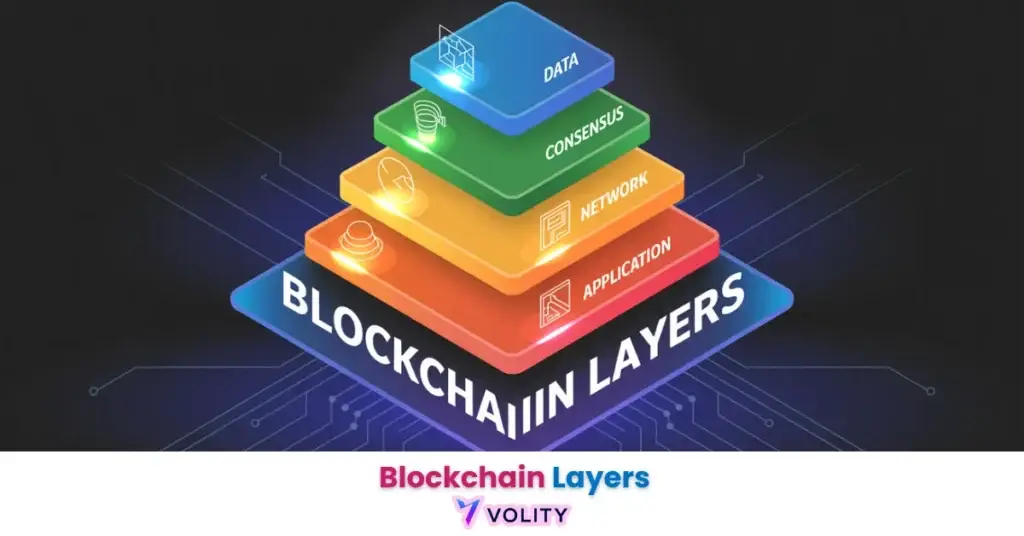
Blockchain layers describe how networks are structured: Layer 0 is the underlying infrastructure connecting chains, Layer 1 is the base blockchain like Bitcoin or Ethereum, and Layer 2 is built on top to make transactions faster and cheaper, such as rollups. Higher layers add apps and customization. Layers exist mainly to solve scalability without sacrificing security.
The Crypto Trading Starter Kit
A plain-English PDF: what to check before you trade, how orders and risk really work, and the mistakes to skip. Get it free.
Blockchain layered scaling architectures, including Layer 2 rollups and Layer 3 AppChains, involve smart contract risk, sequencer centralization, and cross-chain bridging vulnerabilities. ZK-proof systems and optimistic rollups, while cryptographically sound, remain subject to implementation flaws and economic exploits.
Layer transitions, token wrapping, and liquidity fragmentation across chains create slippage and execution risk. Regulatory status of layered DeFi protocols remains uncertain in multiple jurisdictions.
Past performance is not indicative of future results. Capital at risk.
Blockchain layers organize decentralized networks into specialized levels that handle security, execution, and application functions independently. Layer 1 (L1) established the foundational security and mainnet settlement, but current demand requires modular scaling solutions. The architecture identifies the specific roles of L0 through L3 in providing a globally scalable financial infrastructure.
Traders who understand the scaling hierarchy can optimize their capital by choosing the most efficient execution environment for their specific needs. Modern DeFi relies on blockchain oracles to synchronize data across these layers, ensuring that price feeds remain accurate regardless of the underlying chain. Capitalizing on these modular improvements is essential for navigating the complex 2026 crypto landscape.
While understanding Blockchain Layers is important, applying that knowledge is where the real growth happens. Create Your Free Crypto Trading Account to practice with a free demo account and put your strategy to the test.
What are the primary levels of the blockchain scaling hierarchy?
Blockchain layers are organized into a four-tier hierarchy consisting of Layer 0 (interoperability), Layer 1 (settlement), Layer 2 (scaling), and Layer 3 (applications). This modular architecture allows each layer to optimize for specific network properties without compromising the others. The classification emerged as developers recognized that monolithic chains cannot simultaneously achieve decentralization, security, and scalability, a principle known as the blockchain trilemma.
The categorization begins with Layer 0 (L0), the connectivity layer that enables diverse blockchains to communicate through mechanisms like wormhole crypto bridges and cross-chain messaging. Layer 1 (L1) consists of the security anchor systems (Bitcoin, Ethereum, Solana) that establish consensus and finality. The transition from monolithic chains to modular stacks has accelerated as transaction demand exceeded single-layer capacity. Over 100 independent Layer 1 chains are now interconnected via L0 protocols, fragmenting liquidity but creating specialized security and execution environments (Source: Infrastructure Census, 2025).
Each layer serves a distinct economic function in the larger ecosystem. L0 protocols prioritize interoperability and standardization, enabling value transfers between incompatible chain architectures. L1 blockchains manage the core consensus mechanism, the computationally expensive process that secures the network against attacks. L2 and L3 layers are deployed on top of L1 to increase throughput and reduce costs for end users.
Layer 0: The Network Interoperability Layer
Layer 0 is the foundational protocol level that enables diverse Layer 1 blockchains to communicate and transfer data. Polkadot and Cosmos operate as L0 networks that coordinate security and data transfer across independent subnets. The role of wrapped tokens in L0 communication allows assets from one chain to be represented as tokens on another chain while remaining backed by an on-chain guarantee.
Ready to Elevate Your Trading?
You have the information. Now, get the platform. Join thousands of successful traders who use Volity for its powerful tools, fast execution, and dedicated support.
Create Your Account in Under 3 MinutesLayer 1: The Foundational Security and Settlement Layer
Layer 1 (L1) blockchains are independent networks that manage their own security and finalize transactions directly on their native ledgers. The separation of L1 and L2 roles allows L1s to prioritize decentralization and security over transaction throughput. How L1s act as the “source of truth” for all subsequent layers establishes the foundational claim of a layered architecture, that all transactions, regardless of which layer they execute on, ultimately settle on the most secure network.
The use of crypto sharding improves L1 throughput in 2026 by partitioning the network into parallel processing queues. Ethereum’s Danksharding roadmap aims to increase base layer capacity from 12 TPS to several hundred TPS without compromising decentralization. Comparison of security models between Bitcoin (Proof-of-Work) and Ethereum (Proof-of-Stake) reveals different approaches to achieving immutability, Bitcoin relies on computational difficulty, while Ethereum relies on economic incentives and validator penalties.
Solana and BNB Chain remain the largest monolithic L1s by active address count in 2026, maintaining their own validators and executing transactions directly on their networks (Source: Web3 Stats, 2026). These monolithic chains prioritize throughput but sacrifice some decentralization properties compared to Ethereum’s modular architecture.
Layer 2 Scaling: Rollups, Sidechains, and 2026 Metrics
Layer 2 (L2) solutions are scaling protocols built on top of L1s that execute transactions off-chain to reduce costs and increase speed. The core innovation that enables L2 scaling is the ability to batch thousands of transactions into a single proof submitted to the L1 chain. This compression reduces the on-chain footprint by 99%, driving fees from $15.00 per transaction to $0.02.
Rollup mechanics differentiate between Optimistic and ZK-Rollups based on how they prove transaction validity to the base layer. Optimistic Rollups (Arbitrum, Optimism) assume transactions are valid by default and only compute proofs if a validator challenges them. ZK-Rollups (zkSync, StarkNet) generate zero-knowledge proofs for every batch, providing faster finality but requiring more computational overhead. The 2026 TVL rankings show Arbitrum and Optimism dominating L2 value with $40.45B in aggregate TVL, while emerging ZK solutions capture specialist niches.
The 95% volume shift from Ethereum L1 to L2 networks represents the most significant capital migration in DeFi since 2023. This reallocation occurred as traders recognized that L2 security is equivalent to L1 security, proofs settle on Ethereum’s foundation, giving L2 transactions identical finality guarantees as L1 transactions.
Real Trading Example:
Ethereum (ETH) swap execution demonstrates the economic advantage of L2 scaling. Swapping $1,000 on L1 mainnet costs $15.00 in gas during peak hours, consuming 15 basis points of the swap’s value. The identical swap on an L2 (e.g., Base) costs $0.02 thanks to PeerDAS optimization and transaction batching. The trader saves 99.8% in fees while maintaining L1-grade security through cryptographic proofs. Past performance is not indicative of future results.
Layer 3: The Specialized Application Layer
Layer 3 (L3) blockchains are application-specific protocols that provide hyper-customized environments for high-performance decentralized applications (dApps). These “AppChains” allow developers to abstract away the complexity of L1/L2 architecture and optimize for their specific use case. Use cases for crypto subnets and L3 AppChains span high-frequency trading, large-scale gaming, and institutional DeFi protocols.
How L3s support over 1,500 gaming and HFT dApps in 2026 reflects the emergent modularity of the blockchain stack. Gaming dApps benefit from sub-millisecond finality, enabling real-time player interactions without network latency. Institutional traders deploy HFT strategies on L3 AppChains that offer custom virtual machine designs and sequencer ordering, features impossible to implement on public L1s.
The benefit of sub-millisecond finality for institutional trading allows traders to execute strategies with confidence that transaction ordering cannot be front-run by faster competitors. Aggregate TPS for L2/L3 stacks exceeded 325+ in Q1 2026, providing sufficient throughput for global DeFi settlement (Source: Scalability Index, 2026).
The Blockchain Trilemma: How Layers Solve the Problem
The blockchain trilemma is a technical theory stating that a network can only optimize for two of three properties: decentralization, security, or scalability. This constraint emerges from fundamental trade-offs in how distributed systems coordinate consensus. A highly decentralized network requires extensive communication overhead, reducing throughput. A scalable network with high throughput typically centralizes into fewer validators, reducing decentralization.
The layered architecture resolves the trilemma by assigning different properties to different layers. L1 prioritizes security and decentralization, accepting throughput limitations as acceptable. L2 prioritizes scalability, achieving this by inheriting L1 security through periodic settlements. L3 prioritizes application customization, enabling developers to design specialized systems for their specific needs.
| Layer Type | Primary Focus | Specification |
| Layer 1 | Primary Focus | Security & Decentralization |
| Layer 2 | Primary Focus | Scalability & Low Fees |
| Layer 3 | Primary Focus | Application Customization |
| L2 TVL | 2026 Value | $40.45 Billion |
| L2 Fees | 2026 Range | $0.01 – $0.10 |
Sources: Ethereum Foundation Ecosystem Report 2026 and L2Beat real-time scaling metrics.
Security Risks and Future Trends in Layered Architecture
Managing the security risks of a layered architecture requires understanding crypto bridging vulnerabilities and sequencer centralization risks. A bridge represents the weakest point in a layered system, it must custody assets from one chain while minting representations on another. If a bridge is exploited, the entire layer it connects becomes worthless.
The future of “Training Wheels” represents the gradual decentralization of sequencers, the entities that order transactions on L2s. Currently, most major L2s operate with centralized sequencers controlled by their founding teams. In 2026-2027, sequencer decentralization is expected to progress, creating true permissionless L2 infrastructure. The impact of the lightning network on Bitcoin’s L2 utility demonstrates that even older blockchains are adopting layered architectures to improve throughput.
Predictions for 2027 suggest that abstracted complexity will enable users to move seamlessly across layers without understanding the technical distinctions. Cross-layer liquidity aggregators will route swaps to whichever layer offers the best execution, hiding the infrastructure details from traders and developers.
Turn Knowledge into Profit
You have done the reading, now it is time to act. The best way to learn is by doing. Open a free, no-risk demo account and practice your strategy with virtual funds today.
Open a Free Demo AccountKey Takeaways
- Blockchain layers identify the hierarchical levels used to scale decentralized networks without compromising security.
- Layer 1 blockchains provide the secure settlement base, while Layer 2 networks currently handle 95% of transaction volume.
- Layer 2 Total Value Locked (TVL) reached a record $40.45B in April 2026 as DeFi activity migrated to rollups.
- Layer 3 AppChains allow developers to deploy specialized environments for gaming and high-frequency institutional trading.
- PeerDAS technology has optimized Layer 2 transaction costs to a range of $0.01 to $0.10 in early 2026.
- Blockchain layers solve the traditional scaling trilemma by delegating throughput to off-chain environments.
Frequently Asked Questions
This article contains references to blockchain layers, Layer 2 protocols, and Volity, a regulated CFD trading platform. This content is produced for educational purposes only and does not constitute financial advice or a recommendation to buy or sell any financial instrument. Always verify current blockchain security audits, bridge collateralization, and regulatory status before deploying capital on any layer. Some links in this article may be affiliate links.
What our analysts watch: The layers thesis is useful as a map, but layer-stacking alone does not create durable value. We score every new layer launch on three pragmatic signals. Real user activity (not testnet metrics, not airdrop farmers), credible security inheritance (not just marketing claims about a parent chain), and a defensible reason to exist beyond the layer below. Most new L2s and L3s fail one of those three within 18 months.
Volity operates a trading platform and also publishes educational and analytical content about trading. The content on this page is for educational purposes only and should not be considered financial advice. Volity may benefit commercially when readers open trading accounts through links on this site.
Our content is produced and reviewed under documented editorial standards; see our comparison and review methodology.