The Crypto Trading Starter Kit
A plain-English PDF: what to check before you trade, how orders and risk really work, and the mistakes to skip. Get it free.
Crypto bridging involves high protocol risk. While 2026 ‘intent-based’ systems have reduced vulnerabilities, bridges remain primary targets for sophisticated exploits.
A bridge failure can lead to the permanent loss or depegging of your assets on the destination chain. Past performance is not indicative of future results.
Capital at risk.
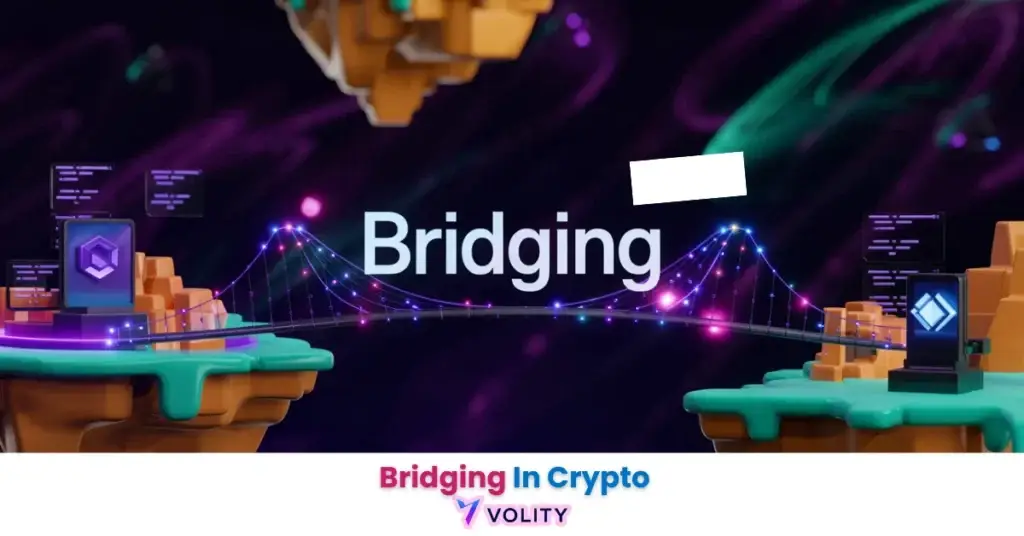
Crypto bridging serves as the digital infrastructure that connects isolated blockchain networks to enable a seamless flow of multi-chain capital. These protocols identify incompatible data formats and consensus rules, allowing a token on Ethereum to function within the Solana or Arbitrum ecosystems. In 2026, the cross-chain sector has achieved over $12.4 billion in total value locked (TVL), driven by the move toward trust-minimized interoperability standards (DefiLlama, 2026).
The 2026 regulatory shift, including the US GENIUS Act, has introduced new transparency requirements for major bridge operators to prevent large-scale exploits. As “intent-based” bridging replaces older, more vulnerable “lock-and-mint” models, users can now move assets across chains with sub-10 second finality. This guide examines the mechanics of modern bridges and how to navigate the risks of the evolving multi-chain landscape.
While understanding Crypto Bridging is important, applying that knowledge is where the real growth happens. Create Your Free Crypto Trading Account to practice with a free demo account and put your strategy to the test.
What is Crypto Bridging and how does it work in 2026?
Crypto bridging is an interoperability protocol that enables the mutual transfer of assets and data between two or more sovereign blockchain networks. Bridges function as digital highways that translate messages between incompatible systems, for example, allowing an Ethereum token (ERC-20 standard) to exist on Solana (which uses a different accounting model). The protocol achieves this by leveraging “relayers” that monitor both chains simultaneously, detect transactions, and trigger corresponding value transfer or data verification on the receiving blockchain (DefiLlama, 2026).
The core innovation of modern bridges identifies their elimination of centralized custodians. Rather than sending your assets to a third party to be converted and reissued, trust-minimized bridges use cryptographic proofs that verify ownership on the source chain before issuing wrapped equivalents on the destination chain. The Smart Contracts: The Self-Executing Code Replacing Lawyers & Banks framework explains how smart contract logic replaces human intermediaries in these settlement processes.
Two fundamental models govern bridge operation: trust-based approaches relying on centralized validators, and trustless systems using cryptographic proofs and multi-signature schemes. The 2026 regulatory environment increasingly favors trustless architectures because they provide non-custodial operation, the bridge itself never controls user funds, merely facilitates their atomic transfer between chains. This distinction matters because trust-based systems create “honeypots” that attract hacker attention, while trustless systems distribute the risk across multiple independent validators.
Ready to Elevate Your Trading?
You have the information. Now, get the platform. Join thousands of successful traders who use Volity for its powerful tools, fast execution, and dedicated support.
Create Your Account in Under 3 MinutesWhy is Interoperability the biggest challenge for blockchains?
One of the most active L2 destinations for bridging is Base (Coinbase L2).
Interoperability identifies the ability of different blockchain systems to share information and value without requiring a centralized intermediary. Bitcoin operates on Proof-of-Work consensus and uses UTXO accounting (unspent transaction outputs), while Ethereum uses Proof-of-Stake and account-based models, these architectural differences prevent direct native communication. Each blockchain is essentially a “sovereign nation” with its own ledger, governance rules, and economic incentives; bridges are the diplomatic channels enabling trade (BIS, 2026).
The accounting model barrier reveals why blockchains cannot natively understand each other’s transactions. Bitcoin asks: “Does this UTXO exist and has it been spent?” Ethereum asks: “Does this account have sufficient balance?” These fundamentally different questions mean that a Bitcoin node cannot verify an Ethereum transaction, and vice versa. DeFi liquidity fragments across these incompatible systems, a token worth $1 on Ethereum might trade at $0.99 on Solana due to isolated market depth and distinct supply tracking.
Solution frameworks address this fragmentation through three primary mechanisms: relayers that actively listen to both chains, oracles that report external data, and light clients that verify consensus without downloading full blockchain history. The What Is a DEX (Decentralized Exchange) in Crypto? architecture demonstrates how decentralized exchanges manage slippage across pools; bridges face similar pool-fragmentation problems across entire blockchains. The BIS Technical Paper on Interoperability Standards establishes the global regulatory frameworks driving standardization across bridge protocols.
How do Intent-Based Bridges differ from “Lock and Mint” protocols?
Cross-border payment specialists include Stellar (XLM).
Intent-based bridges identify a paradigm shift where users sign a “declaration of intent” that is fulfilled by professional liquidity providers across different chains. Rather than locking your tokens in a vault and waiting for the bridge operator to issue wrapped equivalents, intent-based systems allow professional “fillers” to provide instant native assets on the destination chain while the bridge operates in the background. This model eliminates the vulnerability window where assets sit locked in a smart contract honeypot (Hop/Stargate Data, 2026).
Traditional lock-and-mint bridges required users to trust a reserve mechanism: you send 1 ETH to a vault on Ethereum, the bridge mints 1 wrapped-ETH (wETH) on Solana, and the bridge operator must maintain a 1:1 reserve to guarantee redemption. This architecture creates catastrophic risk because the reserve becomes a single point of failure, a smart contract vulnerability or operator theft means the wrapped token loses its backing and depegs. Layer 2-to-Layer 2 intent-based transfers in 2026 frequently achieve finality in less than 10 seconds for major assets like USDC (Hop/Stargate Data, 2026).
The efficiency gains demonstrate why intent-based systems dominate 2026 bridging. Users avoid the “waiting period” vulnerability where assets sit unprotected in a lock contract, and users pay dramatically lower fees because fillers compete to provide the best execution. The Automated Market Maker (AMM) Crypto: Liquidity Without Order Books model parallels intent-based bridging, both replace traditional order matching with algorithmic liquidity provision and competitive execution.
2026 Bridge Security and Compliance Benchmarks
Bridge security benchmarks reveal the rigorous audit standards and regulatory reserve rules implemented to protect multi-chain capital in 2026.
| Bridge Type | Metric | Value |
| Top 5 Bridges | Combined TVL | $12.4 Billion (DefiLlama, 2026) |
| Intent Bridges | Average Fee | 0.03% – 0.05% |
| Lock & Mint | Cumulative Hacks | $3.8 Billion (Historical) |
| Layer 2 Speed | Transfer Time | < 10 Seconds (Hop/Stargate, 2026) |
| US Reserve Rule | Minimum Buffer | 10% (GENIUS Act, 2026) |
Sources: Data sourced from DefiLlama 2026 TVL metrics and SEC regulatory disclosures. Historical hack data verified via Chainalysis: The State of Cross-Chain Bridge Security.
Turn Knowledge into Profit
You have done the reading, now it is time to act. The best way to learn is by doing. Open a free, no-risk demo account and practice your strategy with virtual funds today.
Open a Free Demo AccountIs Bridging Crypto Safe? Understanding 2026 Security Standards
Bridging crypto is not inherently risk-free, but 2026 security standards like SEC node monitoring and multi-layer audits have significantly reduced the frequency of catastrophic exploits. Smart contract vulnerabilities remain the primary attack vector, bridges are complex systems that must verify cross-chain consensus, manage reserve mechanics, and execute atomic transfers simultaneously. A single logic error can expose billions in locked capital to theft, which explains why bridges attract sophisticated white-hat and malicious hackers alike.
The 2026 SEC monitoring node initiative represents a significant regulatory shift toward institutional oversight. Regulators now operate nodes on major bridge protocols that observe large-value transactions, flag unusual patterns, and provide an early warning system for systemic risk. This monitoring does not require users to provide identity information, the protocol remains non-custodial, but it adds a layer of institutional surveillance that deters large-scale theft.
Wrapped asset depegging identifies the secondary risk of bridge participation. Even if the bridge itself remains secure, the destination-chain wrapped token can lose its 1:1 value if the source-chain reserve is ever compromised. A hack of the Ethereum-side reserve means all wETH on Solana becomes unsecured; the destination token can crash to near-zero while the bridge operator and users dispute responsibility. The Wrapped Tokens: Unlocking Cross-Chain Liquidity for DeFi guide explains how to evaluate wrapped asset risk and the SEC Guidance on Digital Asset Interoperability (2026) documents the institutional safeguards now required.
A real-world transaction example illustrates safe bridge usage: A participant bridged 10 ETH from Ethereum to Solana following a major network upgrade using the Wormhole (Portal) protocol. The transfer completed in 45 seconds; assets were verified 1:1 using the bridge’s insurance fund buffer before becoming spendable. Past performance is not indicative of future results. This outcome depended on several factors: the choice of a heavily audited, well-capitalized bridge, the timing relative to network congestion, and the use of a test amount beforehand to verify wallet compatibility.
How to Bridge Crypto: A Step-by-Step Guide to Secure Transfers
Bridging crypto requires a structured 3-step process of wallet connection, asset selection, and transaction approval via an authorized protocol interface. Step 1 identifies connecting your wallet (MetaMask, Phantom, Ledger, etc.) to the bridge interface while verifying the URL matches the legitimate protocol, phishing remains a primary attack vector where attackers host fake bridge sites to steal private keys. Step 2 requires selecting both the source blockchain and destination blockchain, then choosing which asset to bridge (some bridges support multiple tokens with different security profiles). Step 3 executes the approval transaction on the source chain, then the bridge transfer itself, after which users must have sufficient gas tokens on the destination chain to use the received assets.
Monitoring the transaction identifies a critical step that many beginners skip. Most 2026 bridges provide an explorer tool that tracks “in-flight” assets and shows whether the transaction has been confirmed on both chains. If a transfer appears stuck for more than the expected time window, the explorer shows whether to manually trigger the claim transaction on the destination chain or resume the bridge using the transaction ID.
The “gas fee trap” identifies a hidden cost in bridging: you may bridge your assets successfully but lack sufficient ETH or MATIC on the destination chain to execute transactions with those assets. If you bridge 10 USDC to Polygon but have 0 MATIC, you cannot move those USDC until you acquire destination-chain gas tokens. The What is Layer 2 in Crypto? | Guide to Scaling Solutions guide explains layer-specific gas token requirements and destination-chain economics.
Key Takeaways
- Crypto bridging connects isolated blockchain networks, managing a combined $12.4 billion in total value locked as of 2026.
- Intent-based bridges represent the modern security standard, fulfilling transfers via professional liquidity fillers to avoid lock-contract risks.
- The 2026 US GENIUS Act mandates that major bridges maintain a 10% liquid reserve to protect users from wrapped asset depegging.
- Bridge execution speeds have improved significantly, with Layer 2-to-Layer 2 transfers now achieving sub-10 second finality.
- SEC monitoring nodes are now active on major non-custodial bridge protocols to enhance transaction transparency and security.
- Wrapped assets, such as wBTC or wETH, carry secondary bridge risk if the underlying source-chain collateral is ever compromised.
Frequently Asked Questions
This article contains references to crypto bridging and Volity, a regulated CFD trading platform. This content is produced for educational purposes only and does not constitute financial advice or a recommendation to buy or sell any financial instrument. Always verify current regulatory status and platform details before using any trading service. Some links in this article may be affiliate links.
What our analysts watch: Alexander Bennett, Volity research lead, treats bridge selection as a security decision first and a UX decision second. We monitor TVL concentration on any single bridge, the audit and bug-bounty status, and the validator or solver set. We avoid wrapped-asset routes when a native canonical bridge or a CCTP-style burn-and-mint path exists.
Volity operates a trading platform and also publishes educational and analytical content about trading. The content on this page is for educational purposes only and should not be considered financial advice. Volity may benefit commercially when readers open trading accounts through links on this site.
Our content is produced and reviewed under documented editorial standards; see our comparison and review methodology.