Investing in financial products involves risk. Losses may exceed the value of your original investment.
The Crypto Trading Starter Kit
A plain-English PDF: what to check before you trade, how orders and risk really work, and the mistakes to skip. Get it free.
While understanding Crypto Mining is important, applying that knowledge is where the real growth happens. Create Your Free Crypto Trading Account to practice with a free demo account and put your strategy to the test.
Quick takeaways
Here is what matters most for this guide.
- Crypto markets trade 24/7 with high volatility and no central authority.
- Liquidity, execution venue, and self-custody choices shape every trade outcome.
- Furthermore, MiCA and FATF rules now reshape EU and global crypto flow.
Therefore, read on for the full breakdown below.
What is Crypto Mining & Why is it Essential?
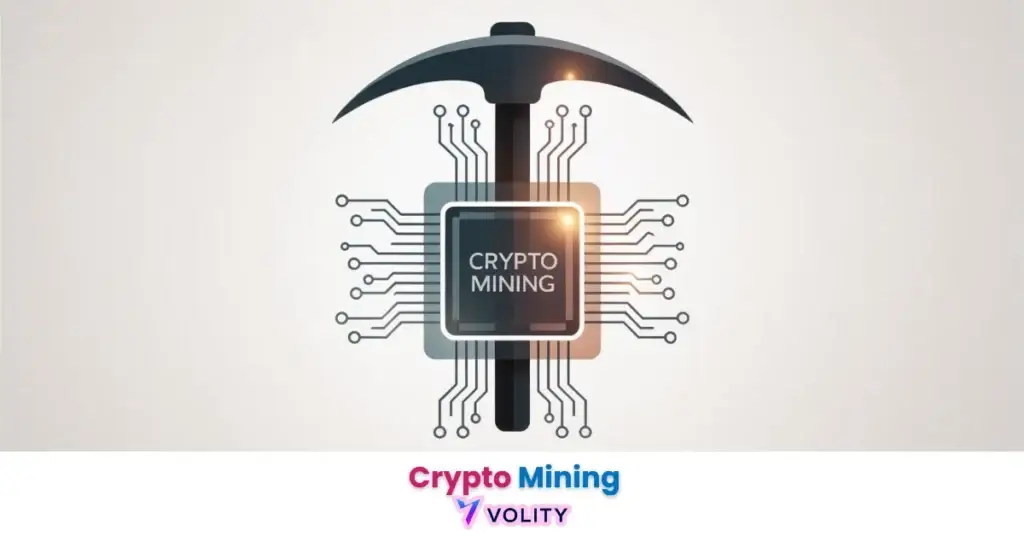
Crypto mining is the process by which new cryptocurrencies are entered into circulation and new transactions are verified and added to the blockchain. This labor-intensive computational work is crucial for maintaining the integrity and security of decentralized networks.
Miners dedicate computing power to solve complex cryptographic puzzles, competing to be the first to validate a block of transactions.
The Digital Gold Rush
Crypto mining is analogous to a digital gold rush, where participants use specialized computer hardware to solve intricate mathematical problems. These problems are designed to be computationally intensive, requiring significant processing power. The first miner to successfully solve a puzzle is rewarded with a set amount of newly minted cryptocurrency and often transaction fees. This process is how new coins, such as Bitcoin, are introduced into the market.
Securing the Blockchain
Miners play a vital role in the ecosystem by acting as auditors and record-keepers for the blockchain. They gather pending transaction data, organize it into a block, and then compete to find a valid hash for that block.
Bitcoin’s Proof-of-Work consensus mechanism is designed to secure the network and validate transactions, preventing double-spending. This decentralized verification process ensures that no single entity controls the network, building transparency and trust. By continuously adding new blocks, miners maintain the immutable ledger and uphold the decentralization that defines cryptocurrencies.
The Proof-of-Work Process
Crypto mining, particularly for prominent cryptocurrencies like Bitcoin, primarily operates through a consensus mechanism known as Proof-of-Work (PoW). This mechanism requires participants to expend computational effort to solve a puzzle, making the network secure and resistant to attacks.
The core of how crypto mining works involves a continuous competition among miners to add new blocks of verified transactions to the existing blockchain.
The Core of PoW
The mining process begins with miners attempting to solve a cryptographic puzzle. This involves finding a specific numerical value, called a “nonce,” which, when combined with the block’s data and hashed, produces a result that meets a predetermined difficulty target.
Miners use their computing power to rapidly generate billions of hashes per second, a measure known as hash rate, until one of them finds the correct nonce. This race to discover the solution is what secures the network, as it requires immense computational effort to alter past transactions.
Once a miner finds the correct nonce, they have effectively solved the puzzle and can propose a new block of transactions to the network.
Adding New Blocks & Earning Rewards
After a miner successfully solves the cryptographic puzzle, they broadcast their newly validated block to the rest of the network. Other miners then verify the solution and the integrity of the transactions within the block.
If validated by the majority of network participants, the new block is officially added to the blockchain, becoming a permanent and immutable part of the ledger.
As a reward for their computational effort and for securing the network, the successful miner receives a block reward, which typically includes newly minted coins and any transaction fees associated with the transactions in that block.
What You Need to Mine
Engaging in crypto mining requires specific hardware and software to effectively participate in the Proof-of-Work process. The type of equipment needed has evolved significantly over time, becoming more specialized and powerful as network difficulty increases. Miners also often join forces to increase their chances of earning rewards.
ASICs, GPUs, and CPUs
The evolution of mining hardware reflects the increasing computational demands of crypto networks. Early Bitcoin mining could be done with a standard CPU (Central Processing Unit), but this quickly became inefficient.
The next step was GPU (Graphics Processing Unit) mining, which offered superior parallel processing power, making it a viable option for a period, especially for cryptocurrencies like Ethereum before its transition to Proof-of-Stake. Today, for Bitcoin and many other PoW coins, ASIC (Application-Specific Integrated Circuit) miners are dominant.
These machines are purpose-built for mining a specific algorithm, offering significantly higher efficiency and hash rate compared to GPUs or CPUs.
| Hardware Type | Primary Use | Efficiency (Relative) | Cost (Relative) |
| ASIC | Bitcoin, SHA-256 coins | Very High | High |
| GPU | Altcoins (historically) | Medium | Medium |
| CPU | Early/Niche coins | Very Low | Low |
The Role of Mining Pools
For individual miners, especially those with limited hardware, consistently earning rewards can be challenging due to the immense hash rate of the global network. This is where mining pools become essential. A mining pool is a group of miners who combine their computational resources to increase their collective chance of solving a block.
When the pool successfully mines a block, the block reward is then distributed among all participants proportionally to the amount of hash rate they contributed.
Over 70% of Bitcoin’s hash rate is concentrated in large mining pools, making it difficult for individual miners to consistently earn rewards without joining one. This collaborative approach makes mining more accessible and provides a more predictable, albeit smaller, stream of income for participants.
Ready to Elevate Your Trading?
You have the information. Now, get the platform. Join thousands of successful traders who use Volity for its powerful tools, fast execution, and dedicated support.
Create Your Account in Under 3 MinutesProfitability & Energy Consumption
The economic viability of crypto mining is a complex equation influenced by numerous factors, with profitability often fluctuating based on market conditions and operational costs. One of the most significant considerations for any miner is the substantial energy consumption required to run mining hardware.
Is Crypto Mining Still Profitable?
Determining the profitability of crypto mining involves assessing several key variables. The initial investment in specialized hardware, such as ASIC miners, can be substantial. Operational costs, primarily electricity rates, are a continuous expense that can significantly erode profits. The price of the cryptocurrency being mined, network difficulty adjustment, and the block reward are also critical.
For instance, mining rewards for Bitcoin halve approximately every four years, an event known as “halving,” which impacts miner profitability and Bitcoin’s supply dynamics.
This event reduces the supply of new Bitcoin, potentially increasing its value, but it also directly cuts the primary income source for miners, making efficient operations paramount.
Costs & Concerns
The electricity factor is arguably the most critical component in the profitability equation for Proof-of-Work mining. High-performance mining rigs consume vast amounts of electricity, leading to significant operational costs.
This substantial energy consumption not only impacts a miner’s bottom line but also raises environmental concerns, as the power source often dictates the carbon footprint of the mining operation. For many aspiring miners, the question, “Is crypto mining still worth it with high electricity costs?” is a major deterrent.
Risks & Challenges of Crypto Mining
While crypto mining offers potential rewards, it also comes with a unique set of risks and challenges that aspiring miners must understand and navigate. These include the complexities of the regulatory landscape and various security threats that can jeopardize investments.
The Volatile Regulatory Landscape
One of the significant challenges facing crypto miners is the volatile regulatory landscape. The legality and specific regulations surrounding crypto mining vary dramatically across different jurisdictions worldwide. Some countries have embraced mining, offering incentives or stable environments, while others have imposed strict bans or heavy restrictions.
For example, China notably banned crypto mining, leading to a massive migration of mining operations to other regions. This unpredictable environment means that miners must constantly monitor and understand the local laws and potential policy changes in their operating region.
Failing to comply with these regulations can result in severe penalties, including fines or the confiscation of equipment.
Protecting Your Investment
Crypto mining is not immune to security threats and scams. Miners face risks such as hardware failure, which can lead to costly repairs or replacements, and hardware obsolescence, where older machines become unprofitable due to increasing network difficulty.
Cyberattacks, including malware designed to hijack mining rigs (cryptojacking) or phishing attempts targeting wallet credentials, pose significant threats. Furthermore, the allure of high returns has led to numerous mining scams, particularly in the cloud mining sector, where fraudulent companies promise returns on rented hash power but deliver nothing.
To protect investments, miners must use robust cybersecurity measures, verify the legitimacy of any cloud mining service, and secure their private key and cryptocurrency assets in reputable, cold storage wallets.
The Future of Mining & Sustainable Alternatives
The future of crypto mining is evolving beyond the traditional Proof-of-Work model, driven by growing concerns over environmental impact and the development of more sustainable alternatives. While PoW remains central to Bitcoin, other networks are exploring different consensus mechanisms to achieve network security and transaction validation.
A Nuanced View
The environmental impact of Proof-of-Work mining, particularly for Bitcoin, has been a subject of intense debate due to its substantial energy consumption. Critics often point to the carbon emissions generated by electricity-hungry mining operations. However, a nuanced view acknowledges the industry’s ongoing shift towards more sustainable practices.
The energy consumption of Bitcoin mining, while significant, is increasingly shifting towards renewable sources, with estimates suggesting over 50% of Bitcoin mining uses sustainable energy. This trend includes leveraging abundant hydropower, solar, wind, and even capturing methane gas from landfills.
A Greener Alternative to Mining
As an alternative to energy-intensive PoW mining, Proof-of-Stake (PoS) has emerged as a prominent consensus mechanism. In PoS, validators “stake” their cryptocurrency as collateral to participate in transaction validation, rather than expending computational power. This method significantly reduces energy consumption.
A prime example is Ethereum, which transitioned from Proof-of-Work to Proof-of-Stake in an event known as “The Merge.” This transition significantly reduced its energy consumption by an estimated 99.95%, demonstrating an alternative to energy-intensive PoW.
This makes PoS a much greener alternative, contributing to network security through economic incentives rather than raw computing power.
| Feature | Proof-of-Work (PoW) | Proof-of-Stake (PoS) |
| Energy Use | High | Low |
| Security Basis | Computational power | Staked capital |
| Participants | Miners | Validators |
| Reward Mechanism | Block reward | Staking rewards |
| Example | Bitcoin | Ethereum (post-Merge) |
Turn Knowledge into Profit
You have done the reading, now it is time to act. The best way to learn is by doing. Open a free, no-risk demo account and practice your strategy with virtual funds today.
Open a Free Demo AccountA Beginner’s Roadmap to Crypto Mining
For beginners interested in crypto mining, understanding the foundational steps is crucial. While the landscape is competitive, a clear roadmap can help navigate the initial complexities. This section provides an actionable guide, from choosing your cryptocurrency to setting up your equipment and joining a mining pool.
Your Mining Journey Begins
Starting your crypto mining journey involves several key steps. First, research and choose the cryptocurrency you wish to mine, considering its profitability, algorithm, and future outlook. While Bitcoin is the most prominent, its mining is dominated by ASICs. Historically, GPU mining was viable for Ethereum.
Second, select your hardware, which could be an ASIC miner for Bitcoin or GPUs for some altcoins. Third, set up your mining software, which connects your hardware to the blockchain network. Fourth, join a mining pool to combine your hash rate with others, increasing your chances of earning consistent rewards.
Finally, set up a secure wallet to receive and store your mined cryptocurrency.
Choosing Your Crypto & Equipment
The choice of cryptocurrency to mine is paramount for beginners. Factors such as current price, network hash rate, and future development plans should influence your decision. While Bitcoin is the largest, its high difficulty and specialized hardware requirements make it challenging for small-scale miners. Some altcoins may offer lower entry barriers.
When it comes to equipment, reputable online retailers and specialized crypto hardware marketplaces are the best places to buy crypto mining equipment. Always research vendors thoroughly to ensure authenticity and good customer support. Consider the power efficiency (joules per terahash) and hash rate of any equipment before purchase.
An Alternative for Beginners?
For beginners seeking an entry point without a huge upfront investment in hardware, cloud mining presents an alternative. This involves renting hash power from a large data center, meaning you don’t own or maintain the physical equipment. While it offers a low barrier to entry and convenience, beginners must exercise extreme caution.
The cloud mining sector is unfortunately rife with scams, and many legitimate services offer poor returns that barely cover fees, especially during market downturns. Always conduct extensive due diligence, read reviews, and understand the terms of any contract.
Bottom Line
Crypto mining is the foundational process that secures decentralized networks, validates transactions, and introduces new cryptocurrencies into circulation. It relies on computational effort, primarily through Proof-of-Work, to maintain network integrity and prevent fraud.
While historically profitable, the economic landscape of mining is now highly competitive, influenced by hardware costs, electricity rates, coin prices, and halving events. Future trends indicate a move towards more sustainable practices and alternative consensus mechanisms like Proof-of-Stake, which significantly reduce energy consumption.
For beginners, understanding the equipment, the role of mining pools, and the inherent risks, including scams and regulatory volatility, is essential for a well-informed approach to this evolving industry.
Key Takeaways
- Crypto mining secures decentralized networks and validates transactions, introducing new cryptocurrencies.
- Proof-of-Work (PoW) is the primary consensus mechanism for cryptocurrencies like Bitcoin, requiring significant computational power.
- ASIC miners are the most efficient hardware for Bitcoin mining, while mining pools are essential for individual miners to earn consistent rewards.
- Profitability is influenced by hardware costs, electricity rates, coin price, and halving events.
- The industry is exploring sustainable alternatives like Proof-of-Stake (PoS) to reduce environmental impact.
Frequently Asked Questions
What our analysts watch: Three numbers determine whether a hash-rate operation is solvent or one halving from liquidation. Marginal cost per coin (electricity plus depreciation, expressed in dollars per BTC, against the spot price).
Hash-price (the dollar revenue earned per terahash per day, the single metric that captures network difficulty, fees, and price together). Energy mix (the rising share of stranded gas, hydro, and grid-balancing demand-response that institutional miners now route into operations).
When all three line up, mining is a cash-generative business. When any one breaks, the next halving forces consolidation.
Related guides
Volity operates a trading platform and also publishes educational and analytical content about trading. The content on this page is for educational purposes only and should not be considered financial advice. Volity may benefit commercially when readers open trading accounts through links on this site.
Our content is produced and reviewed under documented editorial standards; see our comparison and review methodology.