A leveraged position does not usually go wrong because the trader was wrong about the market. It goes wrong because nobody was reading the panel. Five numbers sit on the screen of any connected trading venue, and a sixth one, the liquidation price, quietly decides whether the position lives long enough for the trader to be proved right. Learning to read those figures takes about ten minutes and it is the single most useful ten minutes anyone trading on margin will spend. The venue documentation is unusually direct about the trigger: a liquidation happens when account equity falls below the maintenance margin, and nothing about that calculation is hidden from you.
TL;DR / Quick insight: Account value is everything you have including open profit and loss. Available balance is what is left after margin used is set aside. Unrealised P&L is a mark, not cash. The liquidation price is the mark price at which your account value would fall to the maintenance requirement, and it does not move when the market moves. It moves when you add margin or change position size. Cutting size shifts it further than adding the same money as margin.
Nothing here is personal advice. Leveraged positions can be closed automatically at a loss, and that loss can be the whole margin committed to the position.
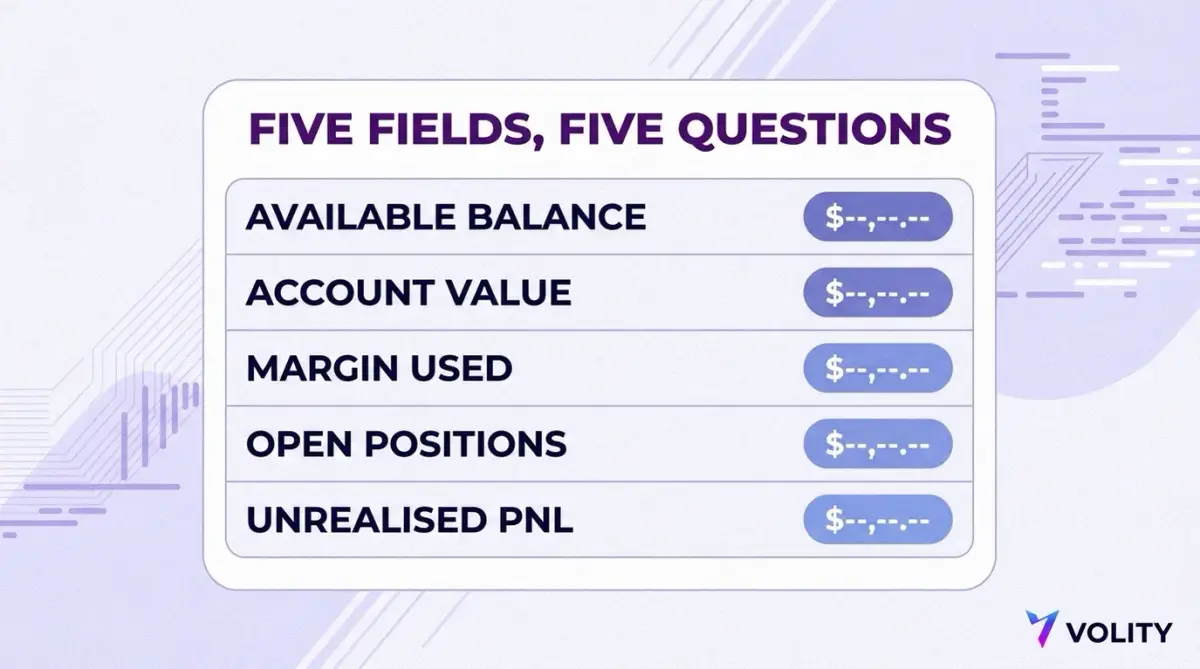
The five numbers on your position panel
Every field on the panel is answering a different question, and the reason people misread them is that four of the five are measured in the same currency and look interchangeable. They are not. On a connected Hyperliquid account each figure is denominated in USDC and refreshed against a timestamp, so what you are looking at is the venue’s own record of your margin state rather than an estimate.
| Field | The question it answers | What moves it |
|---|---|---|
| Available balance | What can I still commit to something new? | Deposits, withdrawals, opening or closing positions, mark price |
| Account value | What would I have if everything closed right now at the mark? | Deposits, withdrawals, realised results, every tick of unrealised profit and loss |
| Margin used | How much is locked behind my open positions? | Position size, mark price, the leverage you chose |
| Open positions | What am I actually exposed to, and in which direction? | Your own opens and closes, and any liquidation |
| Unrealised P&L | How far has the market moved my way since I opened? | The mark price, continuously |
The venue’s clearinghouse holds the perpetuals margin state for every address, which is why these figures are the same whether you read them on the venue itself or on a dashboard that queries it. There is no second version of the truth to reconcile.
One habit is worth building before any of the arithmetic. Look at the refresh timestamp. A panel that last updated four minutes ago is describing a market that has moved on, and in a fast tape four minutes is a long time to be reading history.
Available balance is not the same as account value
Take an account funded with $2,000. Nothing is open, so available balance is $2,000, account value is $2,000, margin used is zero and unrealised P&L is zero. All four agree because there is nothing to disagree about. Now open a long of 50 units in an asset priced at $100, using five times leverage. The position is worth $5,000 at the mark, and the initial margin is position size multiplied by mark price and divided by leverage, which is $1,000.
Watch what the panel does as the mark moves.
| Mark price | Unrealised P&L | Account value | Margin used | Available balance |
|---|---|---|---|---|
| $100.00 | $0 | $2,000 | $1,000 | $1,000 |
| $110.00 | +$500 | $2,500 | $1,100 | $1,400 |
| $90.00 | -$500 | $1,500 | $900 | $600 |
Account value is the total. It carries every cent of open profit or loss, which is why it moved by $500 in each direction while nothing was traded. Available balance is the remainder after margin used is subtracted, and it is the figure the venue will check when you try to open something else or move money out.
Notice that margin used moved as well, from $1,000 to $1,100 and down to $900. That surprises people who expect the number set at entry to stay put. Because initial margin is calculated against the mark price rather than your entry price, a position that gains in value also demands more margin behind it. The same requirement drives what you are allowed to take off the venue: withdrawing unrealised profit leaves margin that must still cover both the initial requirement and ten per cent of total position value, whichever is larger.
What is committed and what stays free
Margin used is not a fee and it has not left your account. It is the slice of your money the venue has ring-fenced against the open position, and you get it back the moment you close. What matters is which pool it is drawn from, because that decides how much of your account is standing behind the trade.
Under cross margin, the default on most perpetual venues, collateral is shared between all cross positions. The whole account value defends every position, which buys a lot of room and means a single bad position can reach the money supporting all the others. Isolated margin ring-fences a fixed amount per asset, so a liquidation in that market leaves the rest of the account untouched, and it lets you add or remove margin on that position after opening. The trade-off is honest in both directions: cross gives you depth, isolated gives you a firewall.
Your choice here changes the liquidation price more than almost anything else you do, because the formula reads from a different pool depending on which mode the position sits in. The venue’s onboarding notes walk through selecting margin mode and leverage before the order goes in, and it is far easier to set correctly at that point than to fix under pressure later.
Unrealised P&L is not money you have yet
An open profit of $500 feels like $500. It is a valuation, produced by multiplying your position size by the gap between the mark price and your entry, and it reverses as easily as it appeared. Until you close, that number belongs to the market rather than to you.
The mark price is worth understanding for exactly this reason, because it is what values your position and what triggers your liquidation. It is not the last trade printed on the book. The venue builds it by combining external exchange prices with its own book state, and liquidations are assessed against that composite rather than an instantaneous quote, which stops a single thin print from closing accounts. It also means your panel can show a loss while the last trade you saw looked fine.
Unrealised P&L does real work in the margin calculation even though you cannot spend it. On a cross position, open profit counts as available initial margin for opening something new. On an isolated position, it acts as additional margin for that position alone. So the number is not decorative, and it is also not cash. Treating it as cash is how a good week turns into a forced close in a bad hour. Anyone who wants to see the shape of that over time can read the venue’s account value and P&L graphs, where the difference between the two lines is the part that was never banked.
A second flow moves through the same field on perpetual futures. Because these contracts have no expiry, a funding payment passes between longs and shorts at regular intervals to hold the contract near the underlying price. Holding a position through funding periods adds or subtracts from your balance whatever the market does, which our glossary covers in more detail under what a funding rate is and what a perpetual contract is.
The number to check before you size up
Liquidation price is the mark price at which your account value would have fallen to the maintenance requirement, and it is the only figure on the panel that tells you where the position stops being yours. Maintenance margin is set at half the initial margin at maximum leverage, which on 2 August 2026 the venue documented as a range running from 1.25% on assets with 40x maximum leverage to 16.7% on assets capped at 3x. Those parameters are set per asset and they change, so read the current figure rather than a remembered one.
The formula published by the venue is this:
liq_price = price - side x margin_available / position_size / (1 - l x side), wheresideis 1 for a long and -1 for a short.lis one divided by the maintenance leverage, so an asset with 20x maximum leverage has a 2.5% maintenance requirement and anlof 0.025.margin_availableon a cross position is account value minus the maintenance margin required. On an isolated position it is the isolated margin minus that same requirement.
Run the earlier position through it. Fifty units at $100 is $5,000 of notional, the maintenance requirement at 2.5% is $125, and with an account value of $2,000 the margin available is $1,875. That gives a liquidation price of $61.54. Check it the other way and the arithmetic closes: at $61.54 the position is worth $3,076.92, the open loss is $1,923.08, the account value is down to $76.92, and 2.5% of $3,076.92 is $76.92. The two sides meet exactly, which is what a liquidation level is.
Here is the part almost nobody expects. Move the mark to $110 or down to $90 and recompute, and the liquidation price is still $61.54. It does not drift when the market moves, because the loss that eats your account value and the shrinking notional that lowers the requirement move in step. Your liquidation price changes when you add margin, take margin out, or change the size of the position. Everything else is noise.
What happens at that level is mechanical. The venue first tries to close the position with market orders into the book, and if account value falls below two thirds of the maintenance requirement without that working, a backstop liquidation moves the position to the liquidator vault. That last step carries a cost the formula does not show you, because in a backstop liquidation the maintenance margin is not returned to you. The liquidator vault holds it as a buffer. Closing a position yourself before the mark reaches that level is the difference between keeping what is left and keeping nothing. The broader dynamics of forced selling, cascades and why they cluster are covered in our guide to crypto margin trading mechanics. On the panel in front of you, the practical point is narrower: the closing is automatic, it is priced off the mark, and it does not wait for you to be available.
Regulators treat the close-out point as consequential enough to legislate around it in the retail contracts-for-difference market. ESMA introduced a margin close-out rule on a per-account basis, the FCA set out its own permanent restrictions in PS19/18, and ASIC issued a product intervention order strengthening CFD protections in Australia. Those rules govern a different product in different jurisdictions and none of them applies to a perpetual futures venue. What they do tell you is that the level at which a leveraged position gets closed is treated as a serious matter by serious people, and on an on-chain venue that level is a published number on your own screen.
How adding margin or cutting size moves that number
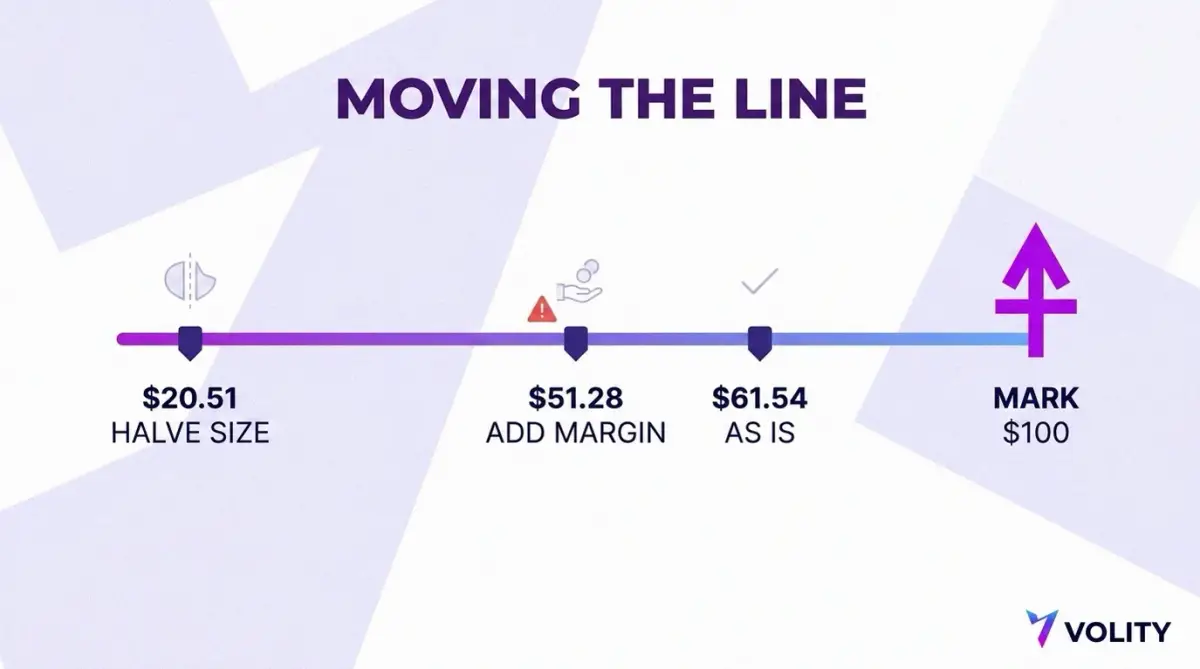
Only margin and size reach the liquidation price, and they are not equally strong. Suppose you are uncomfortable with $61.54 on the position above and you have $500 you could commit. You could deposit that $500 as additional margin, or you could close half the position instead and free up the margin behind it.
| Action | Position size | Account value | Liquidation price | Room below the mark |
|---|---|---|---|---|
| Leave it alone | 50 units | $2,000 | $61.54 | 38.5% |
| Add $500 of margin | 50 units | $2,500 | $51.28 | 48.7% |
| Close half the position | 25 units | $2,000 | $20.51 | 79.5% |
Cutting the size does far more work, and it does it without putting another cent at risk. Adding $500 buys about ten percentage points of extra room and increases the amount that can be lost. Halving the position roughly doubles the room and halves the exposure at the same time. The arithmetic behind the gap is simple enough: adding margin raises the numerator of the formula once, while cutting size shrinks the denominator and the maintenance requirement together.
Other events move that number too, and it is worth knowing which is which. Realised losses elsewhere in a cross account pull it closer, because they lower the account value backing every position. Withdrawing funds does the same. Raising the leverage on a new position of the same size does not change the liquidation price of an existing one, but it does reduce what you have spare to defend it. Our guide to how stablecoin margin works covers what the collateral itself is doing while all this is going on.
A routine for checking a position without watching it all day
Screen-watching is not risk management, and it is a poor substitute for a decision made in advance. Write down the numbers before the position exists, then check them on a schedule rather than on a feeling.
- Before you open, work out the liquidation price at the size and margin mode you intend to use, and ask whether the market can plausibly reach it in the time you plan to hold. If the answer is yes, the size is the thing to change, not the plan.
- Set the exit at the same time as the entry. Venues support take profit and stop loss orders attached to a position, and a stop that sits above your liquidation level is a decision you made calmly rather than one the venue makes for you. It is not a guarantee of a fill in a gapping market.
- Know your order types before you need them. The difference between market, limit and reduce-only orders matters most in the minute when you are trying to get smaller quickly.
- Check the panel on a fixed rhythm and read account value first, then the distance between the mark and your liquidation price as a percentage. A single percentage is easier to judge than four currency figures.
- Set your own line in the sand well above the liquidation price and act on it. By the time the venue acts, the choice is no longer yours.
- Account for the running costs. Trading fees and funding payments both come out of account value, so a position held for weeks erodes its own cushion even in a flat market.
Evidence on what happens without that discipline is not encouraging. The Bank for International Settlements found in its bulletin on crypto shocks and retail losses that most retail users bought as prices rose and were left holding losses when they fell, and the Bank of England reached similar conclusions about leverage and forced selling in its Financial Stability in Focus paper on cryptoassets and decentralised finance.
For the surrounding ground, our guide to what Hyperliquid is covers the venue itself, how to fund a Hyperliquid account covers getting money there, and the comparison with a centralised exchange sets out what changes when the order book is on-chain. The rest of our trader guides cover position sizing and the habits around it.
Where Volity fits
The Markets screen in your Volity dashboard lets you connect a Hyperliquid account, fund it from your Volity USD wallet, and read the same five fields from the same place you manage the rest of your money. Available balance, account value, margin used, open positions and unrealised P&L come through denominated in USDC with a refresh timestamp, so the panel described on this page is the panel you get.
Your position lives at the venue, not with us. Balances and positions are held on the external platform, and trading, availability and withdrawals are subject to that platform’s own terms. Volity does not place or manage orders on your behalf, and no dashboard prevents a liquidation. What one screen gives you is the chance to notice the numbers early enough to do something about them yourself.
What is a liquidation price?
It is the mark price at which your account value would fall to the maintenance margin required for your open positions, at which point the venue closes them automatically. It is calculated from your position size, your account value or isolated margin, and the maintenance requirement for that asset. Reaching it means losing the margin behind the position rather than receiving a warning to top up.
Why is my account value different from my available balance?
Account value counts everything you hold at the venue including unrealised profit and loss on open positions. Available balance is what is left once margin used has been set aside, so it is what you can still commit to a new position or move out. On a $2,000 account with $1,000 of margin committed, both figures are real and they answer different questions.
Does unrealised P&L count as margin?
It counts in the margin calculation and it is not cash. On a cross position, open profit is applied as available initial margin for opening something new. On an isolated position, it acts as additional margin for that position only. Either way it can reverse with the next move in the mark price, so it is not money until the position is closed.
How do I move my liquidation price further away?
Add margin to the position or reduce its size. Reducing size is the stronger of the two and it lowers your exposure at the same time. On the worked example above, adding $500 of margin moved the level from $61.54 to $51.28, while closing half the position moved it to $20.51 without committing anything extra. Withdrawing funds or taking losses elsewhere in a cross account moves it the other way.
Does my liquidation price change when the market moves?
No. As the mark falls, your account value falls but so does the notional value of the position, and the maintenance requirement falls with it. The two effects cancel, which is why the level stays put. It changes when you add or remove margin, when you change position size, or when the venue changes the maintenance parameters for that asset.