Quick answer
Crypto trading signals, also called cryptocurrency signals, are trade ideas, entries, stops and targets, shared by analysts or bots to tell you when to buy or sell a coin. Good signals are transparent about their track record; many are not, and some are pump-and-dump schemes. Use signals as input, verify the source, and never risk more than you can afford on someone else’s call.
The Crypto Trading Starter Kit
A plain-English PDF: what to check before you trade, how orders and risk really work, and the mistakes to skip. Get it free.
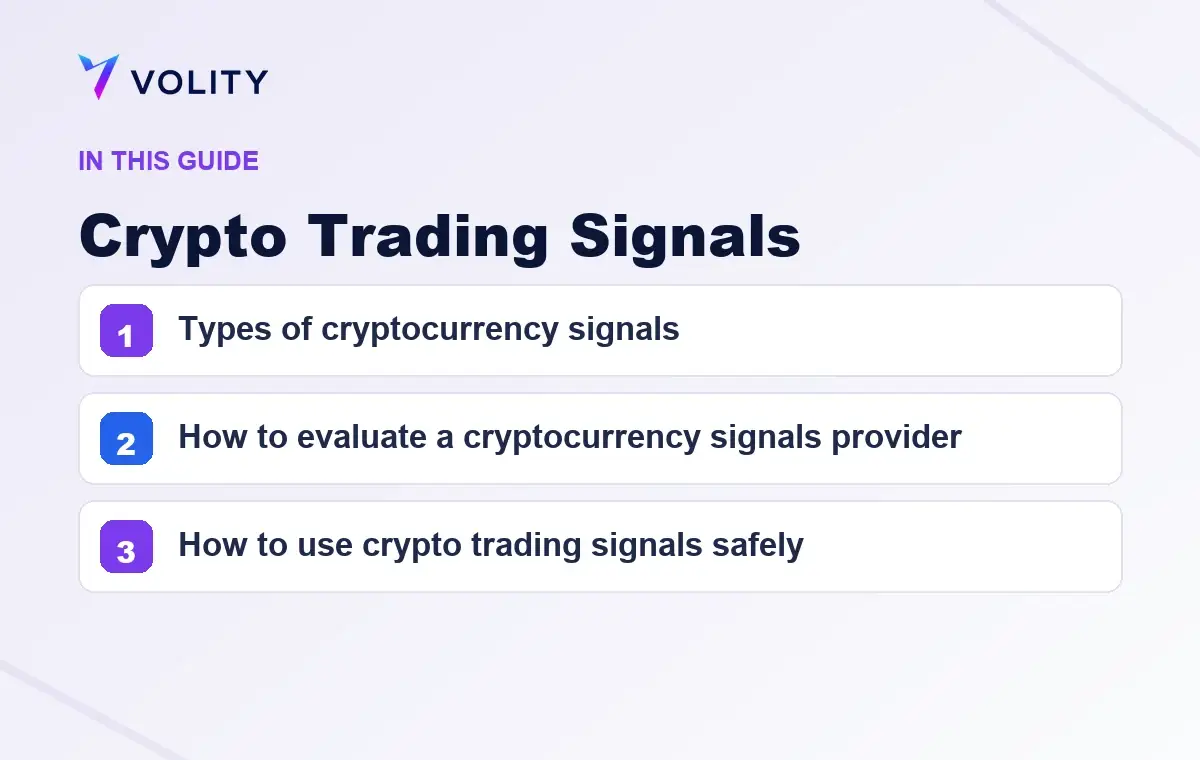
Crypto trading signals are suggested trade ideas, a coin, a direction, an entry, and usually a stop-loss and target, produced by an analyst, an algorithm, or a community. They can save you time and surface setups you would miss, but they are only as good as the source behind them and the risk rules you apply. A signal is a starting point for your own decision, not an instruction to follow blindly. This guide explains how crypto trading signals work, the types, how to judge a provider, and how to use them without handing your account to a stranger.
The appeal is obvious. Markets move around the clock and reading them well takes years, so a ready-made trade idea feels like a shortcut. The danger is just as obvious. Anyone can broadcast a signal, very few track their real record, and a confident message is not the same as a profitable one. Treat signals as research input you verify, and they become useful. Treat them as gospel, and they become a fast way to lose money on someone else’s conviction.
What are crypto trading signals?
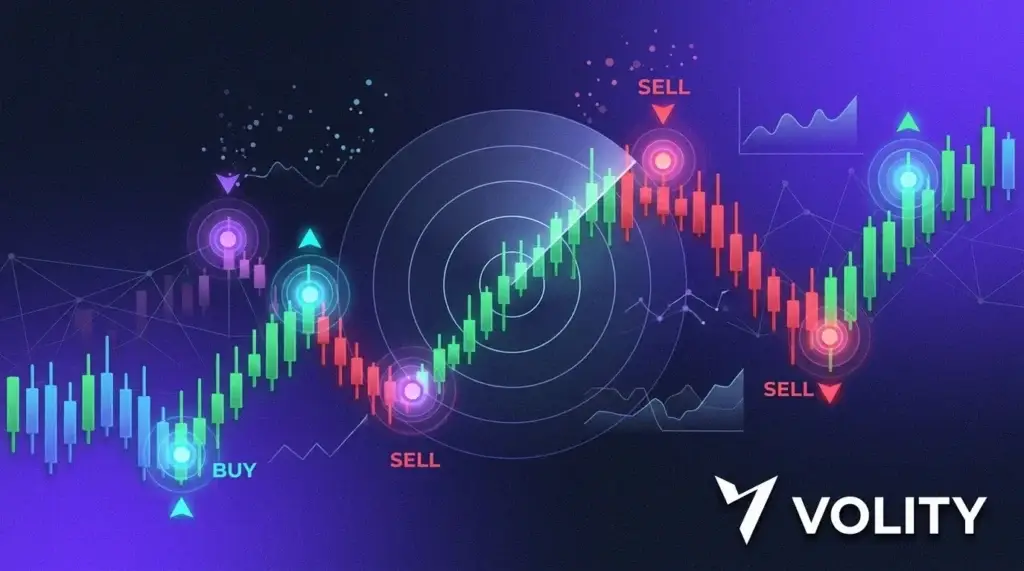
A crypto trading signal is a concrete trade suggestion. A complete one names the asset, the direction (long or short), an entry zone, a stop-loss, and one or more take-profit levels. Some also explain the reasoning, for example a breakout above resistance or a shift in momentum. Signals arrive through channels like messaging apps, dashboards, email, or directly inside a trading platform.
The quality gap between signals is enormous. A good signal comes with a transparent track record, clear risk parameters, and an explanation you can check. A bad one is just a coin name and the word “buy,” with no stop, no reasoning, and no accountability. The first kind helps you learn and act faster. The second kind is closer to a tip from a stranger on the internet.
Types of cryptocurrency signals
Signals differ by how they are generated and who stands behind them. Knowing the source tells you how much to trust it.
| Signal type | How it is produced | What to watch for |
| Manual or analyst | A human analyst publishes setups based on their reading of the market | A verifiable track record and clear reasoning |
| Algorithmic | Software generates signals from technical rules or models | How the rules behave in different market conditions |
| Technical-indicator | Triggered by indicators such as moving averages or momentum | Whether the indicator suits the current market |
| Sentiment or on-chain | Derived from social mood, flows, or blockchain data | That the data source is genuine, not hype |
| Community or copy | Shared by a group or mirrored from another trader | The real, audited performance of the people behind it |
No type is automatically better. An analyst with a strong record can outperform a black-box algorithm, and a simple indicator signal can beat a noisy sentiment feed. What matters is evidence. If a provider cannot show how their signals have actually performed, including the losing trades, treat the signals as unproven.
How to evaluate a cryptocurrency signals provider
Before you act on anyone’s signals, put the source through a few simple tests. The providers worth following welcome the scrutiny. The ones to avoid get defensive.
- Track record, including losses. A win-only history is a marketing reel, not evidence. Real performance shows the losing trades too.
- Complete signals. Every call should include a stop-loss and a target, not just an entry. No stop means no risk control.
- Clear reasoning. You should be able to understand why the trade exists, so you can judge it yourself.
- No guaranteed returns. Anyone promising certain profit is selling a fantasy. Markets do not work that way.
- Independent from your funds. A signal provider should never need access to your account or your deposits.
How to use crypto trading signals safely
Signals work best as one input into your own process, layered on top of strict risk management. Take the idea, check it against your own view, and size it so a wrong call costs little. Always keep your stop-loss, never widen it to avoid being stopped out, and set a daily loss limit so a run of bad signals cannot run away from you. Paper trade a new provider before committing real money, and keep your funds on a regulated platform where you stay in control.
On Volity you trade through a single regulated account on the Volity MT platform, with TradingView charts to validate any signal before you act on it. If you would rather mirror an experienced trader than interpret signals yourself, copy-trading/">crypto copy trading is a more hands-off option while keeping oversight of your own account. For the coins you can trade and the conditions that apply to you, see the crypto hub and account types. If you prefer to automate a rules-based approach, our guide to crypto trading bots is a useful next read.
Are cryptocurrency signals worth it?
Crypto trading signals are worth it when they come from a transparent source and you treat them as research rather than orders. They can shorten your learning curve and flag setups you would otherwise miss. They are not worth it as a way to avoid learning the market, because a signal you cannot evaluate is just a gamble with extra steps. Verify the source, keep your own risk rules, and the signal becomes a tool instead of a trap.
Frequently asked questions
Crypto trading signals reward scrutiny and punish blind trust. Verify the source and its real record, insist on complete signals with proper risk parameters, apply your own stop-loss and limits, and keep your capital somewhere regulated. Used that way, signals become useful research instead of someone else’s risk dressed up as advice.
Investing in financial products involves risk. Losses may exceed the value of your original investment.
Sources
This guide draws on the following public sources.
- European Commission – EU crypto-asset policy and the MiCA framework
- BIS – BIS working paper on crypto trading behaviour and losses
- Financial Stability Board – FSB monitoring of crypto-asset market structure
- Bank for International Settlements – BIS Annual Economic Report chapter on the crypto system
- ESMA – Markets in Crypto-Assets Regulation (MiCA) overview
- European Central Bank – ECB analysis of Bitcoin's role in the financial system
- Financial Stability Board – FSB global regulatory framework for crypto-asset activities
- Bitcoin whitepaper – Nakamoto, Bitcoin: A Peer-to-Peer Electronic Cash System