The Crypto Trading Starter Kit
A plain-English PDF: what to check before you trade, how orders and risk really work, and the mistakes to skip. Get it free.
Crypto ETFs and digital assets are highly volatile and speculative. Investing involves significant risk of loss. Regulatory changes or market conditions can impact ETF performance. Past performance is not indicative of future results. Capital at risk.
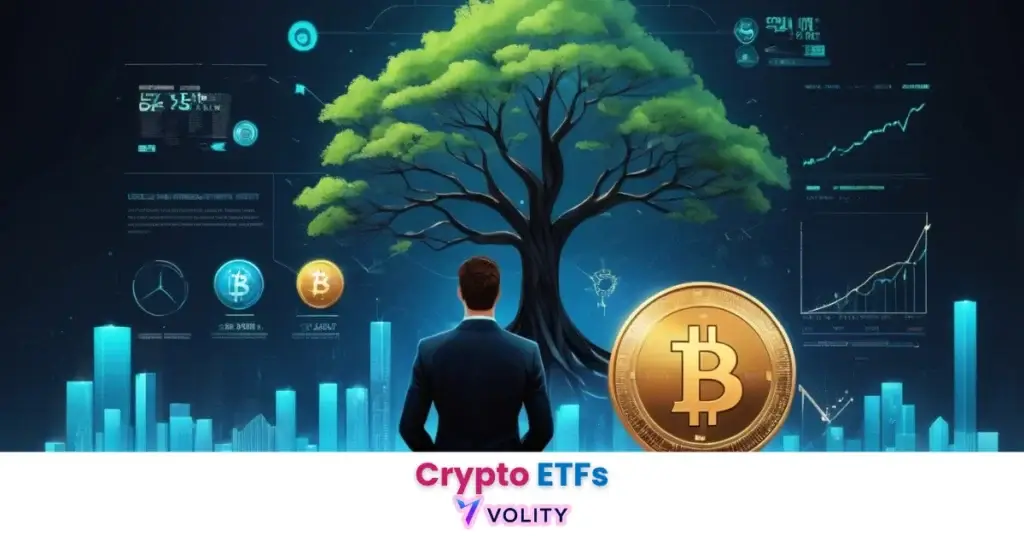
Crypto ETFs reveal a regulated pathway for investing in Bitcoin and Ethereum without the complexities of direct ownership. In 2026, spot ETFs dominate the market with record institutional inflows following the 2024 halving. Understanding the differences between spot and futures funds, alongside fee structures, is essential for identifying the best funds for your portfolio.
Crypto ETFs reveal a maturing digital asset landscape, providing regulated, institutional-grade access to Bitcoin and Ethereum. These funds identify a bridge between traditional stock exchanges and the decentralized world of digital assets.
Selecting the best fund requires an understanding of spot market mechanics, expense ratios, and the impact of systemic events like the Bitcoin halving. This guide explains how to navigate the 2026 crypto ETF market to achieve your investment goals safely.
While understanding Best Crypto ETFs is important, applying that knowledge is where the real growth happens. Create Your Free Crypto Trading Account to practice with a free demo account and put your strategy to the test.
What is a crypto ETF and how does it work?
A crypto ETF is an investment vehicle that tracks the price of digital assets and trades on traditional stock exchanges like the NYSE or NASDAQ. The structure of crypto ETFs separates into two distinct categories: spot funds (which hold the actual underlying asset) and futures funds (which track price through contractual agreements). Spot ETFs represent the modern standard, holding Bitcoin or Ethereum directly and creating a transparent, auditable mechanism for tracking asset prices without counterparty risk.
The role of Authorized Participants (APs) in creating and redeeming shares reveals how ETF mechanics maintain price accuracy. When demand for an ETF exceeds the current share supply, Authorized Participants deliver physical bitcoin to the fund issuer (like BlackRock or Fidelity) and receive newly created ETF shares. This arbitrage mechanism ensures that the ETF price stays tightly synchronized with the underlying asset price, preventing the discounts or premiums that plagued earlier crypto investment vehicles.
Institutional-grade custody solutions provided by fund managers identify a critical security advantage over direct ownership. Fidelity and BlackRock employ multi-signature wallets, cold storage vaults, and third-party audits that exceed security standards available to retail participants managing their own private keys.
what is an ETF in crypto provides foundational understanding of how ETFs function and their historical role in other asset classes.
Ready to Elevate Your Trading?
You have the information. Now, get the platform. Join thousands of successful traders who use Volity for its powerful tools, fast execution, and dedicated support.
Create Your Account in Under 3 MinutesIs it better to buy crypto directly or through an ETF?
The choice between direct ownership and an ETF identifies a trade-off between absolute control and regulatory convenience. Direct ownership grants holders complete authority over private keys, cryptographic strings that unlock on-chain movement of funds, and the ability to stake coins for yield, use them in DeFi protocols, or transfer them at any time without intermediaries. This autonomy comes with responsibility; a compromised private key results in permanent asset loss, and no regulatory authority can recover stolen coins.
ETF ownership reveals regulatory protection and tax-reporting ease that direct wallets cannot provide. Funds held through regulated brokers may be covered by an investor-compensation scheme (such as the FSCS in the UK) up to specified limits, so that broker insolvency does not automatically result in total capital loss. Tax reporting becomes straightforward; brokers typically issue annual statements showing purchase dates, cost, and gains or losses to support your filing. Direct ownership requires manual tracking of thousands of transactions for accurate tax compliance.
The security models diverge fundamentally: personal responsibility versus institutional custody. Direct ownership means you alone bear the burden of securing private keys, backing them up, protecting hardware wallets, and defending against social engineering attacks. Institutional custody delegates these responsibilities to regulated entities subject to periodic audits and regulatory oversight. The convenience of institution-grade security removes the technical learning curve that prevents most retail investors from safely managing their own coins.
securing your crypto wallet explains the specific security practices required for direct ownership and demonstrates why most beginners struggle with this responsibility.
ETFs do not provide “private keys”; you own shares in a fund, not the underlying coins. If you value absolute control over your assets, direct ownership is the only path. Choose the strategy that aligns with your technical comfort and security preferences.
How does the Bitcoin halving affect ETF performance?
Bitcoin’s 2024 halving represents a supply-side catalyst that historically identifies a long-term upward trajectory for ETF underlying assets. The halving mechanism reduces the daily miner production of new Bitcoin by 50%, creating a mathematical scarcity that has preceded every major bull market in Bitcoin’s history. The 2024 halving cut miner rewards from 6.25 BTC per block to 3.125 BTC, immediately reducing the rate at which new Bitcoin enters the market.
The impact on daily miner production versus ETF demand reveals why halvings matter: at 6.25 BTC per block, roughly 900 new Bitcoin reached the market each day. After the 2024 halving that fell to about 450 a day, while institutional demand for crypto ETFs continues accelerating. Institutional inflows into crypto ETFs reached record levels following the 2024 halving, signaling that the supply reduction aligns with sustained demand growth. Historical price performance following the 2012, 2016, and 2020 halving events identifies a consistent pattern: 12-18 month rally periods as supply constraints meet institutional adoption.
The 2026 context reveals the long-term “supply crunch” effect on spot fund AUM. Bitcoin’s total supply approaches its 21 million maximum (roughly 95% already mined), while spot ETFs have accumulated a large share of it in institutional custody. This concentration of supply into long-term holders (both institutional and individual) reduces the circulating supply available for daily trading, potentially identifying a structural support floor for prices.
Bitcoin halving and price scarcity explains the mathematical mechanics of the halving schedule and historical price patterns following these events.
💡 KEY INSIGHT: The 2024 halving reduced the supply of new BTC, creating a “supply crunch” that historically identifies a catalyst for long-term ETF price appreciation. The convergence of reduced miner selling and record institutional inflows positions ETFs as the primary accumulator of scarce Bitcoin supply in 2026.
Which crypto ETF has the lowest fees in 2026?
Crypto ETF expense ratios have settled into a competitive range of 0.20% to 0.25% for leading spot Bitcoin and Ethereum funds in 2026. This compression from earlier rates (some funds charged 0.50% to 0.95%) reflects competitive pressure from institutional providers. Bitwise Bitcoin ETF sits at the bottom of that band, while the BlackRock and Fidelity spot funds sit at the top of it. Check the current sponsor fee on the issuer’s own fund page before you buy, because several issuers ran introductory waivers that have since expired.
Understanding management fees versus total expense ratios reveals hidden costs that many investors overlook. A fund might advertise a 0.20% management fee but include additional operational costs (custody fees, auditing, administrative expenses) that total 0.25% or higher in the “all-in” expense ratio. Futures-based ETFs carry additional hidden costs through contango, the pattern where futures contracts trade at a premium to spot prices. This contango requires constant rolling of contracts at higher prices, creating an ongoing drag on returns that spot-based funds eliminate entirely.
BlackRock (IBIT), Fidelity (FBTC), and Bitwise (BITB) represent the market leaders in low-fee spot Bitcoin exposure. For Ethereum, Fidelity’s Ethereum ETF and other institutional providers similarly compete in the 0.20-0.25% range. This fee competition directly benefits investors; every 0.05% reduction in annual fees translates to meaningful compounding advantage over decades.
impact of fees on crypto investment returns demonstrates the specific mathematical impact of fee differences on long-term portfolio growth and compound returns.
Look for funds with “fee waivers” for new investors, but ensure the long-term expense ratio remains competitive after the waiver period expires. Many funds offer promotional waiver periods where fees are temporarily reduced to attract capital, always verify the permanent fee structure before committing long-term capital.
Top Crypto ETFs Comparison: 2026 Market Leaders
The 2026 crypto ETF landscape identifies a clear dominance by institutional providers following the integration of spot Ethereum funds. This consolidation reflects how regulatory approval and market maturity have concentrated capital into the largest, most transparent platforms rather than fractionalizing across dozens of small competitors.
| ETF | Property | Value |
| iShares Bitcoin Trust (IBIT) | Ticker | IBIT |
| Fidelity Wise Origin Bitcoin | Ticker | FBTC |
| Grayscale Ethereum Trust | Structure | Spot Ethereum |
| Bitwise Bitcoin ETF | Expense Ratio | 0.20% |
| ProShares Bitcoin Strategy | Mechanism | Futures-based |
Turn Knowledge into Profit
You have done the reading, now it is time to act. The best way to learn is by doing. Open a free, no-risk demo account and practice your strategy with virtual funds today.
Open a Free Demo AccountWhat are the best altcoin ETFs beyond Bitcoin?
Altcoin ETFs reveal opportunities for diversification into the broader blockchain ecosystem beyond Bitcoin and Ethereum dominance. Multi-asset baskets tracking top 10 or top 20 tokens by market capitalization provide exposure to projects across DeFi (decentralized finance), layer 1 protocols, staking networks, and infrastructure layers. Blockchain technology ETFs track companies that mine cryptocurrencies or produce chips and software powering the ecosystem, offering indirect exposure to crypto trends through traditional equities.
Regulatory progress for Solana and other Layer 1 assets in 2026 has enabled dedicated ETF development for these networks. Investors seeking concentrated bets on specific protocols can now access Solana, Polygon, or Cardano exposure through regulated funds rather than purchasing tokens directly. This expansion identifies an important accessibility milestone; mainstream investors can now diversify across the entire digital asset ecosystem within their traditional brokerage accounts.
Real trading example: A long-term investor purchased iShares Bitcoin Trust (IBIT) following the 2024 halving “supply crunch” confirmation in early 2025, viewing the reduced miner selling combined with institutional inflows as a structural tailwind. The position achieved institutional-grade tracking of Bitcoin price with a 0.25% annual fee, providing transparent exposure without the security risks of private key management. Past performance is not indicative of future results.
diversifying with altcoins explains how altcoin ETF holdings complement a core Bitcoin and Ethereum allocation and the specific risks of smaller-cap token exposure.
Key Takeaways
- Crypto ETFs reveal institutional access to digital assets through ordinary brokerage accounts on regulated exchanges.
- Spot Bitcoin ETFs identify a direct asset-holding structure that avoids the contango risks of futures-based funds.
- Crypto ETF expense ratios have compressed into a roughly 0.20% to 0.25% band across the leading spot funds.
- The Bitcoin halving represents a supply-side event that historically identifies a long-term price catalyst for ETFs.
- Spot Ethereum ETFs show full regulatory integration in 2026, expanding the available asset class for retail portfolios.
- Crypto ETF custody identifies institutional-grade security measures, replacing the personal risk of private key management.
Frequently Asked Questions
This article contains references to crypto ETFs, institutional investment vehicles, and Volity, a regulated CFD trading platform. This content is produced for educational purposes only and does not constitute financial advice or a recommendation to buy or sell any financial instrument. Always verify current regulatory status and platform details before investing. Some links in this article may be affiliate links.
What our analysts watch: We rank spot crypto ETFs on three criteria. Expense ratio (sub-25 bps is now standard for the majors). Premium or discount to NAV (anything over 50 bps signals creation/redemption stress). Daily flows aggregated across issuers; sustained net inflows historically precede multi-week price strength, while persistent outflows have called several local tops. Liquidity matters more than brand name once flows turn institutional.
Volity operates a trading platform and also publishes educational and analytical content about trading. The content on this page is for educational purposes only and should not be considered financial advice. Volity may benefit commercially when readers open trading accounts through links on this site.
Our content is produced and reviewed under documented editorial standards; see our comparison and review methodology.