Investing in financial products involves risk. Losses may exceed the value of your original investment.
The Crypto Trading Starter Kit
A plain-English PDF: what to check before you trade, how orders and risk really work, and the mistakes to skip. Get it free.
Quick answer
OTC crypto trading is off-exchange execution for block-size trades that would move the order book on public venues. Typical desk minimums are $50,000 to $250,000 per trade; common counterparties are Cumberland, Galaxy Digital, and B2C2. OTC trades settle within hours, avoid slippage, and price against an exchange-rate index plus spread (typically 5-30 bps depending on size and counterparty).
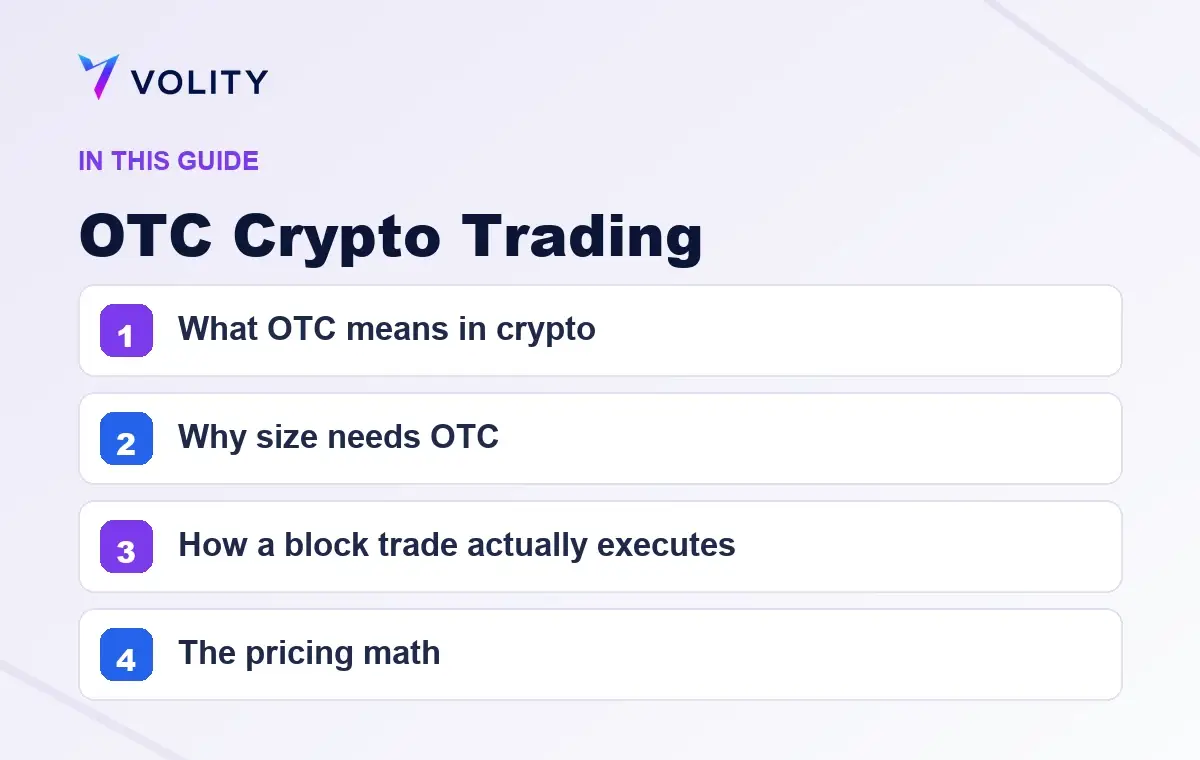
OTC crypto trading is how large orders get filled without moving the market. Instead of hitting a public order book, the buyer and seller negotiate directly through a desk that sources liquidity from its network of counterparties, then settles at a single agreed price. A $10m bitcoin trade on a public exchange could move the price 50-150 basis points against you before fully filling. The same trade on an OTC desk fills at one number, on the day, with no slippage signature on the tape. That is the entire reason the venue exists.
What OTC means in crypto
Over-the-counter trading is bilateral execution outside an exchange’s central limit order book. In traditional finance the term covers everything from FX swaps to corporate bonds. In crypto, OTC desks typically handle three flow types:
- Block spot. A single negotiated trade in BTC, ETH, USDT, or other large-cap coins, usually starting at $250,000 to $1m minimum ticket.
- Structured products. Variance swaps, accumulators, principal-protected notes referencing crypto baskets.
- Options blocks. Large delta-one or delta-hedged option packages that would distort listed-option markets if printed publicly.
Why size needs OTC
Public order books are thin relative to traditional asset classes. The visible top-of-book depth on a major BTC pair is typically $5-20m within a 50-basis-point band. A $50m market order would walk through the book, print at progressively worse prices, and signal to every algo on the venue that a forced buyer is in the market. Three direct consequences:
- Price impact. The actual fill price is materially worse than the screen price.
- Information leakage. Every fill is public; competitors can front-run the remaining order.
- Operational risk. Splitting the order across venues introduces settlement timing and counterparty exposure.
OTC fixes all three. One quote, one fill, one settlement instruction.
How a block trade actually executes
The workflow on a typical desk:
- Indication of interest (IOI). The client sends size, side, and reference window. Example: “Buy 200 BTC, fill before London close, against today’s CME 4pm fix +/- 5 bp.”
- Quote. The desk returns a firm price, typically valid for 30-120 seconds. The price reflects the desk’s inventory, hedge cost, and risk premium.
- Acceptance. The client lifts the offer or hits the bid. Trade is done at that price.
- Settlement. Same day for crypto-versus-fiat on most desks. Crypto leg moves on-chain (or via internal book transfer at a custodian); fiat leg moves via wire or stablecoin.
- Confirmation. Both sides sign a deal ticket. Audit trail, KYC, AML checks completed before the desk would quote in the first place.
The pricing math
An OTC desk does not simply quote you the screen price. The quote is built from:
- Mid-market reference. A blend of the deepest venues at quote time.
- Hedge cost. If the desk has to lift offers across exchanges to neutralise the trade, that cost is priced in.
- Inventory adjustment. If the desk is already long BTC and the client wants to sell, the quote is more competitive (the desk wants to flatten).
- Counterparty premium. Settlement risk, KYC tier, historical fill quality.
Net all-in cost on a $5m BTC trade typically runs 10-30 basis points versus the public market price, which is materially better than the slippage cost of executing the same size on-screen.
Settlement risk and how it is managed
The defining risk of OTC is settlement: one side delivers before the other. Three mitigations are standard:
- Pre-funding. The smaller counterparty wires fiat or transfers crypto first, then receives the other leg.
- Tri-party custody. Both legs are placed with a regulated custodian who releases simultaneously when both arrive.
- Atomic settlement on-chain. Smart-contract escrow for crypto-to-crypto trades; less common for crypto-to-fiat.
Who actually uses OTC desks
- Hedge funds and family offices. Building or unwinding multi-million-dollar positions.
- Miners. Selling block-reward crypto into fiat for operational expenses without telegraphing supply to the market.
- Treasuries. Public companies converting balance-sheet bitcoin to dollars for accounting cycles.
- Whales. Long-tenured holders rebalancing.
Is OTC for retail?
Mostly no. Minimum ticket sizes of $250k to $1m put OTC out of reach for nearly all retail traders, and the operational lift (KYC, settlement instructions, counterparty diligence) is meaningful. Retail traders who think they need OTC almost always need better limit-order placement on a deep public venue instead.
Volity and large-order execution
Volity offers CFD exposure to 20+ cryptocurrencies with deep aggregated liquidity, no platform-side withdrawal fees, and a 4-hour withdrawal target on most rails. Retail leverage is capped at 1:2 under ESMA. Trading is executed by UBK Markets Ltd, a Cyprus Investment Firm authorised by CySEC under licence 186/12. For investors with size beyond standard retail, professional client classification under MiFID II provides access to bespoke execution arrangements.
Volity operates a trading platform and also publishes educational and analytical content about trading. The content on this page is for educational purposes only and should not be considered financial advice. Volity may benefit commercially when readers open trading accounts through links on this site.
Our content is produced and reviewed under documented editorial standards; see our comparison and review methodology.
Frequently asked questions
Why do large trades go OTC instead of on an exchange?
Because a large order on a public order book moves the price against the person placing it. An OTC desk quotes a single price for the whole size, which removes that slippage and keeps the trade out of public view until it settles.
How is an OTC crypto price set?
The desk quotes a price around the prevailing market, adjusted for the size and the asset's liquidity. The spread you are quoted is the desk's compensation for taking on the position and unwinding it themselves.
What size typically justifies an OTC trade?
The threshold is where the order would visibly move the public order book, which depends on the asset's depth rather than a fixed figure. Desks generally publish a minimum, and below it an exchange order is the cheaper route.